Skip to Main Content

Ansys Zemax OpticStudio
Next-Gen Optical Design Software

Design, simulate, and refine advanced optical systems faster with powerful, physics-based modeling that boosts performance, reduces risk, and accelerates innovation from concept through production.

Design, Optimize, and Validate Optics With Confidence 

Ansys Zemax OpticStudio enables you to design, simulate, and validate optical systems faster. Combining powerful physics-based modeling with an intuitive workflow, it helps engineers predict real-world performance, reduce design iterations, and confidently deliver optimized, production-ready optics across imaging, illumination, and photonic applications.

  • Check icon outline
    Non-Sequential Raytracing
  • Check icon outline
    Physical Optics Propagation
  • Check icon outline
    Tolerance Sensitivity Analysis
  • Check icon outline
    Freeform Surface Modeling
  • Check icon outline
    Polarization Ray Tracing
  • Check icon outline
    Stray Light Analysis
  • Check icon outline
    Multiphysics Coupling

Quick Specs

Model, analyze, and optimize sophisticated optical systems using physics-based simulation, sequential as well as non-sequential ray tracing, and advanced tolerancing tools that provide accurate performance prediction from concept through manufacturability.

  • Wavefront Error Analysis
  • Modulation Transfer Function
  • Point Spread Function
  • Diffractive Optics Modeling
  • Coating Performance Analysis
  • Gradient Index Modeling
  • Thermal Optical Effects
  • Glass Catalog Integration
  • Merit Function Optimization

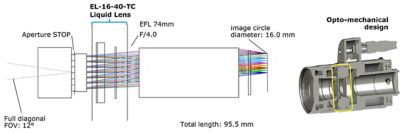
Liquid Lens Simulation Advances Medical Imaging Design

Simulation-driven insights improve early detection and diagnostic accuracy.

Optomechanical design

Simulation in Ansys Zemax gave us clear performance insight early, allowing rapid optimization of our liquid lens technology for accurate, real-world medical imaging.

Ansys Zemax enabled Optotune to simulate and optimize advanced liquid lens systems for high-resolution medical imaging. Using physics-based modeling, engineers evaluated optical performance, minimized design iterations, and predicted real-world behavior before prototyping. The study demonstrates how simulation-driven design accelerated development while ensuring precision, reliability, and manufacturability. By integrating comprehensive analysis with rapid optimization, the team delivered imaging performance capable of supporting early disease detection. This case study highlights how advanced optical simulation reduces risk, shortens development timelines, and enables innovation in next-generation diagnostic technologies worldwide today across healthcare environments and demanding clinical performance requirements everywhere.

March 2026

What's New

Simplify complex optical designs with the 2026 R1 release of Ansys Zemax OpticStudio. Enhanced tools and seamless integrations make tolerancing, imaging, and cross-tool workflows faster, easier, and more reliable for real-world systems.

Zemax 2026 R1 Nested Elements and System Tolerancing
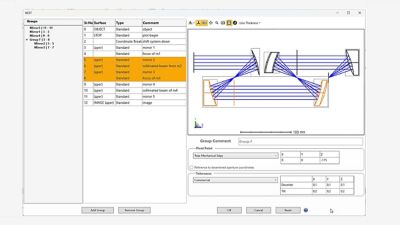
Nested Elements and System Tolerancing (NEST)

NEST simplifies optomechanical tolerancing with a visual, guided workflow for sequential systems. Key features include smart pivot presets, automatic operand insertion, real-time updates, and support for off-axis designs, enhancing precision while reducing setup complexity.

Zemax 2026 R1 NSC Imaging Design
NSC Imaging Design

NSC imaging enhancements transform Non-Sequential Mode into a practical imaging tool, streamlining workflows with features like proper stops, quick focus, spot diagrams, and sequence grouping, removing long-standing friction in folded and complex systems.

Zemax 2026 R1 Export Optical Design to Speos Enhancements
Export Optical Design (ODX) to Speos Enhancements

ODX enhancements to Speos streamline workflows by enabling seamless integration of real designs, including prisms and Table Glasses, without losing accuracy. Former Code V users benefit from faster, smoother transitions to OpticStudio.

Zemax 2026 R1 NSC Quick Focus
NSC Quick Focus

The NSC Quick Focus Feature simplifies detector positioning in Non-Sequential Mode. It automatically aligns detectors for focus, centering, and orientation using intended ray paths, saving setup time and preserving accuracy. With support for multi-wavelength systems and multiple sources, it’s perfect for tackling complex optical designs with confidence. Available in Premium and Enterprise.

Zemax 2026 R1 NSC Sequence Grouping
NSC Sequence Grouping

The NSC Sequence Grouping feature simplifies management of large ray-path sets, allowing sequences to be grouped manually or automatically based on key optical and physical properties, with dynamic updates and range-based filtering for precise analysis. Available in Premium and Enterprise.

Export to Speos
NSC Spot Diagram

The NSC Spot Diagram feature, enables native spot diagram analysis in Non-Sequential Mode. This feature lets you evaluate image quality directly using rays traced along selected sequences and provides detailed reporting on RMS and geometric spot size, flux, and more. With seamless integration into the Sequence Selector and a new RSNC operand, optimization and analysis are more precise than ever. Available in Premium and Enterprise.

Applications

Autonomous Sensor Development

Autonomous Sensor Development

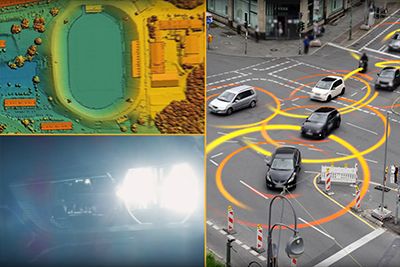
Comprehensive autonomous vehicle sensor simulation capability that includes lidar, radar, and camera design and development.

Autonomous System Validation

Autonomous System Validation

Model-based safety and cybersecurity solutions accelerate autonomous system development and certification.

Cardiovascular

Cardiovascular

Rapid and reliable innovation and testing of new cardiovascular medical devices and implants

OLED

FAQ

Zemax.com은 Ansys.com으로 전환 중이며 이는 모든 Ansys 제품 및 서비스를 위한 통합 플랫폼을 제공하기 위해서입니다. 이제 Ansys 웹 사이트에서 소프트웨어 다운로드, 설명서 및 지원을 포함한 모든 Zemax 리소스에 직접 액세스할 수 있습니다. Optics & Photonics 섹션으로 이동하여 Zemax 제품을 찾기만 하면 됩니다.

Zemax 소프트웨어를 다운로드하려면 Ansys.com에서 귀하의 Ansys 계정에 로그인하십시오. 로그인한 후 지원 아래의 다운로드 섹션으로 이동하거나 Zemax 제품 페이지로 이동합니다. Ansys 계정이 없는 경우 원활한 액세스를 보장하기 위해 귀하의 Zemax 계정과 연결된 이메일을 사용하여 계정을 만드십시오.

Ansys는 Ansys 고객 포털을 통해 Zemax 제품에 대한 종합적인 지원을 제공합니다. 계정에 로그인하고 지원 섹션으로 이동합니다. 여기에서 티켓을 제출하고, FAQ에 액세스하고, 전문가와 연결할 수 있습니다. Ansys를 처음 사용하는 경우 지원 기능을 잠금 해제하려면 계정 설정 중에 Zemax 라이선스를 등록해야 할 수 있습니다.

Ansys Zemax OpticStudio는 다양한 학습 옵션을 제공합니다.

  • 광범위한 기술 자료는 시작부터 시스템 수준 방법 문서에 이르기까지 광범위한 자습서를 제공합니다.
  • Zemax 사용자 커뮤니티는 고급 사용자와 교류하고 팁과 요령을 배우는 데에도 유용합니다.
  • Ansys Learning Hub는 Ansys Zemax OpticStudio를 배울 수 있는 자습형 비디오 과정을 제공합니다.

STAR 다중물리 툴을 사용하면 고객은 STOP 분석(구조, 열, 광학 성능)과 Ansys 독점 SOFT 분석(구조 광학 유체 열)을 모두 수행할 수 있습니다. Ansys Zemax OpticStudio를 사용하면 외부 솔버에서 필요한 데이터를 쉽고 정확하게 로드할 수 있습니다. 그러면 사용자는 구조, 광학, 유체 및 열 효과를 사용하여 시스템 성능을 동시에 평가할 수 있습니다.

이 웨비나에서 자세히 알아보기: 자동화된 워크플로우와 함께 STAR를 사용한 STOP 분석(ansys.com)

현재 고객은 Ansys 고객 포털의 다운로드 센터에서 Ansys Zemax OpticStudio를 다운로드할 수 있습니다. 현재 고객은 아니지만 OpticStudio 사용에 관심이 있는 사람들을 위해 Ansys는 무료 평가판을 제공합니다. 샘플 파일과 설계 템플릿이 함께 제공됩니다. 광범위한 기술 자료는 시작부터 시스템 레벨 방법 문서에 이르기까지 광범위한 자습서를 제공합니다.

Ansys Zemax OpticStudio는 이상적인 위상 프로필을 사용하여 메타표면을 모델링한 다음 광선 추적 기능을 사용하여 최적화할 수 있습니다. 그러면 Ansys Lumerical은 나노 구조 수준에서 신속하게 응답을 생성할 수 있습니다. 이 정보를 바탕으로 메타렌즈가 OpticStudio의 사용자 정의 표면에 정확하게 설정될 수 있습니다. 모든 광선 기반 툴을 사용하여 시스템 성능을 평가할 수 있습니다.

Ansys Zemax OpticStudio의 고급 공차 툴에는 사용하기 쉬운 표면 불규칙성 옵션이 포함되어 있습니다. 이는 복합 표면 기능을 활용하고 Zernike 처짐 데이터를 사용하여 비구면 또는 다양한 유형의 자유형 표면과 같은 복잡한 기본 형상을 포함하여 표면 불규칙성을 모델링합니다. 실제 성능 수율을 평가하기 위해 다른 모든 제조 공차를 추가할 수 있습니다. 

Ansys Zemax OpticStudio는 이미징, 조명, 레이저 시스템 등을 구상하는 데 사용되는 광학 설계 소프트웨어 툴입니다. OpticStudio의 사용자 친화적인 인터페이스는 제조 적합성 설계를 위한 분석, 최적화 및 공차 도구를 결합합니다. 확장된 사용자 정의 옵션을 통해 OpticStudio를 필요에 맞게 조정하거나 작업을 자동화할 수 있습니다. 통합 다중물리 워크플로를 통해 구조, 열 또는 유체 시뮬레이션 결과 사용 간소화 

High-Fidelity Optical Modeling and Performance Prediction

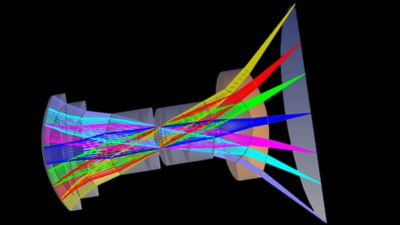
Ansys Zemax OpticStudio provides high-fidelity optical modeling using advanced ray tracing, wave optics, and polarization analysis. Engineers can predict system performance, evaluate tolerances, and assess environmental effects with high numerical accuracy. Integrated sequential and non-sequential simulation enables rigorous, system-level optical validation before prototyping.

Zemax capabilities


Key Features

Simplify and expedite your optical design projects with Ansys Zemax OpticStudio software capabilities.

  • Unified Sequential & Non-Sequential Modeling Architecture
  • Physical Optics Propagation (POP) for Wavefront Analysis
  • Advanced Optimization & Tolerance Analysis Engine
  • Ansys Multiphysics & Structural–Thermal Coupling
  • High-speed sequential and non-sequential ray tracing
  • Advanced stray light and ghost image analysis
  • Polarization and coating performance modeling
  • Built-in glass catalogs and material modeling
  • API automation and scripting (ZOS-API) integration
  • Unified sequential, non-sequential, and mixed-mode optical design workflows
  • Advanced illumination, LiDAR, AR/VR, headlamp, and stray light modelling
  • Direct physical modeling with broader system capability 
  • True wave optics: Propagates full complex wavefront (amplitude + phase) to capture diffraction and interference.
  • Wavefront precision: Quantifies aberrations, beam quality, and coupling efficiency.
  • Seamless workflow: Switches smoothly from ray tracing to POP when diffraction matters.
  • Delivers robust optimization and tolerance analysis for manufacturable, high-performance optical designs.
  • Accelerates convergence using advanced merit functions and global/local optimization algorithms.
  • Predicts real-world performance with Monte Carlo and sensitivity-based tolerancing tools.
  • Predicts optical performance under thermal and mechanical loads.
  • Couples structural deformation directly to optical analysis.
  • Validates designs against real-world environmental conditions.
  • Sequential mode for imaging system design and optimization
  • Non-sequential mode for illumination, scattering, and stray light analysis
  • Fast, multi-threaded performance for large, complex optical assemblies
  • Accurate modeling of reflections, refractions, diffraction, and detector response
  • Scales from simple lens systems to full opto-mechanical environments
  • Identifies ghost reflections from lens surfaces, filters, and detectors
  • Simulates scattering, surface roughness, and coating imperfections
  • Quantifies contrast degradation and veiling glare
  • Supports non-sequential ray tracing for realistic stray light paths
  • Enables mitigation strategies early in the design process
  • Analyzes polarization state changes through complex optical systems
  • Models thin-film coatings with angle- and wavelength-dependent behavior
  • Evaluates transmission, reflection, and phase effects across surfaces
  • Supports Jones and Mueller matrix methods
  • Optimizes coating stacks for performance and manufacturability
  • Accesses comprehensive manufacturer glass catalogs
  • Models dispersion, absorption, and thermal properties
  • Supports custom material definitions and melt data
  • Enables accurate chromatic and environmental performance prediction
  • Integrates directly into optimization and tolerancing workflows
  • Automates design, optimization, and analysis tasks programmatically
  • Integrates with Python, MATLAB, and .NET environments
  • Enables batch simulations and parametric studies
  • Connects optical models to external engineering workflows
  • Scales processes for enterprise-level development and validation

Ansys Zemax OpticStudio 라이센스

Ansys Zemax OpticStudio는 광학 엔지니어와 설계자가 실제 프로토타입을 제작하기 전에 광학 설계를 시뮬레이션, 최적화 및 검증할 수 있는 강력한 툴입니다. 엔지니어가 가상 환경에서 설계를 반복하고 개선할 수 있으므로 광학 시스템 개발에 소요되는 시간과 리소스를 절약할 수 있습니다.

다중물리 해석에 Ansys Zemax OpticStudio를 활용하려면 Ansys Zemax OpticStudio Enterprise 라이센스가 필요합니다. Ansys Zemax OpticStudio Enterprise 라이센스를 사용하면 구조, 열 및 굴절률 데이터를 OpticStudio 워크플로로 간단하게 가져올 수 있으므로 중요한 설계 인사이트와 상당한 시간 절약, 새로운 시스템 분석 가능성을 얻을 수 있습니다. 

제품 패키지

‌OPTICSOpticStudio ProOpticStudio PremiumOpticStudio Enterprise
Ansys Optics Launcher포함포함포함
순차 광선 추적포함포함포함
몬테카를로 포워드(비순차) 광선 추적포함포함포함
다중 구성 시스템 모델링포함포함포함
라이센스당 병렬 애플리케이션 인스턴스 수488
편광, 구배 지수 및 복굴절 광선 추적포함포함포함
설계 템플릿 및 공급업체 렌즈 카탈로그포함포함포함
재료 카탈로그포함포함포함
코팅 카탈로그포함포함포함
강력한 최적화 방법포함포함포함
감도 공차포함포함포함
몬테카를로 공차포함포함포함
광선 조준포함포함포함
비구면 광학포함포함포함
자유형 광학포함포함포함
회절 광학포함포함포함
복합 표면포함포함포함
이미지 품질 분석(기하학 및 회절)포함포함포함
가우시안 빔포함포함포함
물리광학 전파포함포함포함
고스트 포커스 생성기포함포함포함
광선 분할 및 산란포함포함포함
중요도 샘플링포함포함포함
STAR 다중물리 하중, 피팅 및 시각화 툴(FEA, CFD)  포함
STAR 성능 분석  포함
표면, 개체, 소스 및 분산 프로필을 위한 사용자 정의 플러그인포함포함포함
ZOS-API 및 스크립트 자동화를 통한 워크플로 자동화포함포함포함
전체 설계 또는 축차 모델(ROM)을 Speos로 내보내기포함포함포함
LSWM(Lumerical Sub-Wavelength) 모델 플러그인 시뮬레이션을 사용한 동적 및 정적 교환포함포함포함
메타렌즈 시뮬레이션용 Lumerical 플러그인(정적 데이터 교환) 포함포함
STEP, IGES, SAT, STL 불러오기 및 내보내기포함포함포함
Creo Parametric 및 Autodesk Inventor에 대한 동적 링크 포함포함

OPTICSTUDIO RESOURCES & EVENTS

Featured Webinars

White Papers

Speos sustainability

Small Optics, Big Sustainability Impact

Explore how optics simulation enables sustainable miniaturized optical systems by reducing materials, energy use, and waste while optimizing design, production, and lifecycle performance across industries.

Videos

Blogs

Ansys Zemax Scanway optics
BY: CATY FAIRCLOUGH

Future of Space Optics with Scanway’s Modular Payload Solutions

Scanway’s modular payload solutions advance space optics, boosting mission flexibility, improving imaging performance, and enabling adaptable, high‑resolution observation capabilities for a range of satellite applications.

Case Studies