Skip to Main Content

Ansys Zemax OpticStudio
Next-Gen Optical Design Software

Design, simulate, and refine advanced optical systems faster with powerful, physics-based modeling that boosts performance, reduces risk, and accelerates innovation from concept through production.

Design, Optimize, and Validate Optics With Confidence 

Ansys Zemax OpticStudio enables you to design, simulate, and validate optical systems faster. Combining powerful physics-based modeling with an intuitive workflow, it helps engineers predict real-world performance, reduce design iterations, and confidently deliver optimized, production-ready optics across imaging, illumination, and photonic applications.

  • Check icon outline
    Non-Sequential Raytracing
  • Check icon outline
    Physical Optics Propagation
  • Check icon outline
    Tolerance Sensitivity Analysis
  • Check icon outline
    Freeform Surface Modeling
  • Check icon outline
    Polarization Ray Tracing
  • Check icon outline
    Stray Light Analysis
  • Check icon outline
    Multiphysics Coupling

Quick Specs

Model, analyze, and optimize sophisticated optical systems using physics-based simulation, sequential as well as non-sequential ray tracing, and advanced tolerancing tools that provide accurate performance prediction from concept through manufacturability.

  • Wavefront Error Analysis
  • Modulation Transfer Function
  • Point Spread Function
  • Diffractive Optics Modeling
  • Coating Performance Analysis
  • Gradient Index Modeling
  • Thermal Optical Effects
  • Glass Catalog Integration
  • Merit Function Optimization

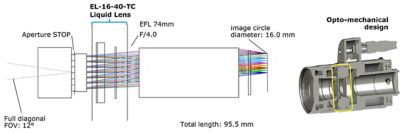
Liquid Lens Simulation Advances Medical Imaging Design

Simulation-driven insights improve early detection and diagnostic accuracy.

Optomechanical design

Simulation in Ansys Zemax gave us clear performance insight early, allowing rapid optimization of our liquid lens technology for accurate, real-world medical imaging.

Ansys Zemax enabled Optotune to simulate and optimize advanced liquid lens systems for high-resolution medical imaging. Using physics-based modeling, engineers evaluated optical performance, minimized design iterations, and predicted real-world behavior before prototyping. The study demonstrates how simulation-driven design accelerated development while ensuring precision, reliability, and manufacturability. By integrating comprehensive analysis with rapid optimization, the team delivered imaging performance capable of supporting early disease detection. This case study highlights how advanced optical simulation reduces risk, shortens development timelines, and enables innovation in next-generation diagnostic technologies worldwide today across healthcare environments and demanding clinical performance requirements everywhere.

March 2026

What's New

Simplify complex optical designs with the 2026 R1 release of Ansys Zemax OpticStudio. Enhanced tools and seamless integrations make tolerancing, imaging, and cross-tool workflows faster, easier, and more reliable for real-world systems.

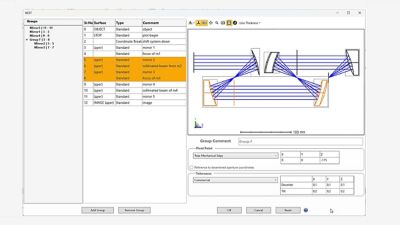
Zemax 2026 R1 Nested Elements and System Tolerancing
Nested Elements and System Tolerancing (NEST)

NEST simplifies optomechanical tolerancing with a visual, guided workflow for sequential systems. Key features include smart pivot presets, automatic operand insertion, real-time updates, and support for off-axis designs, enhancing precision while reducing setup complexity.

Zemax 2026 R1 NSC Imaging Design
NSC Imaging Design

NSC imaging enhancements transform Non-Sequential Mode into a practical imaging tool, streamlining workflows with features like proper stops, quick focus, spot diagrams, and sequence grouping, removing long-standing friction in folded and complex systems.

Zemax 2026 R1 Export Optical Design to Speos Enhancements
Export Optical Design (ODX) to Speos Enhancements

ODX enhancements to Speos streamline workflows by enabling seamless integration of real designs, including prisms and Table Glasses, without losing accuracy. Former Code V users benefit from faster, smoother transitions to OpticStudio.

Zemax 2026 R1 NSC Quick Focus
NSC Quick Focus

The NSC Quick Focus Feature simplifies detector positioning in Non-Sequential Mode. It automatically aligns detectors for focus, centering, and orientation using intended ray paths, saving setup time and preserving accuracy. With support for multi-wavelength systems and multiple sources, it’s perfect for tackling complex optical designs with confidence. Available in Premium and Enterprise.

Zemax 2026 R1 NSC Sequence Grouping
NSC Sequence Grouping

The NSC Sequence Grouping feature simplifies management of large ray-path sets, allowing sequences to be grouped manually or automatically based on key optical and physical properties, with dynamic updates and range-based filtering for precise analysis. Available in Premium and Enterprise.

Export to Speos
NSC Spot Diagram

The NSC Spot Diagram feature, enables native spot diagram analysis in Non-Sequential Mode. This feature lets you evaluate image quality directly using rays traced along selected sequences and provides detailed reporting on RMS and geometric spot size, flux, and more. With seamless integration into the Sequence Selector and a new RSNC operand, optimization and analysis are more precise than ever. Available in Premium and Enterprise.

Applications

Autonomous Sensor Development

Autonomous Sensor Development

Comprehensive autonomous vehicle sensor simulation capability that includes lidar, radar, and camera design and development.

Autonomous System Validation

Autonomous System Validation

Model-based safety and cybersecurity solutions accelerate autonomous system development and certification.

Cardiovascular

Cardiovascular

Rapid and reliable innovation and testing of new cardiovascular medical devices and implants

OLED

FAQs

Zemax.com is transitioning to Ansys.com to provide a unified platform for all Ansys products and services. You can now access all Zemax resources, including software downloads, documentation, and support, directly on the Ansys website. Simply navigate to the Optics & Photonics section to find Zemax offerings.

To download Zemax software, log in to your Ansys account at Ansys.com. After logging in, go to the Downloads section under Support or the product page for Zemax. If you don’t have an Ansys account, create one using the email associated with your Zemax account to ensure seamless access.

Ansys provides comprehensive support for Zemax products via the Ansys Customer Portal. Log in to your account and navigate to the Support section. Here, you can submit tickets, access FAQs, and connect with experts. If you are new to Ansys, you may need to register your Zemax license during account setup to unlock support features.

Ansys Zemax OpticStudio offers a variety of learning options.

  • The extensive knowledge base offers a wide range of tutorials from getting started to system-level how-to articles.
  • Our Zemax users community is also useful to engage with power users and learn tips and tricks.
  • The Ansys Learning Hub provides self-paced video courses that allow you to learn Ansys Zemax OpticStudio.

The STAR Multiphysics tools enable customers to do both STOP analysis (Structural, Thermal, Optical Performance) and Ansys-exclusive SOFT analysis (Structural Optical Fluids Thermal). Ansys Zemax OpticStudio allows you to easily and accurately load the needed data from external solvers. Users can then assess system performance with structural, optical, fluids, and thermal effects simultaneously.

Learn more in this webinar: STOP Analysis Using STAR with an Automated Transient Workflow (ansys.com)

Current customers can download Ansys Zemax OpticStudio from the Download Center in the Ansys Customer Portal. For those who are not current customers but are interested in trying OpticStudio, Ansys offers a free trial. It comes with sample files and design templates. Our extensive knowledge base offers a wide range of tutorials, from getting started to system-level how-to articles.

Ansys Zemax OpticStudio can use an ideal phase profile to model the metasurface and then optimize it using ray tracing capabilities. Ansys Lumerical can then quickly generate its response on the nano-structure level. Based on this information, the metalens can then be accurately set in OpticStudio on a user-defined surface. All ray-based tools are available to assess the performances of your system.

The advanced tolerancing tools from Ansys Zemax OpticStudio include an easy-to-use surface irregularities option. It leverages the composite surface capabilities and uses Zernike sag data to model the surface irregularities, including for complex base shapes such as aspherical or many types of freeform surfaces. All other manufacturing tolerances can be added in order to assess your as-built performance yield. 

Ansys Zemax OpticStudio is an optical design software tool, used to conceive imaging, illumination, laser systems, and more. OpticStudio’s user-friendly interface combines analysis, optimization and tolerancing tools to design for manufacturability. Extended customization options can tailor OpticStudio to your needs, or automate your work. Integrated Multiphysics workflows streamline the use of structural, thermal or fluid simulation results 

High-Fidelity Optical Modeling and Performance Prediction

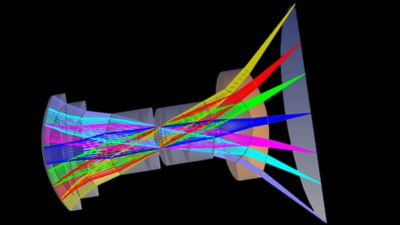
Ansys Zemax OpticStudio provides high-fidelity optical modeling using advanced ray tracing, wave optics, and polarization analysis. Engineers can predict system performance, evaluate tolerances, and assess environmental effects with high numerical accuracy. Integrated sequential and non-sequential simulation enables rigorous, system-level optical validation before prototyping.

Zemax capabilities


Key Features

Simplify and expedite your optical design projects with Ansys Zemax OpticStudio software capabilities.

  • Unified Sequential & Non-Sequential Modeling Architecture
  • Physical Optics Propagation (POP) for Wavefront Analysis
  • Advanced Optimization & Tolerance Analysis Engine
  • Ansys Multiphysics & Structural–Thermal Coupling
  • High-speed sequential and non-sequential ray tracing
  • Advanced stray light and ghost image analysis
  • Polarization and coating performance modeling
  • Built-in glass catalogs and material modeling
  • API automation and scripting (ZOS-API) integration
  • Unified sequential, non-sequential, and mixed-mode optical design workflows
  • Advanced illumination, LiDAR, AR/VR, headlamp, and stray light modelling
  • Direct physical modeling with broader system capability 
  • True wave optics: Propagates full complex wavefront (amplitude + phase) to capture diffraction and interference.
  • Wavefront precision: Quantifies aberrations, beam quality, and coupling efficiency.
  • Seamless workflow: Switches smoothly from ray tracing to POP when diffraction matters.
  • Delivers robust optimization and tolerance analysis for manufacturable, high-performance optical designs.
  • Accelerates convergence using advanced merit functions and global/local optimization algorithms.
  • Predicts real-world performance with Monte Carlo and sensitivity-based tolerancing tools.
  • Predicts optical performance under thermal and mechanical loads.
  • Couples structural deformation directly to optical analysis.
  • Validates designs against real-world environmental conditions.
  • Sequential mode for imaging system design and optimization
  • Non-sequential mode for illumination, scattering, and stray light analysis
  • Fast, multi-threaded performance for large, complex optical assemblies
  • Accurate modeling of reflections, refractions, diffraction, and detector response
  • Scales from simple lens systems to full opto-mechanical environments
  • Identifies ghost reflections from lens surfaces, filters, and detectors
  • Simulates scattering, surface roughness, and coating imperfections
  • Quantifies contrast degradation and veiling glare
  • Supports non-sequential ray tracing for realistic stray light paths
  • Enables mitigation strategies early in the design process
  • Analyzes polarization state changes through complex optical systems
  • Models thin-film coatings with angle- and wavelength-dependent behavior
  • Evaluates transmission, reflection, and phase effects across surfaces
  • Supports Jones and Mueller matrix methods
  • Optimizes coating stacks for performance and manufacturability
  • Accesses comprehensive manufacturer glass catalogs
  • Models dispersion, absorption, and thermal properties
  • Supports custom material definitions and melt data
  • Enables accurate chromatic and environmental performance prediction
  • Integrates directly into optimization and tolerancing workflows
  • Automates design, optimization, and analysis tasks programmatically
  • Integrates with Python, MATLAB, and .NET environments
  • Enables batch simulations and parametric studies
  • Connects optical models to external engineering workflows
  • Scales processes for enterprise-level development and validation

Ansys Zemax OpticStudio License

The Ansys Zemax OpticStudio is a powerful tool for optical engineers and designers to simulate, optimize, and validate their optical designs before physical prototypes are built. It helps save time and resources in the development of optical systems by allowing engineers to iterate and refine designs in a virtual environment.

To leverage the Ansys Zemax OpticStudio for multiphysics analysis requires the Ansys Zemax OpticStudio Enterprise license. The Ansys Zemax OpticStudio Enterprise license makes it simple to import structural, thermal, and refractive index data into OpticStudio workflows, yielding critical design insights, significant time savings, and new possibilities for system analysis. 

Product Packages

OPTICSOpticStudio ProOpticStudio PremiumOpticStudio Enterprise
Ansys Optics LauncherIncludedIncludedIncluded
Sequential Ray TracingIncludedIncludedIncluded
Monte Carlo Forward (Non-Sequential) Ray TracingIncludedIncludedIncluded
Multiple Configuration System ModelingIncludedIncludedIncluded
Number of Parallel Application Instances per License488
Polarization, Gradient Index, and Birefringence Ray TracingIncludedIncludedIncluded
Design Templates and Vendor Lens CatalogIncludedIncludedIncluded
Materials CatalogIncludedIncludedIncluded
Coatings CatalogIncludedIncludedIncluded
Robust Optimization MethodsIncludedIncludedIncluded
Sensitivity TolerancingIncludedIncludedIncluded
Monte Carlo TolerancingIncludedIncludedIncluded
Ray AimingIncludedIncludedIncluded
Aspheric OpticsIncludedIncludedIncluded
Freeform OpticsIncludedIncludedIncluded
Diffractive OpticsIncludedIncludedIncluded
Composite SurfaceIncludedIncludedIncluded
Image Quality Analysis (Geometric and Diffractive)IncludedIncludedIncluded
Gaussian BeamsIncludedIncludedIncluded
Physical Optics PropagationIncludedIncludedIncluded
Ghost Focus GeneratorIncludedIncludedIncluded
Ray Splitting and ScatteringIncludedIncludedIncluded
Importance SamplingIncludedIncludedIncluded
STAR Multiphysics Loading, Fitting, and Visualization tools (FEA, CFD)  Included
STAR Performance Analysis  Included
User-Defined Plugin for Surface, Objects, Sources, and Scatter ProfilesIncludedIncludedIncluded
Workflow automation with ZOS-API and Script AutomationIncludedIncludedIncluded
Export Full Design or Reduced Order Model (ROM) to SpeosIncludedIncludedIncluded
Dynamic and Static Exchange with Lumerical Sub-Wavelength model (LSWM) plugin simulationIncludedIncludedIncluded
Lumerical Plugin for metalens simulation (Static Data Exchange) IncludedIncluded
Import and Export of STEP, IGES, SAT, STLIncludedIncludedIncluded
Dynamic Link to Creo Parametric and Autodesk Inventor IncludedIncluded

OPTICSTUDIO RESOURCES & EVENTS

Featured Webinars

White Papers

Speos sustainability

Small Optics, Big Sustainability Impact

Explore how optics simulation enables sustainable miniaturized optical systems by reducing materials, energy use, and waste while optimizing design, production, and lifecycle performance across industries.

Videos

Blogs

Ansys Zemax Scanway optics
BY: CATY FAIRCLOUGH

Future of Space Optics with Scanway’s Modular Payload Solutions

Scanway’s modular payload solutions advance space optics, boosting mission flexibility, improving imaging performance, and enabling adaptable, high‑resolution observation capabilities for a range of satellite applications.

Case Studies

Let’s Get Started

If you're facing engineering challenges, our team is here to assist. With a wealth of experience and a commitment to innovation, we invite you to reach out to us. Let's collaborate to turn your engineering obstacles into opportunities for growth and success. Contact us today to start the conversation.