Skip to Main Content

Ansys Zemax OpticStudio
Next-Gen Optical Design Software

Design, simulate, and refine advanced optical systems faster with powerful, physics-based modeling that boosts performance, reduces risk, and accelerates innovation from concept through production.

Design, Optimize, and Validate Optics With Confidence 

Ansys Zemax OpticStudio enables you to design, simulate, and validate optical systems faster. Combining powerful physics-based modeling with an intuitive workflow, it helps engineers predict real-world performance, reduce design iterations, and confidently deliver optimized, production-ready optics across imaging, illumination, and photonic applications.

  • Check icon outline
    Non-Sequential Raytracing
  • Check icon outline
    Physical Optics Propagation
  • Check icon outline
    Tolerance Sensitivity Analysis
  • Check icon outline
    Freeform Surface Modeling
  • Check icon outline
    Polarization Ray Tracing
  • Check icon outline
    Stray Light Analysis
  • Check icon outline
    Multiphysics Coupling

Quick Specs

Model, analyze, and optimize sophisticated optical systems using physics-based simulation, sequential as well as non-sequential ray tracing, and advanced tolerancing tools that provide accurate performance prediction from concept through manufacturability.

  • Wavefront Error Analysis
  • Modulation Transfer Function
  • Point Spread Function
  • Diffractive Optics Modeling
  • Coating Performance Analysis
  • Gradient Index Modeling
  • Thermal Optical Effects
  • Glass Catalog Integration
  • Merit Function Optimization

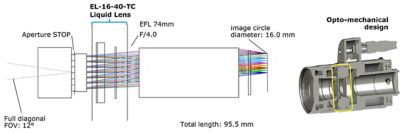
Liquid Lens Simulation Advances Medical Imaging Design

Simulation-driven insights improve early detection and diagnostic accuracy.

Optomechanical design

Simulation in Ansys Zemax gave us clear performance insight early, allowing rapid optimization of our liquid lens technology for accurate, real-world medical imaging.

Ansys Zemax enabled Optotune to simulate and optimize advanced liquid lens systems for high-resolution medical imaging. Using physics-based modeling, engineers evaluated optical performance, minimized design iterations, and predicted real-world behavior before prototyping. The study demonstrates how simulation-driven design accelerated development while ensuring precision, reliability, and manufacturability. By integrating comprehensive analysis with rapid optimization, the team delivered imaging performance capable of supporting early disease detection. This case study highlights how advanced optical simulation reduces risk, shortens development timelines, and enables innovation in next-generation diagnostic technologies worldwide today across healthcare environments and demanding clinical performance requirements everywhere.

March 2026

What's New

Simplify complex optical designs with the 2026 R1 release of Ansys Zemax OpticStudio. Enhanced tools and seamless integrations make tolerancing, imaging, and cross-tool workflows faster, easier, and more reliable for real-world systems.

Zemax 2026 R1 Nested Elements and System Tolerancing
Nested Elements and System Tolerancing (NEST)

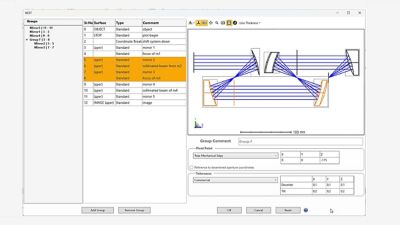
NEST simplifies optomechanical tolerancing with a visual, guided workflow for sequential systems. Key features include smart pivot presets, automatic operand insertion, real-time updates, and support for off-axis designs, enhancing precision while reducing setup complexity.

Zemax 2026 R1 NSC Imaging Design
NSC Imaging Design

NSC imaging enhancements transform Non-Sequential Mode into a practical imaging tool, streamlining workflows with features like proper stops, quick focus, spot diagrams, and sequence grouping, removing long-standing friction in folded and complex systems.

Zemax 2026 R1 Export Optical Design to Speos Enhancements
Export Optical Design (ODX) to Speos Enhancements

ODX enhancements to Speos streamline workflows by enabling seamless integration of real designs, including prisms and Table Glasses, without losing accuracy. Former Code V users benefit from faster, smoother transitions to OpticStudio.

Zemax 2026 R1 NSC Quick Focus
NSC Quick Focus

The NSC Quick Focus Feature simplifies detector positioning in Non-Sequential Mode. It automatically aligns detectors for focus, centering, and orientation using intended ray paths, saving setup time and preserving accuracy. With support for multi-wavelength systems and multiple sources, it’s perfect for tackling complex optical designs with confidence. Available in Premium and Enterprise.

Zemax 2026 R1 NSC Sequence Grouping
NSC Sequence Grouping

The NSC Sequence Grouping feature simplifies management of large ray-path sets, allowing sequences to be grouped manually or automatically based on key optical and physical properties, with dynamic updates and range-based filtering for precise analysis. Available in Premium and Enterprise.

Export to Speos
NSC Spot Diagram

The NSC Spot Diagram feature, enables native spot diagram analysis in Non-Sequential Mode. This feature lets you evaluate image quality directly using rays traced along selected sequences and provides detailed reporting on RMS and geometric spot size, flux, and more. With seamless integration into the Sequence Selector and a new RSNC operand, optimization and analysis are more precise than ever. Available in Premium and Enterprise.

Applications

Autonomous Sensor Development

Autonomous Sensor Development

Comprehensive autonomous vehicle sensor simulation capability that includes lidar, radar, and camera design and development.

Autonomous System Validation

Autonomous System Validation

Model-based safety and cybersecurity solutions accelerate autonomous system development and certification.

Cardiovascular

Cardiovascular

Rapid and reliable innovation and testing of new cardiovascular medical devices and implants

OLED

常见问题

Zemax.com正在向Ansys.com过渡,以便为所有Ansys产品和服务提供统一的信息平台。您现在可以通过Ansys网站直接访问所有Zemax资源,包括软件下载、文档和支持。只需导航到光学和光子学部分,就能找到Zemax产品。

请在Ansys.com上登录至您的Ansys账户,下载Zemax软件。登录后,转至“支持”下的下载区域,或Zemax的产品页面。如果您还没有Ansys帐户,请使用与您的Zemax账户相关联的电子邮件创建一个,以确保无缝访问。

Ansys通过Ansys客户门户(Ansys Customer Portal)为Zemax产品提供全面的支持。登录到您的账户并导航至“支持”。在这里,您可以提交请求,访问常见问题解答并与专家联系。如果您是Ansys的新用户,可能需要在账户设置过程中注册您的Zemax许可证,才能开启支持功能。

Ansys Zemax OpticStudio提供了多种学习选项。

  • 丰富的知识库提供从入门课程到系统级操作指南文章的广泛内容。
  • 此外,我们的Zemax用户社区还可用于与高级用户互动,并学习产品技巧与小窍门。
  • Ansys学习中心提供可自定义进度的视频课程,使您能够学习Ansys Zemax OpticStudio。

STAR多物理场工具使客户能够进行STOP分析(结构、热、光学性能)并与Ansys专用的SOFT分析(结构、光学、流体、热)相结合。Ansys Zemax OpticStudio使您能够轻松准确地从外部求解器加载所需数据。然后,用户可以同时评估系统的结构、光学、流体和热效应。

在本次网络研讨会中了解更多信息:使用STAR和自动化瞬态工作流程开展STOP分析(ansys.com)

当前客户可以从Ansys客户门户网站的下载中心下载Ansys Zemax OpticStudio。Ansys为非当前客户但又想试用OpticStudio的用户提供了免费试用。其附有样本文件和设计模板。我们丰富的知识库提供从入门课程到系统级操作指南的广泛教程。

Ansys Zemax OpticStudio可以使用理想的相位分布对超表面进行建模,然后使用光线追迹功能对其进行优化。接下来,Ansys Lumerical可以快速生成纳米结构级别的响应。根据这些信息,可以在OpticStudio中将超透镜准确设置在用户定义的表面上。所有基于光线的工具都可用于评估系统的性能。

Ansys Zemax OpticStudio的高级公差工具包括一个易于使用的表面不规则度选项。其利用复合表面功能并使用Zernike矢高数据对表面不规则性进行建模,包括对非球面或许多类型的自由曲面等复杂的表面基底形状进行建模。可以添加所有其他制造公差,以评估您的成品性能良率。 

Ansys Zemax OpticStudio是一款光学设计软件工具,用于设计成像、照明、激光系统等。OpticStudio的用户友好型界面将分析、优化和公差工具相结合,从而实现可制造性设计功能。扩展的定制选项可以根据您的需求定制OpticStudio,或者自动化您的工作。集成的多物理场工作流程可简化结构、热或流体仿真结果的使用 

High-Fidelity Optical Modeling and Performance Prediction

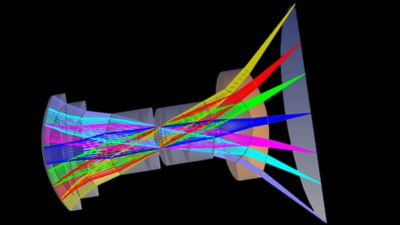
Ansys Zemax OpticStudio provides high-fidelity optical modeling using advanced ray tracing, wave optics, and polarization analysis. Engineers can predict system performance, evaluate tolerances, and assess environmental effects with high numerical accuracy. Integrated sequential and non-sequential simulation enables rigorous, system-level optical validation before prototyping.

Zemax capabilities


Key Features

Simplify and expedite your optical design projects with Ansys Zemax OpticStudio software capabilities.

  • Unified Sequential & Non-Sequential Modeling Architecture
  • Physical Optics Propagation (POP) for Wavefront Analysis
  • Advanced Optimization & Tolerance Analysis Engine
  • Ansys Multiphysics & Structural–Thermal Coupling
  • High-speed sequential and non-sequential ray tracing
  • Advanced stray light and ghost image analysis
  • Polarization and coating performance modeling
  • Built-in glass catalogs and material modeling
  • API automation and scripting (ZOS-API) integration
  • Unified sequential, non-sequential, and mixed-mode optical design workflows
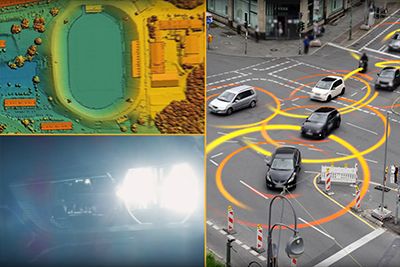
  • Advanced illumination, LiDAR, AR/VR, headlamp, and stray light modelling
  • Direct physical modeling with broader system capability 
  • True wave optics: Propagates full complex wavefront (amplitude + phase) to capture diffraction and interference.
  • Wavefront precision: Quantifies aberrations, beam quality, and coupling efficiency.
  • Seamless workflow: Switches smoothly from ray tracing to POP when diffraction matters.
  • Delivers robust optimization and tolerance analysis for manufacturable, high-performance optical designs.
  • Accelerates convergence using advanced merit functions and global/local optimization algorithms.
  • Predicts real-world performance with Monte Carlo and sensitivity-based tolerancing tools.
  • Predicts optical performance under thermal and mechanical loads.
  • Couples structural deformation directly to optical analysis.
  • Validates designs against real-world environmental conditions.
  • Sequential mode for imaging system design and optimization
  • Non-sequential mode for illumination, scattering, and stray light analysis
  • Fast, multi-threaded performance for large, complex optical assemblies
  • Accurate modeling of reflections, refractions, diffraction, and detector response
  • Scales from simple lens systems to full opto-mechanical environments
  • Identifies ghost reflections from lens surfaces, filters, and detectors
  • Simulates scattering, surface roughness, and coating imperfections
  • Quantifies contrast degradation and veiling glare
  • Supports non-sequential ray tracing for realistic stray light paths
  • Enables mitigation strategies early in the design process
  • Analyzes polarization state changes through complex optical systems
  • Models thin-film coatings with angle- and wavelength-dependent behavior
  • Evaluates transmission, reflection, and phase effects across surfaces
  • Supports Jones and Mueller matrix methods
  • Optimizes coating stacks for performance and manufacturability
  • Accesses comprehensive manufacturer glass catalogs
  • Models dispersion, absorption, and thermal properties
  • Supports custom material definitions and melt data
  • Enables accurate chromatic and environmental performance prediction
  • Integrates directly into optimization and tolerancing workflows
  • Automates design, optimization, and analysis tasks programmatically
  • Integrates with Python, MATLAB, and .NET environments
  • Enables batch simulations and parametric studies
  • Connects optical models to external engineering workflows
  • Scales processes for enterprise-level development and validation

Ansys Zemax OpticStudio许可证

对于光学工程师和设计人员而言,Ansys Zemax OpticStudio是一款功能强大的工具,可用于在构建物理原型之前仿真、优化和验证其光学设计。其使工程师能够在虚拟环境中迭代和优化设计,从而有助于在光学系统开发过程中节省时间和资源。

若需使用Ansys Zemax OpticStudio进行多物理场分析,需要持有Ansys Zemax OpticStudio Enterprise版许可证。Ansys Zemax OpticStudio Enterprise版 可以实现轻松将结构、热和折射率数据导入OpticStudio工作流程,从而获得关键的设计洞察,大幅节省时间,并为系统分析提供新的可能性。 

产品包

光学OpticStudio Pro版OpticStudio Premium版OpticStudio Enterprise版
Ansys Optics Launcher包含包含包含
序列光线追迹包含包含包含
蒙特卡罗正向(非序列)光线追迹包含包含包含
多配置系统建模包含包含包含
每个许可证的并行应用实例数488
偏振、梯度指数和双折射光线追迹包含包含包含
设计模板和供应商镜头目录包含包含包含
材料目录包含包含包含
涂层目录包含包含包含
鲁棒性优化方法包含包含包含
灵敏度公差包含包含包含
蒙特卡罗公差包含包含包含
光线瞄准包含包含包含
非球面光学包含包含包含
自由曲面光学包含包含包含
衍射光学包含包含包含
复合表面包含包含包含
图像质量分析(几何和衍射)包含包含包含
高斯光束包含包含包含
物理光学传播包含包含包含
鬼影焦点生成器包含包含包含
光线分光和散射包含包含包含
重要性采样包含包含包含
STAR多物理场载荷、拟合和可视化工具(FEA、CFD)  包含
STAR性能分析  包含
用于表面、物体、光源和散射分布的用户定义插件包含包含包含
使用ZOS-API和脚本自动化实现工作流程自动化包含包含包含
将完整设计或降阶模型(ROM)导出到Speos包含包含包含
利用Lumerical亚波长模型(LSWM)插件仿真进行动态和静态交换包含包含包含
用于超透镜仿真(静态数据交换)的Lumerical插件 包含包含
STEP、IGES、SAT、STL的导入和导出包含包含包含
与Creo Parametric和Autodesk Inventor的动态链接 包含包含

OPTICSTUDIO RESOURCES & EVENTS

Featured Webinars

White Papers

Speos sustainability

Small Optics, Big Sustainability Impact

Explore how optics simulation enables sustainable miniaturized optical systems by reducing materials, energy use, and waste while optimizing design, production, and lifecycle performance across industries.

Videos

Blogs

Ansys Zemax Scanway optics
BY: CATY FAIRCLOUGH

Future of Space Optics with Scanway’s Modular Payload Solutions

Scanway’s modular payload solutions advance space optics, boosting mission flexibility, improving imaging performance, and enabling adaptable, high‑resolution observation capabilities for a range of satellite applications.

Case Studies

现在就开始行动吧!

如果您面临工程方面的挑战,我们的团队将随时为您提供帮助。我们拥有丰富的经验并秉持创新承诺,期待与您联系。让我们携手合作,将您的工程挑战转化为价值增长和成功的机遇。欢迎立即联系我们进行交流。