Skip to Main Content

Ansys Lumerical Multiphysics
Photonics Component Simulation Software

Seamlessly design photonic components by capturing multiphysics effects encompassing optical, thermal, electrical, and quantum wells within a unified design environment.

PRECISION MEETS PHOTONIC INNOVATION

Optimize design early and accurately

Created for design engineering workflows, our intuitive product design software generates a fast user experience. Rapid design exploration includes detailed insight into real-world product performance. Live physics and accurate high-fidelity simulation combine into an easy-to-use interface that supports faster-time-to-market.


  • Check icon outline
    Finite Element Design Environment
  • Check icon outline
    Integrated Multiphysics Workflows
  • Check icon outline
    Comprehensive Material Models
  • Check icon outline
    Automation & Optimization
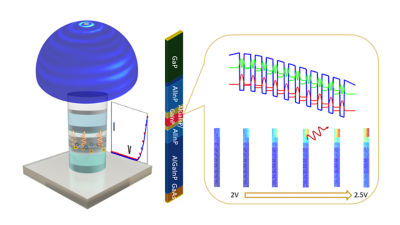
Multiphysics mqw CHARGE mLED

Quick Specs

Simplify the complexities of photonic component design by leveraging the power of seamless multiphysics workflows that accurately capture optical, electrical, thermal, and quantum interactions all within a unified design environment.

  • Waveguide Solver (FEEM)
  • Charge Transport Solver (CHARGE)
  • Heat Transport Solver (HEAT)
  • Multi Quantum Well Solver (MQW)
  • 3D Electromagnetic Solver (DGTD)
  • Advanced Optimizations
  • Comprehensive material models
  • Import STL, GDSII, and STEP
  • Automation API (Lumerical scripting language, Python and MATLAB)
  • Foundry Compatible Automated Layer Builder

March 2026

What's New

The 2026 R1 release of Ansys Lumerical Multiphysics enhances photonic design with Synopsys OptoCompiler integration, introduces PyLumerical for streamlined automation, and debuts a powerful VCSEL Design Tool. 

Multiphysics 2026 R1
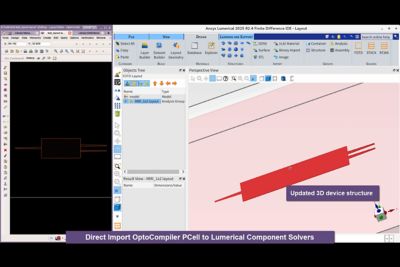
OptoCompiler-Lumerical Synergy

Experience seamless photonic design with the Synopsys OptoCompiler-Lumerical synergy, featuring direct integration with Lumerical MODE, FDTD, and Multiphysics. Accelerate telecom and semiconductor innovation using advanced photonic component modeling and simulation, ensuring efficient, high-tech solutions tailored to your needs.

Multiphysics 2026 R1 Py Lumerical
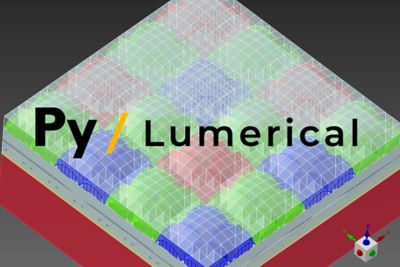
PyLumerical

Automate Lumerical tools seamlessly with PyLumerical, a Python-based solution. Fully compatible with the PyAnsys ecosystem, it integrates with FDTD, MODE, Multiphysics, INTERCONNECT, and other Ansys tools like Optislang and Speos, plus open-source Python libraries. Simplify workflows and enhance multiphysics simulations with this modern, efficient approach.

Multiphysics 2026 R1
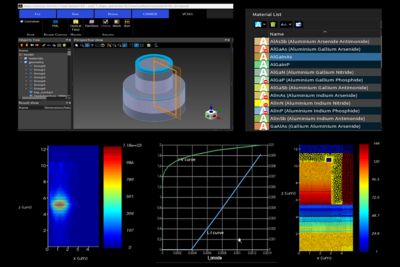
Vertical-Cavity Surface-Emitting Laser (VCSEL) Design Tool

The new VCSEL Design Tool in Ansys Lumerical multiphysics streamlines the creation of 3D cylindrical VCSEL structures, enabling simulations for cavity modes, beam profiles, gain alignment, and polarization effects. It integrates optical, electrical, quantum, and thermal analyses to deliver comprehensive insights, including LIV curves, near/far field profiles, and performance optimization.

CAPABILITIES

Multiphysics Photonic Component Design

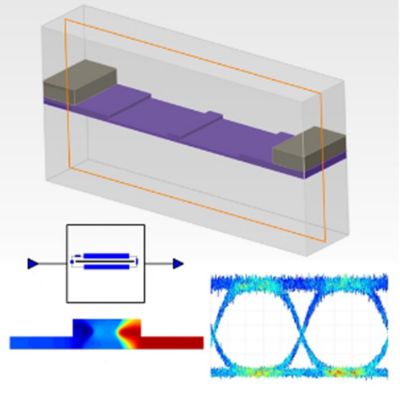
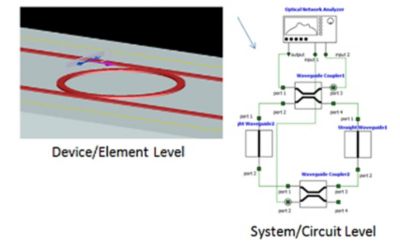
The suite of solvers, seamless workflows, and features in Lumerical Multiphysics enable accurately capturing the interplay of physical effects in modeling passive and active photonic components.


Key Features

Design and optimize a wide range of photonic components. 

  • Flexible and seamless multiphysics simulation workflows
  • Best-in-class analytic engines
  • Interoperability for verification of layouts from EDA tools
  • Automated foundry compatible geometry and material definition
  • Both script-driven and GUI-based design
  • Ansys Engineering Copilot

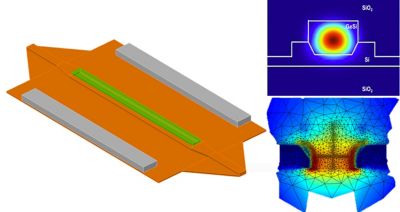
Calculate the modes supported by the 2D cross-section of waveguides or fibers in the frequency domain for a wide range of complex geometries and materials.

  • Comprehensive material models: multi-coefficient, broadband, scriptable
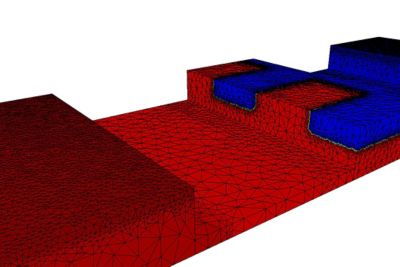
  • Automatic mesh refinement based on imported heat profiles
  • Multiphysics workflows for electro-optic and thermo-optic modeling 

It self-consistently solves Poisson's and drift-diffusion equations, offering precision with automatic mesh refinement to optimize efficiency.

  • Self-consistent charge/heat modeling for capturing self-heating effects in high-current devices
  • Automatic mesh refinement based on geometry, materials, doping, and optical or heat generation
  • Import STL, GDSII, and STEP
  • Steady-state, Transient, and Small-signal AC simulation
  •  Comprehensive material models

Lumerical HEAT allows you to focus on the stability and reliability of your designs with confidence.

  • Comprehensive matetrial models
  • Automatic mesh refinement based on imported heat profiles
  • Joule heating from electrical conduction
  • Steady-state and transient heat transport

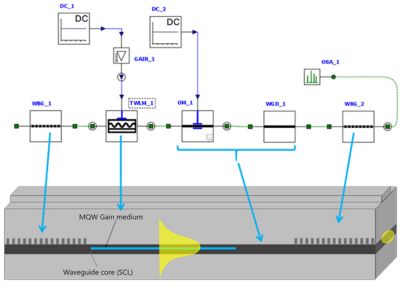
MQW combined with CHARGE, MODE and INTERCONNECT solvers enables design of lasers, SOAs, electro-absorption modulators, microLEDs, and other gain-driven active devices.

  • Wavefunction and band diagram calculation
  • Gain and spontaneous emission
  • Incorporates temperature, exciton, field, and strain effects
  • Comprehensive material model with common III-V and III-N semiconductors and customizable
  • Scriptable and available UI
  • Results used as input for compact laser models in INTERCONNECT

When accuracy is mission critical, DGTD provides superior performance, independent of geometry complexity and within a design environment engineered for multiphysics simulation workflows.

  • Comprehensive material models
  • Automatic mesh refinement
  • Far-field and grating projections
  • Self-heating modeling (CHARGE & HEAT)
  • Photovoltaic modeling (FDTD/DGTD, CHARGE & HEAT)
  • Electro-optic modeling (CHARGE & FDTD/DGTD/FDE/FEEM)
  • Opto-thermal modeling (FDTD/DGTD/FEEM & HEAT)
  • Plasmonics modeling (DGTD & HEAT)

Change the position, ordering, and thickness of each layer. Simulate curved side-angled waveguides, then export the layer configuration, including material data, as a process file (.lbr) that foundries can fabricate.

Automate multiphysics simulation workflows and benefit from the state-of-the-art sensitivity analysis and optimization algorithms available in optiSLang

Ansys Engineering Copilot is now integrated into Ansys Lumerical MODE providing access to the AI-assistant from within the product.

Videos

Application Gallery

View all Photonics Applications

photonic integrated circuit diagram
Examples

Photonic integrated circuits – Actives

  • Modulators
  • Photodetectors
  •  Lasers

ag-passives.jpg
Examples

Photonic integrated circuits – Passives

  • Ring Resonators and more
  • Optical Switches
  • Optical filters

2020-12-other-icon-block.jpg

FEEM Product Reference Manual

The Finite Element EigenMode (FEEM) reference manual provides detailed descriptions of product features.

2020-12-other-icon-block.jpg

CHARGE Product Reference Manual

The CHARGE reference manual provides detailed descriptions of product features.

2020-12-other-icon-block.jpg

HEAT Product Reference Manual

The HEAT reference manual provides detailed descriptions of product features.

2020-12-other-icon-block.jpg

MQW Product Reference Manual

The Multi-Quantum Well (MQW) reference manual provides detailed descriptions of product features.

2020-12-other-icon-block.jpg

DGTD Product Reference Manual

The Discontinuous Galerkin Time-Domain (DGTD) reference manual provides detailed descriptions of product features.

Ansys software is accessible

It's vital to Ansys that all users, including those with disabilities, can access our products. As such, we endeavor to follow accessibility requirements based on the US Access Board (Section 508), Web Content Accessibility Guidelines (WCAG), and the current format of the Voluntary Product Accessibility Template (VPAT).

现在就开始行动吧!

如果您面临工程方面的挑战,我们的团队将随时为您提供帮助。我们拥有丰富的经验并秉持创新承诺,期待与您联系。让我们携手合作,将您的工程挑战转化为价值增长和成功的机遇。欢迎立即联系我们进行交流。