Synopsys and Ansys power the future of innovation—connecting silicon to systems.
-
-
Access Free Student Software
Ansys empowers the next generation of engineers
Students get free access to world-class simulation software.
-
Connect with Ansys Now!
Design your future
Connect with Ansys to explore how simulation can power your next breakthrough.
Free Trials
Products & Services
Learn
About
Back
Products & Services
Back
Learn
Ansys empowers the next generation of engineers
Students get free access to world-class simulation software.
Back
About
Design your future
Connect with Ansys to explore how simulation can power your next breakthrough.
Free Trials
TOPIC DETAILS
What is Automotive Electronics?
Automotive electronics is a vehicle system that processes and modifies electrical signals and power to monitor, control, and carry out functions in the automobile. Modern cars use a complex network of interconnected electronic systems to improve safety, efficiency, performance, comfort, and user experience. Today’s passenger vehicles can have up to 100 electronic modules, with over 200 in electric or hybrid cars. Electronic devices in automobiles will only increase with advances in electric vehicle (EV) technology, autonomous driving, and improved connectivity. This will pose new challenges for the engineers who design and build these vehicles.
The Growing Importance of Automotive Electronics
Electricity use in vehicles began in the very early days with electric headlamps, followed by electric motors to start the car or to move the windshield wipers. The development of discrete semiconductors like transistors and diodes allowed car manufacturers to add alternators and simple electronic fuel injection to gain greater efficiency.
Then, when the industry adopted integrated circuits, multichip electronic control units (ECUs) were added in the 1980s for better engine control, automatic braking systems (ABSs), and electronic stability control (ESC) modules. In the 21st century, automobile manufacturers stepped up their use of automotive electronics, turning cars into computers on wheels and moving toward software-defined vehicles.
Five industry trends are driving the increased importance of automotive electronic systems in vehicles:
- Safety: Governments, consumers, and the automotive industry itself continue to push the boundaries of safety expectations. Sensors, combined with smart systems, can identify and deal with safety hazards much faster and more effectively than human drivers. Manufacturers need to include these features to meet growing standards and satisfy consumer demand.
- Efficiency: Demands to improve efficiency have also grown over time, including more stringent emissions requirements. Manufacturers and suppliers have added real-time electronic monitoring and control systems to every part of the powertrain to improve mileage and reduce pollutants while maintaining performance.
- User experience: Since electronics have changed every aspect of life, drivers and passengers expect the same connectivity, ease of use, and capability as they receive from consumer electronics.
- Electrification: The move from internal combustion engine (ICE)-powered vehicles to hybrid and fully electric vehicles can double the number of electronic modules in a car. At the same time, the high-voltage nature of electric powertrains increases the complexity and functional safety concerns of vehicles using electric propulsion.
- Autonomous driving: The rapid advancement from semi-autonomous to fully autonomous vehicles is also increasing the reliance on electronics in the automotive space. Commonplace autonomous driving features like adaptive cruise control combine sensors, computation, and engine control to automate driver tasks. As manufacturers add more automation, vehicle electronics will increase.
The Components in Automotive Electronics
The different electronic systems in a vehicle consist of several electronic components and the connections among them. Each component has its own unique needs in terms of design, operation, and maintenance.
Here is a list of the most common types of automotive electronics components:
- Sensors: Sensors measure physical values and report back to other systems. They can measure values inside or outside a vehicle, including pressure, velocity, location, temperature, flow, and proximity. More sophisticated sensors, like radar, ultrasonic devices, cameras, and light detection and ranging (lidar), can also provide the distance, shape, azimuth, and elevation position of a target. The inputs from all these sensors can be fed into artificial intelligence (AI) systems that can then employ sensor fusion to provide the vehicle with greater situational awareness.
- Actuators: Over time, auto manufacturers replaced many mechanical linkages with actuators, devices like solenoids and motors that turn an electrical signal into a force that moves a mechanical object. This can be as simple as opening and closing a vent in the air conditioning system or as sophisticated as shifting gears in the transmission.
- ECUs: ECUs gather and process sensor data and operator input to control different functions in the vehicle. Like computers, ECUs use software and firmware to operate the vehicle.
- Power electronics: Power electronics refers to the control modules, power supplies, power converters, and wiring harnesses that carry high voltages. It delivers electrical power to higher-demand systems, such as the starter, electric heaters, or electric motors, and manages the battery state of charge.
- Communication networks: All these modules and their subsystems communicate through wired networks using protocols, such as CAN Bus, LIN, FlexRay, and Ethernet. In addition, communication networks provide wireless vehicle-to-everything (V2X) connectivity to smartphones, the internet, GPS, infrastructure, or other vehicles. This grouping of components is sometimes referred to as telematics.
- User interface components: Drivers and passengers interact with vehicles through user interface components, including buttons, infotainment systems, heads-up displays, dashboard components, and display screens.
The Different Classifications for Modules in Automotive Electronics
One way that the industry keeps track of the growing number of electronic systems in vehicles is to categorize them into different classifications based on their functions.
Here is a list of the standard classifications and the most common components in each category:
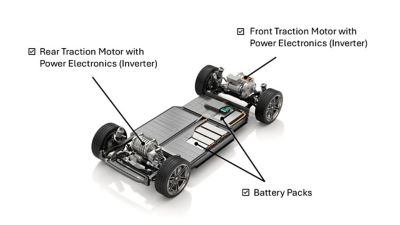
An electric vehicle’s (EV’s) powertrain consists of batteries, motors, and power electronics.
A powertrain consists of the systems in a car that provide torque to the wheels. From the fuel tank and the exhaust pipe to the batteries and the motors for an EV, the powertrain uses the most energy, so most of the electronics in this classification focus on fuel efficiency, vehicle performance, or emissions reduction.
Some of the more common electronic modules in ICE powertrains are:
- Electronic fuel controls
- Emission controls
- Engine control units
- Engine management
- Engine sensors
- Transmission controls
In addition to many of these components, hybrid and electric vehicles use power electronics modules, including:
- Battery management systems
- Battery temperature controls
- Drive motors
- Charging electronics
- Inverters and voltage regulators
Safety Systems
Design teams can leverage the increase in sensor and edge computing capabilities in ECUs to improve vehicle safety and increase module complexity.
Some of the more common safety systems include:
- Airbags
- Antilock braking systems
- Antislip regulations (ASRs)
- Backup cameras
- Blind spot sensors
- Collision detection and avoidance
- Emergency braking
- Hill start assist (HSA)
- Lane departure warnings
- Tire pressure monitoring
- Traction control systems (TCSs)
Infotainment System
The electronic devices that provide information or entertainment to passengers are categorized as infotainment systems. They include:
- Broadband connectivity
- Entertainment systems
- Instrument clusters
- Navigation systems
- Smartphone connectivity
- Speakers and microphones
- User interface devices
- Vehicle diagnostics
- Vehicle feature setup
Chassis Electronics
Automotive electronics systems that don’t belong to the previous categories are referred to as chassis electronics. However, increased automation and integration blur the lines between safety and chassis electronics.
Chassis electronics modules include:
- Adaptive headlights
- Advanced driver assistance systems (ADASs)
- Cabin lighting
- Climate control
- Electronic power braking
- Electronic power steering
- Keyless entry
- Lighting systems
- Suspension control
Driving the Design of Automotive Electronics With Simulation
Engineers can use simulation tools throughout the design process to meet the ever-increasing complexities and challenges of automotive electronics. Teams can’t wait for prototypes to test their ideas and verify whether electronic systems are robust enough for thermal, structural, and electromagnetic loads.
Original equipment manufacturers (OEMs) and their suppliers apply simulation to every component, module, and assembly in a vehicle's electrical system. This virtual prototyping increases performance, reduces warranty claims, verifies safety, reduces costs, and gets new designs to market faster.
Most simulation tasks can be placed into one of these four areas:
1. Functionality
The initial application for simulation is to help engineers design automobiles to try out the functionality of their components. The response of every module can be designed and tested virtually as the design is being created at the component, subsystem, and system levels. Engineers use a tool, such as the Ansys Maxwell advanced electromagnetic field solver, to design electromechanical devices like motors and actuators or power electronics systems, including transformers and voltage regulators. Optical system designers satisfy the requirements for the lenses in light-based sensors with optical simulation platforms like Ansys Zemax OpticStudio optical system design and analysis software. Or interior designers can explore the look and feel of cabin lighting with a product like Ansys Speos CAD integrated optical and lighting simulation software.
2. Optimization
Once they’ve met the functional requirements of an electronic device for an automotive application, engineers need to optimize the design. This is where they improve efficiency, reduce emissions, and maximize performance.
They may use a tool with capabilities like the Ansys SCADE Suite model-based development environment for critical embedded software to modify the firmware for an ECU. Or maybe they will use Ansys HFSS high-frequency electromagnetic simulation software to design and optimize an antenna for GPS applications. This antenna can then be coupled with a digital mission simulation platform like Ansys Systems Tool Kit (STK) digital mission engineering software to ensure that the GPS antenna in the infotainment system receives the strongest possible signal under a wide range of driving situations.
Then, once each module is optimized, engineers can deploy a comprehensive optimization platform like Ansys OptiSLang process integration and design optimization software to achieve their goals quickly and efficiently.
3. Reliability
One of the most important aspects of automotive design is reliability. Owners expect their vehicles to function properly after accumulating many miles. But the heat, vibration, shock, and electromagnetic noise in automobiles make achieving these aggressive robustness goals challenging, which is why engineering teams use structural, thermal, and electromagnetic simulation tools to put their automotive electronics systems through rigorous virtual testing.
They may deploy Ansys Mechanical structural finite element analysis software for thermal, structural, and vibration evaluation to make sure that all components, along with the physical and electrical connections, meet the vehicle's life requirements and perform over time. Or for the printed circuit boards (PCBs) and integrated circuit packages in ECUs, they may rely on a simulation tool focused on electronics like Ansys Icepak electronics cooling simulation software and Ansys Sherlock electronics reliability prediction software.
4. Interference
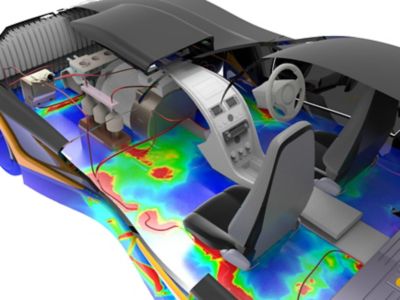
electromagnetic modeling and simulation software
Electromagnetic interference and electromagnetic compatibility (EMI/EMC) present an ever-increasing challenge to automotive electronics, especially when cars include high-voltage systems, as is found in EVs. The number of high-frequency components and high-speed digital signals moving from one module to another, the voltage of electric battery systems, and the use of antennas are increasing. Engineers use tools like Ansys SIwave PCB and package electromagnetics simulation software to solve signal and power integrity issues on PCBs used in an ECU or Ansys EMC Plus electromagnetic modeling and simulation software to study how high-frequency waves interact between cabling and wires. You can even use it to model how a lightning strike can impact the electronics systems in a car.
Related Resources
Let’s Get Started
If you're facing engineering challenges, our team is here to assist. With a wealth of experience and a commitment to innovation, we invite you to reach out to us. Let's collaborate to turn your engineering obstacles into opportunities for growth and success. Contact us today to start the conversation.