Synopsys and Ansys power the future of innovation—connecting silicon to systems.
-
-
学生向け無料ソフトウェアにアクセス
Ansysは次世代の技術者を支援します
学生は、世界クラスのシミュレーションソフトウェアに無料でアクセスできます。
-
今すぐAnsysに接続!
未来をデザインする
Ansysに接続して、シミュレーションが次のブレークスルーにどのように貢献できるかを確認してください。
無料トライアル
製品およびサービス
リソースとトレーニング
当社について
Back
製品およびサービス

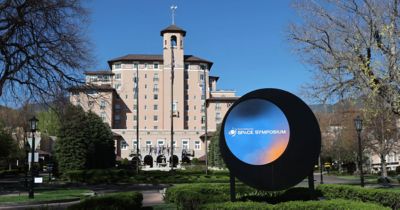
For the 41st year in a row, over 10,000 people from the aerospace and defense (A&D) communities gathered at the foothills of the Rockies for Space Symposium. With three halls of over 400 exhibitors, Space Symposium attracts thousands of representatives from the military, civil, and commercial space sectors.
At our first Space Symposium as Ansys, part of Synopsys, our team focused on how we can assist the A&D industries from silicon to systems. With highlights on using our simulation software for space exploration and operations, artificial intelligence (AI) applications, and electronic design automation (EDA) solutions, we had a successful week talking to customers, partners, and thought leaders. Throughout the week, we heard from many speakers, including senior government officials, military leaders, industry executives, and technical experts who delivered critical insights and strategic directions that help define the global space agenda.
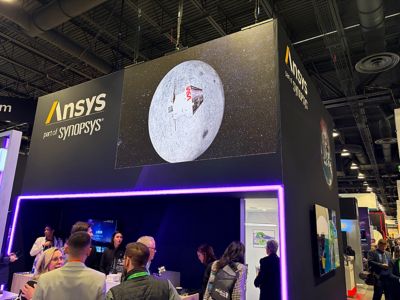
The Ansys, part of Synopsys, booth at the 41st Space Symposium showcased a simulation of Artemis II in Ansys Systems Tool Kit (STK) digital mission engineering software.
Cislunar Space as a Strategic Domain
Cislunar space presents unique challenges due to its vast scale and distance, requiring innovative approaches to ensure operational effectiveness. Advanced propulsion systems, local autonomy, and enhanced situational awareness are essential for addressing the latency and complexity of this environment. Infrastructure priorities include building reliable communication relays, navigation systems, and logistics networks to support long-term missions and sustained human presence. Coordination across civil, defense, and commercial sectors is critical, as collaboration enhances resilience and operational capacity.
Simulating a comparison of the Artemis II and Apollo trajectories in STK software
Global Collaboration and Security
International collaboration in space has evolved into a critical mechanism for addressing both exploration and security challenges. The Artemis Accords serve as a cornerstone, transforming from a principles-based agreement into a functional framework that enables aligned operational participation among over sixty nations. These agreements emphasize transparency, shared standards, and interoperability, creating avenues for joint missions and multinational contributions to lunar and deep-space operations. Coalition frameworks, such as Olympic Defender and combined space operations, further demonstrate the importance of data sharing and integrated architectures to enhance resilience and collective security. As space activities expand, shared responsibilities and aligned efforts remain central to ensuring stability and operational success in a complex and competitive global landscape.
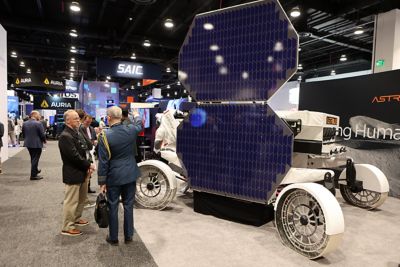
Astro Lab’s rover. Source: Space Foundation.
Commercial Integration and Innovation
The space sector is increasingly driven by data and digital innovation, shifting from hardware-focused models to software-defined architectures and decision-centric approaches. Commercial platforms, particularly in low Earth orbit (LEO), are becoming essential for advancing technology and supporting sustained exploration activities. These platforms enable industries to leverage microgravity environments for groundbreaking research in fields like biotechnology and materials science, aligning commercial goals with national and global objectives. NASA’s evolving procurement practices are fostering early-stage stability for private ventures, encouraging capital flow and accelerating innovation cycles. Additionally, the rapid proliferation of commercial intelligence constellations and communication systems demonstrates how the private industry is now a critical contributor to mission resilience and operational capabilities.
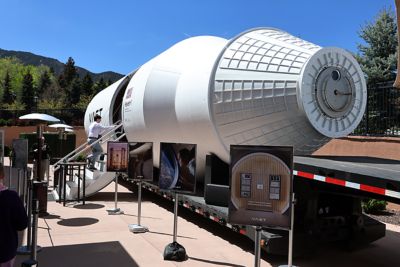
Vast’s Haven-1 1:1 model. Source: Space Foundation.
Rapid Technology Adaptation
The rapid evolution of technology in space operations is transforming how capabilities are developed, tested, and deployed. AI and machine learning (ML) are increasingly embedded within space systems, enabling faster decision-making, orbital congestion management, and anomaly detection. Autonomy is shifting operational paradigms, enabling spacecraft to perform dynamic maneuvering and intent-based tasking with minimal human intervention. These advancements reduce reliance on ground control and compress reaction times, particularly in contested or high-stakes scenarios. Enhanced onboard processing and edge computing capabilities improve real-time responsiveness, which is essential for maintaining effectiveness in complex and competitive environments. Furthermore, software-driven updates are now critical, enabling frequent refresh cycles and adaptability without replacing entire hardware systems.
These technological shifts are not just optimizing current missions but are also redefining operational models, as space systems transition to architectures that prioritize resilience, adaptability, and mission assurance in an environment where speed and precision are indispensable for success.
Learn more about how Ansys can help with your space missions.

Just for you. We have some additional resources you may enjoy.


The Advantage Blog
The Ansys Advantage blog, featuring contributions from Ansys and other technology experts, keeps you updated on how Ansys simulation is powering innovation that drives human advancement.