Synopsys and Ansys power the future of innovation—connecting silicon to systems.
-
-
学生向け無料ソフトウェアにアクセス
Ansysは次世代の技術者を支援します
学生は、世界クラスのシミュレーションソフトウェアに無料でアクセスできます。
-
今すぐAnsysに接続!
未来をデザインする
Ansysに接続して、シミュレーションが次のブレークスルーにどのように貢献できるかを確認してください。
無料トライアル
製品およびサービス
リソースとトレーニング
当社について
Back
製品およびサービス

Systems engineers are increasingly challenged by rapidly rising system complexity. Tighter integration, growing dependencies, and the rise of software‑defined and autonomous behavior have stretched traditional systems engineering practices to their limits. Requirements are harder to verify, architectural decisions have far-reaching consequences, and stakeholder expectations continue to grow. Systems must be not only capable but safe, secure, scalable, sustainable, affordable, and delivered faster than ever.
At the same time, simulation engineers bring deep analytical insight into performance, behavior, and risk, but their work is often constrained by the environment in which it is produced. Over time, simulation ecosystems have evolved around specific life cycle phases: early concept studies, requirements analysis, detailed design, testing, training, and operations. Each phase introduced its own tools, models, assumptions, and workflows. These solutions may be powerful locally, but they are rarely connected globally.
The result is a familiar pattern across industries:
- System architectures are defined with limited performance and design optimization evidence
- Simulations are run over incomplete systems
- Simulations are developed as stand-alone studies and rarely back their results to the system model
- Design phase models are tightly coupled to specific implementations
- Test and operational simulations are rebuilt from scratch
- Insights are lost, revalidated, or reinterpreted as programs move forward
Both disciplines expend significant effort, yet neither has full visibility into how decisions propagate across the life cycle.
During early concept development and design, the gap becomes especially visible. Simulation engineers are asked to produce results before system definitions mature while systems engineers must finalize requirements without strong, mission‑level performance evidence. Without a shared mission context and digital continuity, early analytical insights are frequently discounted or discarded once detailed engineering begins, undermining one of simulation’s greatest strengths.
Digital Engineering: Bringing the Disciplines Together
Digital engineering changes this dynamic by design. Rather than optimizing individual activities in isolation, it integrates digital tools, system architecture models, and data across the product life cycle to enable collaboration, traceability, and informed decision‑making.
This is where model‑based systems engineering (MBSE) and digital mission engineering (DME) meet.
- MBSE provides a shared, authoritative source of truth — the system architecture model — capturing requirements, structure, and behavior and connecting engineering teams and workflows across the product life cycle.
- DME introduces operational context, using modeling and simulation to evaluate how systems perform in realistic mission environments and whether mission objectives are truly met.
Together, they create a common language between systems engineers and simulation engineers.
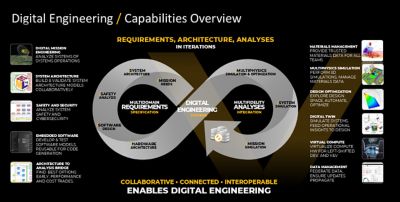
Digital engineering integrates digital tools, system architecture models, and data across the product life cycle.
ModelCenter Software, the Bridge Between System Models and Simulation
Ansys ModelCenter MBSE software sits at the core of DME by establishing a digital thread that connects system architecture, requirements, and mission‑level analysis into a single, automated workflow. While tools like Ansys Systems Tool Kit (STK) DME software provide essential physics‑based mission realism, ModelCenter software ensures that these high‑fidelity insights are traceable, repeatable, and actionable in formal MBSE and multidisciplinary design analysis and optimization (MDAO) practices.
Historically, however, mission‑level analyses, such as those performed in STK software, were often executed outside the SysML‑based system architecture environment. As a result, mission performance analysis results were loosely coupled — or not coupled at all — to system requirements, functional allocations, and design parameters. This limited requirements verification, reduced reuse of analysis assets, and weakened traceability across the digital thread, particularly during early trade studies when mission feedback is most impactful.
ModelCenter software addresses these challenges by acting as the orchestration and integration layer for digital engineering. System engineers define system intent, architecture, and requirements using system architecture models — based either in SysML v1 or SysML v2 like the Ansys System Architecture Modeler (SAM) capability — while ModelCenter software connects those artifacts directly to analysis execution. It automates multitool workflows, manages data exchange, and enables continuous requirements verification as the design evolves.
Through the STK plug-in for ModelCenter software, mission-level simulation is seamlessly integrated with powerful MDAO workflows, enabling automated STK scenario execution, advanced trade studies, optimization, and rich post-processing for more intelligent, targeted design exploration.
In addition, STK software analyses are directly connected to system requirements and models, enabling traceability and better decision-making across the product design life cycle.
The result is a closed‑loop digital engineering workflow that ties SysML architecture models, automated requirements verification, mission simulation, MBSE, and MDAO workflows into a coherent process. ModelCenter software maintains continuity across the life cycle by ensuring that changes in system architecture or requirements automatically propagate to mission‑level analysis — and that mission outcomes flow back to inform system decisions.
By embedding STK software in ModelCenter software‑driven workflows, organizations create a scalable, traceable, and optimization‑ready DME environment where mission success criteria directly guide system design, which is exactly why the integration of STK software and ModelCenter software represents such a significant step forward.
MBSE and DME in Action
ModelCenter software‑enabled digital engineering workflows can be applied across industries and domains. Aerospace and defense organizations have a strong demand for MBSE‑ and MDAO‑driven mission simulation to support the design of satellites, launch vehicles, aircraft, and unmanned aerial vehicles (UAVs). At the same time, space system integrators rely on early‑stage trade studies to evaluate constellation architectures, mission concepts, and payload designs. In defense programs, digital engineering mandates further reinforce the need for rigorous requirements verification, repeatable analysis workflows, and clear traceability among SysML system models, mission‑level performance metrics, and verification evidence.
You can see this approach in action by reading the Lockheed Martin Space MBSE use case. This paper demonstrates how an integrated MBSE and digital mission engineering workflow enabled up to seven times faster design evaluation, enabling teams to rapidly identify issues, reduce cost and schedule risk, and select mission trajectories that met thermal and system constraints with greater confidence.
Meanwhile, advanced mobility and advanced air mobility (AAM) programs, including UAV and electric vertical take-off and landing (eVTOL) development, are driven by rapid design cycles, evolving operational requirements, and the need to continuously assess flight performance and constraints in dynamic environments.
Watch the demo below to explore an end‑to‑end digital engineering workflow using Ansys, part of Synopsys, tools: the SAM capability for system architecture definition, ModelCenter software and noise, vibration, and harshness (NVH) testing for performance and noise analysis, Ansys medini analyze system-oriented safety analysis software for ARP-4761-compliant safety analysis, and the Ansys Scade One model-based embedded software development solution for integrated flight control software design and simulation.
Across all these industries, ModelCenter software provides the orchestration layer that connects system architecture, simulation, and optimization, ensuring that mission outcomes directly inform design decisions throughout the life cycle.
Next Steps
See how SysML requirements and architecture can be linked to mission analysis, trade studies, and system-level simulation to enable faster, better-informed constellation design, with full digital continuity from system definition to analysis and back.
Join our “Bridging MBSE and Mission Analysis for Satellite Constellation Optimization” webinar May 12 or 14 to learn how to connect MBSE, mission analysis, and engineering simulation using ModelCenter software and the STK plug-in.

Just for you. We have some additional resources you may enjoy.
Watch the Webinar
Learn how to connect MBSE, mission analysis, and engineering simulation using ModelCenter software and the STK plug-in: “Bridging MBSE and Mission Analysis for Satellite Constellation Optimization”



The Advantage Blog
The Ansys Advantage blog, featuring contributions from Ansys and other technology experts, keeps you updated on how Ansys simulation is powering innovation that drives human advancement.