Skip to Main Content

Battery Modeling & Manufacturing Simulation for Electric Powertrains

Accelerate the design and implementation of battery technology that strikes a balance between performance, cost, reliability, and safety. 

Electric Vehicle Battery Systems

Widespread adoption of electric vehicles (EVs) depends on battery technology that can reduce range anxiety, lower costs, and increase safety. It requires new approaches to collaboration, prototyping and testing, and production to satisfy increasingly aggressive timelines and tighter budgets. 

Simulation supports the multidisciplinary, model-based engineering approach needed to balance safety, energy density and battery life. In this way, Ansys solutions are transforming automotive engineering teams, encouraging up-front, virtual product development, inspiring collaboration, and refining processes that drive automotive innovation. 

Find out why Ansys is the right partner for EV battery design and manufacturing: 

  • Battery Cell-to-Pack Design: Electrode performance, thermal management, mechanical abuse and durability
  • Battery Management System-Vehicle Integration: BMS architecture and development, design safety analysis, predictive battery aging 
  • Battery Manufacturing Process and Production: Calendaring, film casting, mixing tank simulation, coating slot die… 

1307701920

Cell to Pack Design

From fluctuating market sentiment to complex configurations, the success of Automotive battery systems faces no shortage of challenges. Engineers must navigate complex electrode geometries, electrochemistry, cell configurations, and space allocation within the chassis to satisfy increasing requirements around peak power, safe thermal behavior, performance degradation, and more.

Simulation-based approaches offer new, faster paths to experiment, iterate, and execute trade-offs to find the right mix of design variables. Ansys’s physics-based simulation and model-based solutions for safety analysis and embedded software enable faster and more accurate decision-making for battery pack design.

  • Understand the impact of cell configuration and pack design on battery performance
  • Predict the cell’s optimal electrochemistry and assess performance virtually
  • Assess the relationship between use cycles, thermal degradation, and battery life
  • Perform abuse tests, vibration tests, and collision impact assessments in a virtual environment, including the effect of piercing or crushing cases on thermal runaway
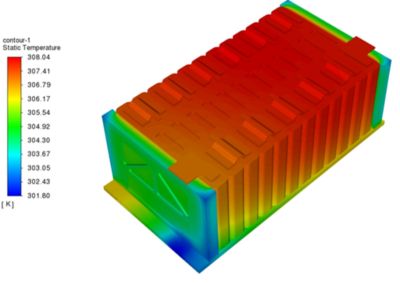
battery-thermal-mgmt-cfd.png

Consider all critical design goals, such as damage vibration, thermal runaway, and crash safety, simultaneously using Ansys multiphysics simulation to find the best possible structural design for a battery.

Optimize Battery Management System Quality and Verify Software-driven Behaviors

The battery management system (BMS) monitors and manages automotive batteries’ charging, energy storage, and daily operation. This sophisticated control center is a complex mix of hardware and software to track and manage performance, degradation, thermal cycling, and safety.

Because of the software’s role as part of a control system for all these battery behaviors, its failures and successes must be verified and validated as early in development as possible to provide insight and time to make holistic, impactful decisions.

Methods that are inherently separate systems provide little insight into how changes might impact behaviors, requirements satisfaction, and safety. Model-based approaches, however, help stakeholders understand the impact of iteration, exploration, and trade-offs between mechanical, electrical, and software engineers.

  • Automatically generate embedded code for BMS software reliability
  • Verify and validate software performance early in the design process
  • Maximize battery system safety and comply with a growing list of associated regulations
  • Systems integration across engineering domains
1355626476

Ansys solutions for model-based development, embedded software, and functional safety analysis enable BMS development for secure, safe, and efficient battery operation.

Battery Manufacturing

Major investments have been made between OEMs and battery suppliers worldwide to meet demands for battery cells as EV production in the automotive and commercial truck sectors grows.

Batteries’ rare materials and complex electrochemistry require unique processes, unusual infrastructure, and highly specialized equipment. Traditional approaches, including manual iteration using traditional methods, provide little insight into the veracity and scalability of proposed procedures. In contrast, simulation-based methods enable highly accurate, fast validation of options to inform process engineering, manufacturing infrastructure, and equipment design for reliable battery production with a high yield rate and lower costs.  

  • Avoid experimental trial and error and get first time right manufacturing process
  • Improve the battery quality and prevent defects
  • Optimize the manufacturing process and production equipment to reduce material waste resulting in cost savings
  • Predict failures and reduce downtime
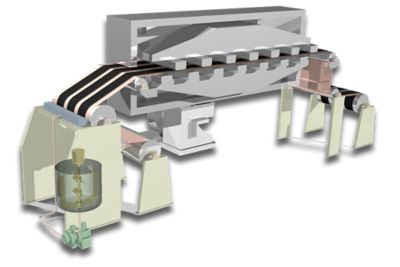
electrode-coating-unlabeled.png

Ansys simulation workflows help optimize manufacturing processes and determine optimal operating conditions, increasing yield, reducing manufacturing testing processes, and producing high-quality uniform electrode parts.