Synopsys and Ansys power the future of innovation—connecting silicon to systems.
-
-
Access Free Student Software
Ansys empowers the next generation of engineers
Students get free access to world-class simulation software.
-
Connect with Ansys Now!
Design your future
Connect with Ansys to explore how simulation can power your next breakthrough.
Free Trials
Products & Services
Learn
About
Back
Products & Services
Back
Learn
Ansys empowers the next generation of engineers
Students get free access to world-class simulation software.
Back
About
Design your future
Connect with Ansys to explore how simulation can power your next breakthrough.
Free Trials

Thousands of years ago, our ancestors listened to storytellers share tales of the Greek pantheon, the gods said to have authority over everything from the sky and thunder to love and beauty. These gods shaped the way people understood the world around them. And today, spacecraft carrying the names of these same gods are carving their way through the darkness surrounding Earth to change not only the way we view our world but our universe.
The first of these missions were part of the Apollo program, which ran from the 1960s through the 1970s and was named after Apollo, the Greek god of the Sun, music, dance, poetry, prophecy, and more. Perhaps Apollo alone could have foretold the great tragedies and accomplishments of the Apollo program, such as when Neil Armstrong and Edwin “Buzz” Aldrin became the first humans to walk across the face of the Moon on July 20, 1969, during the Apollo 11 mission.
Recreation of the Apollo 11 launch
The Artemis missions, which began in 2022, are named after Apollo’s twin sister, Artemis. Like her brother, Artemis is a multifaceted deity, the goddess of wild animals, the Moon, and the hunt, among other things. The Artemis program is similarly complex, with goals ranging from growing the lunar economy to advancing the scientific pursuits started with Apollo and inspiring the next generation.
While their namesakes are ancient, the Apollo and Artemis programs are anything but. These missions are not only expanding our knowledge of the universe — they’ve relied on and developed innovative technologies to launch us into a new era of lunar exploration.
Our First Steps Toward a New Era: The Apollo Missions
The six lunar landing missions and 11 crewed missions of the Apollo program yielded numerous historic and scientific triumphs.
Scientific achievements range from the crew of the Apollo 15 mission proving Galileo’s theory that objects in a vacuum fall at the same rate regardless of mass to the final Apollo mission, 17, culminating in not only the most extensive lunar exploration of the program but the collection of 243 pounds of lunar materials. Through the research conducted by these missions, we’ve made exciting discoveries, including that the Moon is an evolved rocky body, not a primordial object, and that there is abundant hydrogen from the Sun contained in lunar regolith (the Moon’s soil).
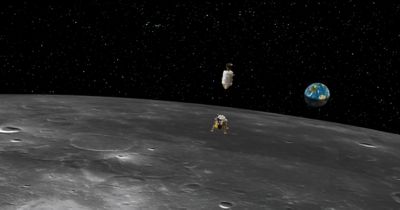
Apollo 11 visualization
Apollo didn’t just let us learn more about the Moon either — we also gained critical insight about Earth itself. Pictures of Earth taken from the Apollo 7 and 8 missions, for instance, helped inspire a worldwide change in our relationship with the environment and highlighted issues, such as diseased crops, from a new perspective. This knowledge led to NASA’s Landsat program, which observes Earth’s resources from space.
Another key triumph of Apollo was helping pave the way for the Artemis program.
Setting the Celestial Stage for the New Space Economy With Artemis
It wasn’t until the following century that Apollo’s twin, the Artemis program, left our planet. The Artemis program is more than a continuation of the Apollo program; it's an evolution with broad long-term goals, including building sustained infrastructure on the Moon (such as a lunar base), advancing scientific discovery, using previously unexplored orbital options, and working toward sending astronauts to Mars.
The Artemis program will make history in other ways, too. It will see the first woman and person of color set foot on the Moon and relies on worldwide commercial and governmental cooperation, such as through the Artemis Accords.
Through the Artemis program, NASA also hopes to aid the growing lunar economy. As Kathryn Flood, senior manager of application engineering at Ansys, part of Synopsys, puts it, the Artemis program is functioning as a truly “multinational experience,” involving contributions from organizations around the world. These collaborations show that we will take the next steps toward a lunar economy together as a global community.
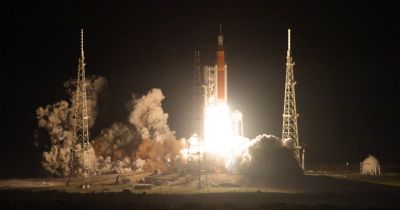
Artemis I launching. Image credit: NASA/Joel Kowsky.
Achieving these goals is a work in progress, which began when the Artemis I mission launched Nov. 16, 2022. This uncrewed mission enabled NASA to test its deep space exploration systems, including the Orion spacecraft — which will be used to carry astronauts in future missions — and the Space Launch System (SLS) rocket with NASA’s current ground systems.
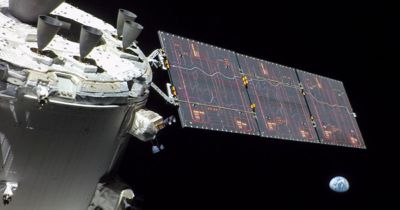
Orion on orbit during the Artemis I mission. Image credit: NASA.
The next mission, Artemis II, is coming up soon. Scheduled for early 2026, Artemis II will be a 10-day crewed mission around the Moon. This will be the next step toward enabling a long-term lunar presence and, eventually, Mars missions.
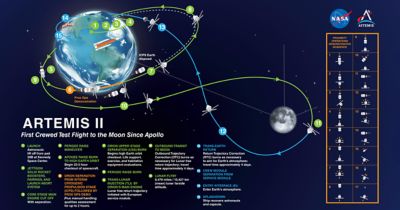
The flight map for the Artemis II mission. Image credit: NASA, public domain, via Wikimedia Commons.
NASA expects Artemis III to launch the year after Artemis II. While originally intended as a lunar landing mission, Artemis III will now focus on testing key technologies in LEO that will eventually enable humans to explore the lunar South Pole region. Artemis IV is expected to build upon previous missions and take astronauts to the lunar surface.
Looking ahead, upcoming Artemis missions may also involve constructing the first lunar space station and other foundational systems that we’ll need for long-term lunar exploration throughout the entire Artemis campaign. These technologies and structures include a Lunar Gateway (a small space station to be assembled and operated in lunar orbit, serving as a waystation for astronauts traveling to the Moon and beyond, as well as for research and communications) and advanced versions of previously used technologies.
Exploring Technological Innovations Powering Space Exploration
Before missions like Apollo and Artemis can change our understanding of the universe and make their mark on history, they must first be designed, developed, and deployed with the highest possible level of care.
To achieve this, innovators can turn to the solutions that Synopsys has to offer, which can aid all aspects of these missions, from development to launch and beyond. “One of the most exciting parts about working here is that because we have such a broad and deep portfolio of tools, we can work with you at every step for every piece of the mission,” says Flood.
As an example, let’s take a closer look at mission planning and operations. Here, engineers can use Ansys Systems Tool Kit (STK) digital mission engineering software and Ansys Orbit Determination Tool Kit (ODTK) orbit measurement processing software, for everything from initial mission planning, orbit determination, SLS communication link analysis, flight trajectory visualizations, and antenna radiation pattern analysis to real-time operations and launch clearance. Engineers can also better ensure safety and success with hardware in the loop (HiL) simulations and advanced design reference missions (DRMs), which have been relied on since the early Apollo missions.
Simulating a comparison of the Artemis II and Apollo trajectories
In regard to the Artemis program, some the ways that Synopsys solutions can aid engineers is by helping them design and develop the SLS, Orion, and other key technologies by using:
- Ansys Thermal Desktop thermal-centric modeling software to ensure that the correct temperature range is maintained during the mission
- Ansys Fluent fluid simulation software to model aspects, such as engine fuel, or perform reentry fluid analyses for the Orion crew
- Ansys Mechanical structural finite element analysis software to study vibrations, such as during launch
- Synopsys services, including Synopsys Technology Computer-Aided Design (TCAD), to create rad-tolerant, safe, and secure designs for the harsh space environment, such as for vital on-board electronics and communications packages.
- Ansys HFSS high-frequency electromagnetic simulation software and Ansys Optics solutions, such as Zemax OpticStudio optical system design and analysis software, to also help in the design and development of communications and sensor systems
- Communications and dependable electronic sensors — all of which involve chips — which are imperative to the success of these missions
- Ansys EMC Plus electromagnetic interface and compatibility simulation software, the Ansys STK Shield Plus capability, and Ansys Sherlock electronics reliability prediction software to perform electromagnetic (EM) assessments, mitigate EM risks, design electronic hardware, and more
- The Ansys SCADE embedded software product collection to ensure the safety and reliability of embedded software
- Thermal Desktop, Fluent software, the Ansys Hans Human Body Model, and Synopsys products to develop and optimize the crew’s spacesuits and their embedded chips and electronics
Artemis I passing through perilune, traversing a construction of its trajectory produced in Ansys Systems Tool Kit (STK) digital mission engineering software’s Astrogator capability. Along the way, the Lunar Reconnaissance Orbiter and the Korea Pathfinder Lunar Orbiter are observed keeping vigil about the Moon.
Then, after the mission is over, Synopsys solutions can still provide insights and help. Take physical and digital twins, for example. Using a physical twin model, NASA was able to simulate and evaluate the oxygen tank explosion on Apollo 13. Today, Synopsys offers technologies that aid in the creation and use of digital twin tools and analyses, such as the Ansys Twin Builder simulation-based digital twin platform and Ansys TwinAI AI-powered digital twin software.
Throughout unbelievably complex programs like Apollo and Artemis, there seems to be no limit to the applications of Synopsys solutions. “The thing about our technology is that we know that you get one shot at this, and if something goes wrong, there are lives on the line,” says Flood. “Our software has to be right, and we know the importance of making sure that every single aspect of our software is going to be technically accurate because it is critically important to the people using our software and designing these systems that they get it right. … We’re there with you every day to make sure that things do go well every time.”
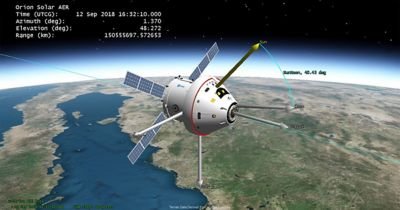
Simulating Orion with STK software
Facing the Dark Depths of Space and Finding Hope
From making history and changing how we view the universe to turning science fiction into reality and inspiring generations, the Apollo and Artemis programs have had — and will continue to have — a profoundly positive impact on all of humanity.
By enabling us to return to the Moon — and beyond — the Artemis program is helping us “get back to being a world of explorers who are exploring not only our world but the cosmos,” says Flood. “We're a people of exploration. That's what we do as humans. … It's about getting back to exploring and getting to understand our universe and our place in it with senses that robots can't provide.”
These missions can be aided by dynamic solutions from Synopsys, which enable space innovators to overcome challenges and achieve their star-studded goals.
See how simulation is reshaping the future of innovation in the space industry and more.
Disclaimer: NASA was not involved in the creation of this article and did not endorse the use of images in this article.

Just for you. We have some additional resources you may enjoy.
“We're a people of exploration. That's what we do as humans. … It's about getting back to exploring and getting to understand our universe and our place in it with senses that robots can't provide.”
— Kathryn Flood, senior manager of application engineering at Ansys, part of Synopsys,


The Advantage Blog
The Ansys Advantage blog, featuring contributions from Ansys and other technology experts, keeps you updated on how Ansys simulation is powering innovation that drives human advancement.