Synopsys and Ansys power the future of innovation—connecting silicon to systems.
-
-
学生向け無料ソフトウェアにアクセス
Ansysは次世代の技術者を支援します
学生は、世界クラスのシミュレーションソフトウェアに無料でアクセスできます。
-
今すぐAnsysに接続!
未来をデザインする
Ansysに接続して、シミュレーションが次のブレークスルーにどのように貢献できるかを確認してください。
無料トライアル
製品およびサービス
リソースとトレーニング
当社について
Back
製品およびサービス

Think back to a time when you tried to assemble furniture without reading the instructions. The picture on the box probably made it look easy — until you realized you’d installed the legs upside down. Learning engineering theory can feel the same way. It may make sense on paper, but things get tricky when you try to put it all together.
This is where simulation steps in. It lets students test, tweak, and learn from their mistakes in a virtual space — no spare parts, no broken bolts, and no panic-inducing Google searches required.
Around the world, universities are leading initiatives to enhance teaching with advanced digital tools, including simulation, to better prepare students for modern engineering practice. As part of an ongoing mission to support the teaching of engineering, science, and design, the Ansys Academic Program developed the Ansys Funded Curriculum program to support strategic ways of teaching with Ansys, part of Synopsys, tools.
Introducing the Ansys Funded Curriculum Program
Created in 2023, the program invites educators from accredited educational institutions to submit proposals for funding the creation of innovative and strategic curricula or redesigning existing courses in undergraduate engineering departments that utilize Ansys simulation tools. With support from the Ansys Academic Program, selected institutions are granted funds to develop curricula, strengthen tutorials that directly tie to industry, ultimately enhancing the skillset and experience students graduate with.
Since the program’s inception, there have been multiple successful open calls for Funded Curriculum proposals. This initiative not only enhances educational experiences but also fosters collaboration between universities and Ansys, helping bridge the gap between classroom learning and real-world application.
Integrating Ansys Simulation at the University of Strathclyde
The University of Strathclyde has a long history of using Ansys software in both teaching and research, dating back to the early 1980s.
“Building on this legacy, I saw an opportunity to further strengthen our curriculum by integrating simulation earlier in the undergraduate journey,” says Dr. Bilal Ahmad, a teaching associate in the Mechanical Engineering department at the University of Strathclyde in Bahrain. “When the Ansys Funded Curriculum Program was announced, it aligned perfectly with our ambition to embed professional-level tools into years one to three, helping students make a stronger connection between theoretical learning and its application.”
Ahmad’s own experience with Ansys tools spans structural analysis, computational fluid dynamics (CFD), and materials selection.
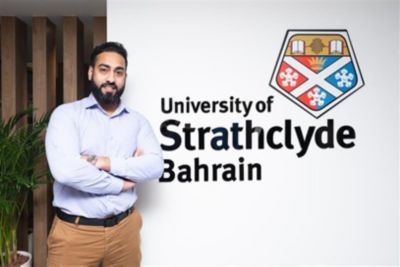
Dr. Bilal Ahmad, University of Strathclyde
Throughout the Ansys Funded Curriculum submission process, Ahmad and his colleague, Dr. Emma Henderson, worked to identify gaps in which simulation could enrich the student learning experience. Once they mapped out how specific Ansys tools would fit into key modules across their curriculum, they focused on presenting the rationale for introducing simulation early to engineering students and the plan for rolling out the courses upon receiving funding.
This integration was carefully planned to ensure students could apply these tools to solve engineering problems that mirror real-world scenarios. By working with Ansys simulation tools such as the Ansys Workbench simulation integration platform, Ansys Fluent fluid simulation software, and Ansys Granta EduPack teaching software for materials education, engineering students can explore concepts such as stress analysis, thermal management, and fluid behavior in a hands-on manner, deepening their understanding of core mechanical engineering principles.
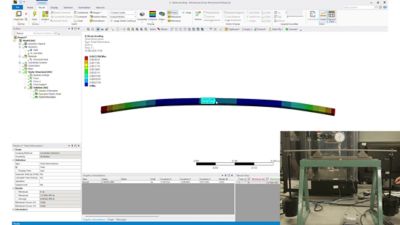
Visualization of numerical and experimental bending behavior in beams in Ansys Mechanical structural finite element analysis software
As part of the redesign, Ansys simulation tools are now introduced in the first year of the curriculum, which enables students to build practical simulation skills alongside theory and apply them effectively in later years.
“In many cases, we are among the first to introduce students to Ansys, particularly in the earlier years of study, where we have recently embedded simulation-based learning. Our role is to guide them through the fundamentals, from understanding the purpose of simulation to running their first analysis,” says Ahmad.
Application is Everything
In the university’s mechanical engineering department, simulation transforms theoretical knowledge into tangible learning experiences through several courses.
In the Engineering Mechanics 2 and Materials Engineering and Design courses for second-year students, beam deflection and stress distribution are among the featured topics. After covering theoretical equations, students then use Workbench software to model the beams with cross sections under different loading conditions. This hands-on approach enables them to visualize deformation patterns and directly compare analytical and simulated results.
In the third-year Engineering Analysis course, students use Fluent software to simulate fluid flow. The visual representation of fluid velocity and temperature gradients helps students better understand abstract concepts like convective heat transfer and vortex formation.
“One of the next steps we are exploring is to extend simulation-based learning into interdisciplinary projects that mirror real engineering scenarios — for example, combining structural, thermal, and materials analyses in integrated design tasks,” says Ahmad.
Using Simulation To Explore Civil and Environmental Engineering (CEE) Concepts
The civil and environmental engineering departments at the University of Strathclyde also recognized that incorporating Ansys tools would greatly strengthen their curriculum and support the overall goals of Strathclyde’s 2025 vision. “Our motivation stemmed from the desire to provide students with opportunities to simulate and analyze complex engineering systems, encouraging creativity, innovation, and employability,” says Maziar Moradi, Ph.D. student and Ansys course demonstrator in the civil engineering department.
The department’s final proposal focused on integrating Ansys tools into the curriculum to enhance students’ knowledge of advanced digital tools for teaching and learning in civil engineering modules, including soil mechanics, geotechnical engineering, and advanced structural analysis and sustainable design.
“Ansys provides powerful tools to simulate many real-world civil engineering problems. Familiarizing civil and environmental engineering students with these powerful tools is a guaranteed way of helping them to succeed in their future career by adding a demanding skill to their resume,” says Moradi.
The department aimed to provide students with practical experience in tackling real-world challenges within civil engineering through Ansys software. Across seven courses, several additional Ansys programs were incorporated to enhance learning, which included:
- Ansys Mechanical software
- Ansys Discovery 3D product simulation software, using SpaceClaim 3D CAD modeling software
- Ansys Granta EduPack teaching software for materials education
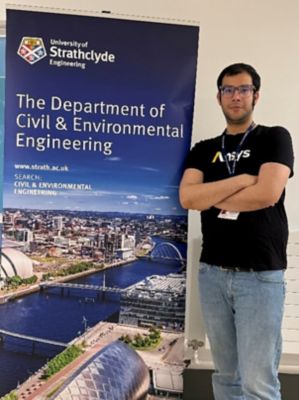
Maziar Moradi, doctoral student, CEE department
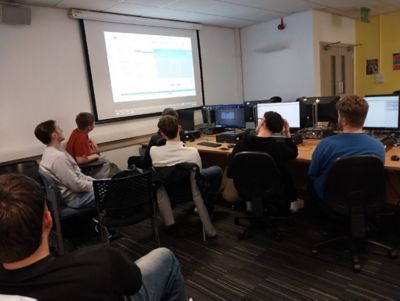
Undergraduate CEE students watching tutorial video of water flow modeling using Ansys, part of Synopsys tools
With Ansys simulation solutions, students gain hands-on opportunities to analyze structural integrity, fluid dynamics, and material performance, enabling them to connect theoretical knowledge with practical application. For example, students use Mechanical software to evaluate the behavior of structures under different loads and conditions. This includes tasks such as simulating stress distribution in building components or analyzing how materials respond to environmental forces.
Additionally, Fluent software enables students to examine fluid flow scenarios, such as water distribution systems or the impact of wind forces on infrastructure. Granta EduPack software complements this by offering material selection and sustainability analysis, ensuring students understand how to make design decisions that consider environmental factors.
From Beginners to Simulation Experts
The introduction of Ansys software has also created opportunities for interdisciplinary projects within the department, as students can apply their simulation skills to a broad range of civil engineering applications. “While this is our undergraduate students’ first-ever experience using a finite element package to simulate their theoretical studies, this new experience has been both exciting and challenging for them,” says Moradi.
Civil engineering department faculty completed a case study that proved that this hands-on approach improves student engagement, with many students expressing greater confidence in their ability to tackle complex engineering problems. Seventy-five percent of students surveyed in the civil engineering department stated that they believe that Ansys software will be useful in their future careers.
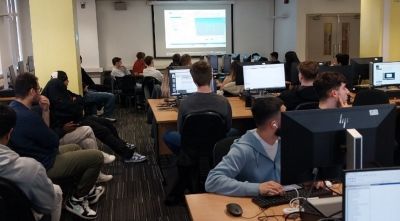
Undergraduate CEE students listening to the lecture of Water Flow modeling using Ansys, part of Synopsys tools
Thanks to the Ansys Funded Curriculum Program, the introduction of Ansys software into the University of Strathclyde’s engineering curriculum has created a more dynamic and practical learning environment for students across departments.
From a teaching perspective, access to simulation tools enables instructors to create more engaging and effective coursework, ensuring that students not only master the theoretical aspects of engineering but also understand how to apply them in professional settings.
This collaboration has also extended to developing partner-led Ansys Education Resources tailored for educators to supplement their lessons with. While the civil engineering department has already published several resources on water flow through soil, strip footing, and slope stability, ongoing efforts from the mechanical engineering department are expanding access to valuable learning materials.
Future Prospects for the Next Generation of Engineers
The University of Strathclyde team credits the Ansys Academic Program and funded curriculum opportunity for paving the way for innovative learning experiences that blend theory with practical application.
“By bringing these tools into the classroom early, we can bridge the gap between conceptual understanding and applied engineering practice,” says Ahmad.
Looking ahead, advanced simulation tools are paving the way for more interdisciplinary projects and hands-on learning across engineering fields. By encouraging students to experiment, analyze, and solve real-world problems, the University of Strathclyde is preparing them for professional success while also setting an example for other institutions to follow.
More than 15,000 students learn Ansys every year as a result of the Funded Curriculum Program; Ansys is now accepting proposals for the 2026-2027 academic year. Visit the Ansys Funded Curriculum page for more information.

Just for you. We have some additional resources you may enjoy.
“Ansys provides powerful tools to simulate many real-world civil engineering problems. Familiarizing civil and environmental engineering students with these powerful tools is a guaranteed way of helping them to succeed in their future career by adding a demanding skill to their resume.”
— Maziar Moradi, Ph.D. Student at CEE Department

The Advantage Blog
The Ansys Advantage blog, featuring contributions from Ansys and other technology experts, keeps you updated on how Ansys simulation is powering innovation that drives human advancement.