Synopsys and Ansys power the future of innovation—connecting silicon to systems.
-
-
Access Free Student Software
Ansys empowers the next generation of engineers
Students get free access to world-class simulation software.
-
Connect with Ansys Now!
Design your future
Connect with Ansys to explore how simulation can power your next breakthrough.
Free Trials
Products & Services
Learn
About
Back
Products & Services
Back
Learn
Ansys empowers the next generation of engineers
Students get free access to world-class simulation software.
Back
About
Design your future
Connect with Ansys to explore how simulation can power your next breakthrough.
Free Trials

What if you had a role where you were responsible for delivering AI-powered tech stacks to the International Space Station (ISS), advancing quantum computing technology, or enabling AI robot development?
Booz Allen Hamilton is advancing technology that builds a broad range of mission and technical capabilities for the government and commercial sector, with leadership from the company’s thousands of engineers. These projects run the gamut — from building quantum computers to operating GPS satellites and 3D printing organs for experiments, just to name a few.
Recently, we had the opportunity to talk with Bill Vass, Booz Allen’s chief technology officer, about his work focused on innovation and emerging technologies; how Ansys, part of Synopsys, is supporting it; and how NVIDIA Omniverse libraries integrated in Ansys tools create a Digital Proving Ground (DPG) for testing security concepts.
How rare is it that a company like Booz Allen can be over 100 years old and able to successfully pivot in reaction to the business climate?
Vass: Booz Allen is 111 years old, and in that time we’ve often pivoted to strengthen our business. In 2008, with a shift away from commercial operations, we started to transition from being a business consulting company to being an advanced technology company.
At that point, we switched primarily to engineering and integrating hardware and software systems for our customer base. And since then, we’ve built a record of being first to the future and creating mission solutions with the most advanced technology. We also collaborate with NVIDIA, Amazon Web Services (AWS), Ansys, and the government, among many others. This gives us a unique view and allows us to anticipate where technology is going and move there often before our customers do.
Can you share some of your recent work in artificial intelligence (AI)?
Vass: There are a lot of new technologies that I’m focused on right now at Booz Allen. We have about 3,000 AI practitioners where we are extending practical deployments of new agentic architectures and large language models.
We were the first company to put a large language model in space (an AI-powered tech stack, powered by NVIDIA AI infrastructure, to support work on the International Space Station Lab). We took the Space Llama (tech stack) model from Meta, put it in space, and it’s running at the edge in space for low-latency processing.
We’re doing significant work with autonomous systems, including aircraft and fully autonomous trucks. In motorsports specifically, we’re using reinforcement learning to develop racing behaviors in highly accurate simulations. We’re using NVIDIA Isaac Sim, an open-source reference framework for robot simulation, to build open-world models for dynamic physical AI testing, with Ansys providing the simulation accuracy.
We’re also developing an AI-native radio access network stack on NVIDIA technology that hosts edge AI applications. Beyond that, we’re working on quantum sensing, networks, and computing. And we built AI agents that automate most phases of the software development life cycle.
What are the biggest security threats you want to help your customers tackle?
Vass: The largest security threats today are broad-ranging. We have about 8,600 cybersecurity professionals at Booz Allen. It’s one of the core technologies we focus on. Nation-state risks are occurring in corporate America and the government, and we focus on improvements there.
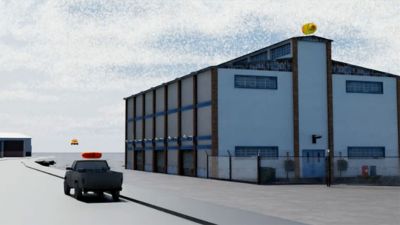
A vehicle and drone dispatched to jam a signal modeled in the Digital Proving Ground (DPG) powered by Ansys Perceive EM software and NVIDIA LiDAR Modeler software
We do extensive risk detection and adversarial AI work for the government. Our experience includes AI-driven threat analysis and protection strategies, which strengthens our ability to anticipate and protect against a full spectrum of threat methodologies.
In addition, many organizations haven't yet embraced the post-quantum cryptographic algorithms they need to adopt today to protect against "harvest now, decrypt later" (HNDL) attacks using future quantum computers.
Could you explain why Booz Allen is uniquely positioned with Ansys to address these threats?
Vass: At Booz Allen, we do a lot of engineering, and we’re collaborating with Ansys in many ways. We design and manufacture electronic hardware, and we work with Ansys for heat dissipation and electromagnetic field operations simulation, and for structural engineering. So a lot of bespoke hardware is involved.
We work on many projects involving electromagnetic and radio frequency work. We're helping lead development of AI-based radio access networks (AI-RANs), the new AI technology for managing cellphone tower signals and enabling new edge applications. We work with multi-antenna systems, and Ansys supports our antenna design and jamming systems, which are tools that enable defense strategies by disrupting communications, radar, or sensing systems.
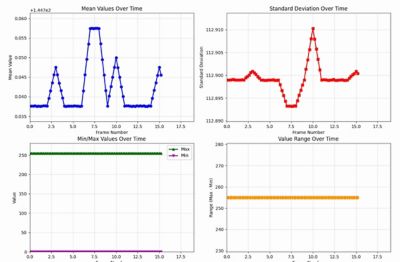

Pictured left is jammer data captured and used to test accuracy against real-world models. Right: simulation of a vehicle jammer disrupting and blocking a signal modeled in the DPG powered by Perceive EM software.
Let’s pivot a bit. Can you talk about the DPG, the virtual test bed used to simulate disruptions at critical maritime logistics hubs?
Vass: The Digital Proving Ground covers port security and other areas, and we are working on simulation of the ocean floor for the government as well. So when we need the real physics capabilities, we integrate Ansys into the simulations. NVIDIA Omniverse libraries provide the real physics simulation of those environments.
Sounds like a big ask. What sorts of physics capabilities are involved?
Vass: A lot. If you’re doing an ocean floor to space, say, a digital battleground simulation, you have all of the physics to deal with of being under the sea. You’ve got pressure. The acoustics also operate totally differently underwater. You have the density changes of the flow of fluid in the water and computational fluid dynamics.
Then when you get to the surface vehicles, now you’re dealing with a combination of the way water operates on the surface and the air together, along with wave action. And that affects the electromagnetic spectrum. There is the evaporative duct layer, for example, along the surface of the ocean that — depending upon the temperature and the activity of the waves — will get larger or smaller. You can transmit electromagnetic frequencies along it.
Being able to model those things is important, as that affects a combination of antennas that are communicating to aerial drones, which have their own set of antennas. And then you're talking about all of the aerodynamic stresses related to that, and how the propellers work, and trying to extend the range of a drone. It’s an amazing array of physics to make an accurate simulation.
What is the reason behind bringing Ansys solutions and integrating Omniverse to accelerate insights in the DPG?
Vass: Booz Allen has worked with NVIDIA for a long time, and we are working in physical AI with Omniverse. When you're doing autonomous training of a drone, surface vehicle, or satellite, you need to ensure the real-world physics are there to enable it. Omniverse has ways to implement different physics algorithms. Ansys has the physics algorithms. And that’s where we are. We actually apply the real-world physics inside this simulation.
It would be great to have a real-world example of your work with Omniverse libraries.
Vass: Imagine you’re training a drone to fly between buildings. That’s very challenging because the airflow between the buildings is going to change based on the wind. Sometimes it could overcome the drone entirely. On a windy day, you have the drone itself, airflow, the types of propellers on it, physics, acceleration, and navigation. It has to learn to do that in many repeated scenarios in simulation, using its suite of integrated sensors.

A truck equipped with a Global Navigation Satellite System (GNSS) jammer, drone lidar, and camera modeled in the DPG powered by Ansys Perceive EM software and NVIDIA LiDAR Modeler software
It might have radar and lidar, or it might just have cameras and GPS as it’s flying. You want to train the model that’s going to be put on that drone in an environment where the simulation includes not just the visual stuff that’ll go into the camera but all of the different components. This could include the radio frequency changing on its communication as it goes between buildings where there’s interference, the airflow between buildings, or weather, such as rain.
All of these things can be simulated, which makes the model much more capable to adapt to those environments when it actually flies in the real world.
What other challenges would you like to solve with our joint tech outside of DPG?
Vass: What I think we’ll be doing with Ansys is work around agentic architectures. You’re going to see the integration of AI from end to end in engineering design cycles, where it’s a collaborative effort between tech companies to offer innovative solutions faster to customers.
Learn More
We want to thank Vass for the one-on-one interview at Simulation World in Detroit. But that’s not all. He also participated in an executive panel during the event.

Just for you. We have some additional resources you may enjoy.
“The Digital Proving Ground covers port security and other areas, and we are working on simulation of the ocean floor for the government as well. So when we need the real physics capabilities, we integrate Ansys into the simulations.”
— Bill Vass, chief technology officer, Booz Allen



The Advantage Blog
The Ansys Advantage blog, featuring contributions from Ansys and other technology experts, keeps you updated on how Ansys simulation is powering innovation that drives human advancement.