Synopsys and Ansys power the future of innovation—connecting silicon to systems.
-
-
Access Free Student Software
Ansys empowers the next generation of engineers
Students get free access to world-class simulation software.
-
Connect with Ansys Now!
Design your future
Connect with Ansys to explore how simulation can power your next breakthrough.
Free Trials
Products & Services
Learn
About
Back
Products & Services
Back
Learn
Ansys empowers the next generation of engineers
Students get free access to world-class simulation software.
Back
About
Design your future
Connect with Ansys to explore how simulation can power your next breakthrough.
Free Trials
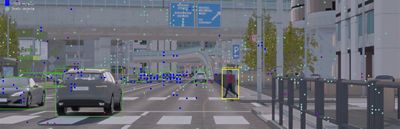
Autonomous vehicle (AV) development is inherently complex because testing and demonstrating the safety of such systems is a massive undertaking.
In the past few years, simulation was used to test individual aspects of a system. But now, as AV systems are growing in complexity and Operational Design Domains (ODD) are expanding, simulation’s role in safety testing has exponentially increased to accommodate this shift.
Today, success in AV development is not only found in the use of isolated simulation tools, but during interactions among physically grounded, sensor-aware digital twins (virtual representations of physical objects, systems, or processes that use real-time data to simulate their behavior and performance throughout an entire life cycle) connected to a sensor pipeline.
To this end, the integration of the NVIDIA Omniverse collection of libraries and NVIDIA NIM microservices for developing physical artificial intelligence (AI)-powered applications into Ansys’ 2026 R1 AVxcelerate Sensors simulation software is driving a new, innovative approach to AV development that connects both real and virtual interactions via digital twins in a single development workflow.
Closing the Loop Between the Real and the Virtual
A network of robust vehicle systems serves as the underpinning of autonomous functions. Their interoperability must be considered in a host of conditions impacted by varying lighting, weather, and other environmental factors.
The AVxcelerate Sensors Omniverse integration connects both the physical and digital worlds in one unified workflow through the use of digital twins.
Thanks to the Omniverse ecosystem, engineers can work within the confines of the workflow to digitally reconstruct driving environments, then run high-fidelity sensor simulations using advanced, physics-based models.
“By combining AVxcelerate Sensors and Omniverse, we’re basically closing the loop between what is real and what is virtual,” says Emmanuel Follin, senior manager, product management at Ansys, part of Synopsys. “We can capture reality, reconstruct it digitally, simulate sensors with physics in this reality, and in the end, scale variation for more robust validation. This creates a continuous pipeline from road to silicon.”
It’s a unique approach that gives engineers the freedom to create virtual scenarios that replicate complex, real-world conditions. The solution leverages the capabilities of both Ansys and NVIDIA products with scalable variations of the driving environment to support a range of testing scenarios. This coupling of physical accuracy with digital scalability helps lay the groundwork for a more efficient, reliable AV system development methodology.
Preparing for a Digital World in the Omniverse
Several changes to 2026 R1 AVxcelerate Sensors software are transforming how digitally reconstructed environments are prepared in Omniverse. They take what is an otherwise fragmented process of moving from simulation-ready environment creation to a more cohesive pipeline from road to silicon, leading to faster, more reliable virtual validations.
“Physically reliable simulations require editing and enriching the reconstructed environment,” says Lionel Bennes, senior manager, product management at Ansys, part of Synopsys. “It means the import of extracted scenes into Omniverse, geometry and semantics refinement, the application of multiphysics, and the confirmation that assets are simulation-ready for AVxcelerate software.”
2026 R1 AVxcelerate Sensors software streamlines the process in the integration of Omniverse into the overall workflow through the introduction of several key features:
- The ability to import and enhance extracted, real-world scenes. Once imported, engineers can refine geometry, adjust semantic details, and apply Ansys multiphysics material (multispectral for optics, electromagnetic, and thermal). This ensures that assets replicate real-world physical properties and are optimized for sensor simulations.
- An intuitive, graphics processing unit (GPU)-native workflow to streamline environment creation. Engineers gain access to tools that can facilitate the rapid construction of large-scale three-dimensional geospatial environments and direct support of content libraries like Cesium or TurboSquid, for example, for instant access to pre-built, high-quality Sim-Ready USD assets.
- Omnigraph and randomization tools such as Replication in Omniverse allow for controlled variations. Now it is possible to introduce diversity into datasets without having to manually re-position assets. A more streamlined approach to sensor-aware digital twin construction reduces the manual effort required for environment preparation.
- An emphasis on asset scalability and reusability. The ability to use the same environments across multiple scenarios supports efficient generation of robust, diverse validation datasets. A greater focus on automation and consistency saves time and improves the fidelity of simulation inputs.
Ultimately, the outcome of these improvements is the ability to build physically grounded, sensor-aware digital twins necessary to support advanced AV development.
What AVxcelerate Software Does Best: Physics-Based Synthetic Sensor Generation
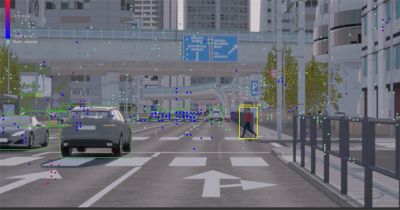
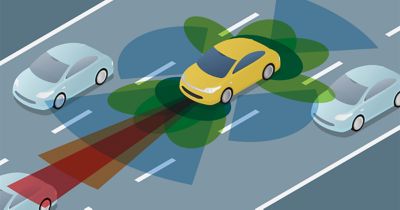
Sensors, whether cameras, radars, thermal cameras or lidars are crucial to AV function. They deliver the data informing vehicle perception systems. AVxcelerate Sensors software provides the GPU-native physically accurate sensor simulation needed for putting vehicle sensor perception to the test in a virtual environment. In the end, this intelligence gathering feeds more reliable AV system design.
“The Omniverse integration builds on AVxcelerate Sensors’ physics-based synthetic sensor generation capabilities to achieve high-fidelity perception inputs without new road testing,” says Bennes.
The following AVxcelerate Sensors features are integral to integration success:
- A light propagation engine that models true light behavior to produce multispectral camera sensing (a technology that captures light across the electromagnetic spectrum). Recording these interactions under a variety of lighting and weather conditions, such as glare, reflections, and light scattering, results in realistic image data that can be used to replicate challenges faced in a variety of real-world scenarios.
- Physics-based radar modeling enhances radar simulation realism by accurately replicating signal propagation and interactions with surrounding objects. It enables the precise emulation of radar behavior, further contextualizing it in terms of material properties, surface angles, environmental conditions, and other factors. Engineers can capture and optimize sensor performance across a range of situations, including rare edge cases.
- A sensor simulation process in AVxcelerate Sensors software delivers a robust way of generating high-quality sensor data. The software can be used to simulate cameras, radar, and other perception devices with physics-driven accuracy. And it ensures that the inputs used for development and validation closely align with the real world, enabling engineers to anticipate and resolve potential challenges earlier in the design process while avoiding a simulation-to-reality gap.
Scaling AV Development With Ansys
The integration of the AVxcelerate Sensors-Omniverse pipeline into existing AV development workflows promises to fundamentally change the way AV systems are designed, tested, and validated, further reducing reliance on physical prototypes and road testing while streamlining development cycles. Engineers can rely on the consistency of high-fidelity simulation inputs to validate perception algorithms, optimize sensor configurations, and ensure the overall reliability of autonomous systems with confidence.
“A newfound ability to simulate realistic environments and sensor behaviors with even greater precision enables thorough evaluation of edge cases and complex scenarios that would otherwise be difficult to recreate,” concludes Follin. “This leaves teams to the business of refining autonomous systems much earlier in the process.”
Interested in shifting toward a more realistic, efficient simulation framework with the ability to tackle the increasing complexity of AV technologies with greater speed and precision?
Synopsys is a gold sponsor of NVIDIA GTC, where the world’s leading engineers, developers, and innovators gather to explore the future of AI and accelerated computing. Be sure to visit us at booth 1135.
To learn more about AVxcelerate software, watch the webinar Ansys 2026 R1: Ansys Autonomous Vehicle Simulation What’s New.

Just for you. We have some additional resources you may enjoy.
Watch the Webinar
To learn more about AVxcelerate software, watch the webinar Ansys 2026 R1: Ansys Autonomous Vehicle Simulation What’s New.

The Advantage Blog
The Ansys Advantage blog, featuring contributions from Ansys and other technology experts, keeps you updated on how Ansys simulation is powering innovation that drives human advancement.