Synopsys and Ansys power the future of innovation—connecting silicon to systems.
-
-
Access Free Student Software
Ansys empowers the next generation of engineers
Students get free access to world-class simulation software.
-
Connect with Ansys Now!
Design your future
Connect with Ansys to explore how simulation can power your next breakthrough.
Free Trials
Products & Services
Learn
About
Back
Products & Services
Back
Learn
Ansys empowers the next generation of engineers
Students get free access to world-class simulation software.
Back
About
Design your future
Connect with Ansys to explore how simulation can power your next breakthrough.
Free Trials

Fusion energy represents a transformative opportunity to address global energy demands with a cleaner, virtually limitless power source. Among the technologies developed to achieve this, stellarators have gained attention for their high efficiency in confining plasma, the hot, charged gas necessary for fusion. Stellarators are one form of well-studied magnetic confinement fusion technology, meaning they use an intricate magnetic field system to contain and stabilize plasma, creating an environment conducive to sustained fusion.
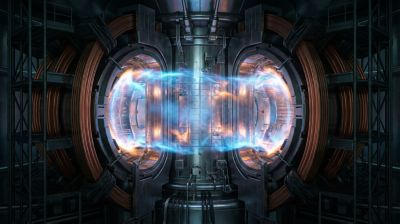
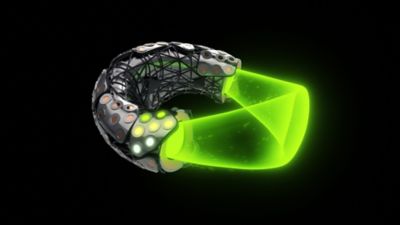
A rendering of a tokomak (left) compared to Thea Energy’s stellarator (right)
For decades, however, the intricate, twisted coils required for stellarators posed significant manufacturing and operational challenges. Early efforts to build stellarators were constrained by the complexity and precision needed for assembly, leading to delays and high costs. Today, advancements in both engineering and computational methods are transforming how these magnetic systems are designed and implemented. The ability to streamline and refine stellarator construction is not only advancing their technical viability but also expanding their potential as a reliable pathway to practical fusion energy.
Compared to prior generations of the stellarator, Thea Energy is focused on using simpler, programmable, and flat magnets to reinvent this system. Thea Energy is applying engineering ingenuity to simplify the construction and operation of the stellarator, while leveraging its bedrock scientific basis. With deep roots in fusion research and design, the team — led by CEO and co-founder Brian Berzin and CTO and co-founder David Gates Ph.D. — integrates decades of fusion experience with modern computational tools to push the boundaries of what is possible in energy development.
To help advance this technology more quickly, Thea Energy is collaborating with NVIDIA, Ansys, part of Synopsys, Argonne National Laboratory (ANL), and Princeton Plasma Physics Laboratory (PPPL) to build the first digital twin of their “Helios” stellarator power plant. This work aligns well to the U.S. Department of Energy’s Genesis Mission which is focused on leveraging artificial intelligence (AI) to fast-track scientific advancement with a core priority of accelerating the development of baseload fusion power.
Helios will create power on-the-grid using Thea Energy’s simplified magnet architecture. A Helios preconceptual design milestone was formally certified by the U.S. Department of Energy (DOE) as part of the Milestone-Based Fusion Development Program. Thea Energy was the first company in the program to receive certification of its power plant design milestone. Helios is a scaled-up version of “Eos,” Thea Energy’s first large-scale integrated stellarator system which is scheduled to be online by 2030.
“With this collaboration, we are expanding our AI applications to include multifaceted device modeling at the click of a button. With the Helios digital twin, we can shorten development cycles and essentially run the system before we even put a shovel in the ground,” says Gates.
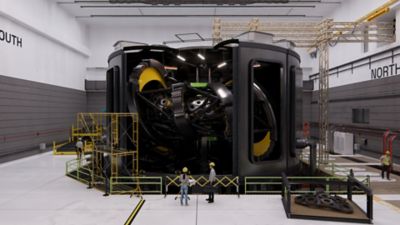
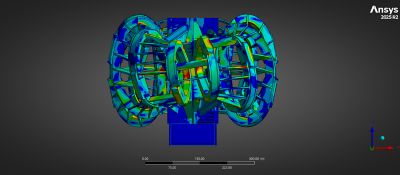
Rendering of the Eos integrated stellarator facility (left) and Thea Energy's stellarator structural architecture analyzed in Ansys Mechanical software (right). The stress fringe plot highlights critical load paths, guiding component sizing and structural optimization.
Magnetic Merry-go-Round
Modern advancements in magnetic confinement have reshaped the possibilities for stellarator design. Traditional approaches required intricate and highly complex coil geometries to generate the twisted magnetic fields necessary for plasma containment. These designs, while effective in theory, proved difficult to manufacture and assemble.
“We’re not inventing new physics, we’re inventing new engineering approaches to the same problem,” says Gates. “And simulation is a fundamental change in the field.”
Thea Energy’s stellarator simplifies this process by splitting the magnetic field generation between two distinct types of planar coils: encircling coils and shaping coils. Encircling coils are responsible for creating the primary field along the length of the toroidal plasma, while shaping coils fine-tune the field around its cross-section. Unlike the wiggly and irregular shapes of traditional coils, both coil types are flat or feature constant curvature, making them far easier to fabricate.
The team uses Ansys Maxwell advanced electromagnetic field solver, accessed through Apex Channel Partner Rand SIM, to simulate the magnetic fields of the coil systems then transfers them to Ansys Mechanical structural simulation software to understand and optimize the mechanical load on the magnets.
“Ansys is great for large-scale, multi-fidelity models,” says Gates. “We routinely do two-dimensional approximations in fractions of a millisecond.”
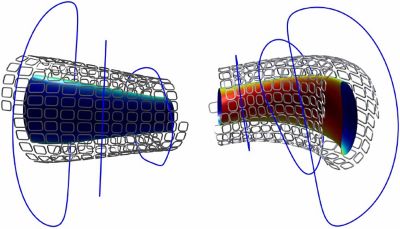
A half field period of encircling coils are plotted (blue) along with shaping coils (gray) and a target plasma boundary.
Cool It
High temperature superconductors (HTS) are transforming the capabilities of fusion technology by enabling the construction of more efficient and compact magnetic systems.
“These superconductors operate at around 20 degrees above absolute zero. For context, most superconductors operate at four degrees above absolute zero,” explains Gates. “And they’re incredibly thin, only 4 millimeters wide and 100 microns thick. So, we essentially put the amount of current it takes to power your house into a human hair.”
HTS also improves the durability of the magnets, as the reduced thermal strain during cooling minimizes mechanical stresses. Additionally, the higher operating temperatures simplify cryogenic systems, enabling more practical, energy saving, and cost-effective solutions for cooling. The team uses Ansys Icepak electronics cooling simulation software and Mechanical software to simulate the thermal and mechanical loads of the superconductors and magnets.
“When you cool everything down, it shrinks pretty considerably,” says Gates. “We need to know where they are when we start and when we end so they aren’t damaged under the enormous loads from the thermal changes.”
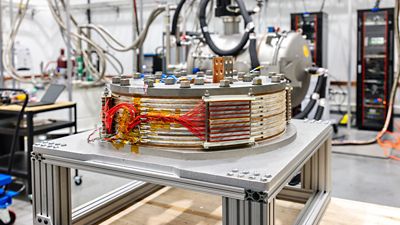
Thea Energy’s superconducting planar coil magnet.
The Future is Fusion
Thea Energy is currently focused on scaling its magnet manufacturing infrastructure. The integration of advanced materials, like HTS, introduces new opportunities but also demands meticulous attention to detail in design and assembly. These challenges require not only engineering expertise but also rigorous computational modeling to validate performance under real-world operating conditions.
Learn more about how Ansys can help with your fusion energy needs.

Just for you. We have some additional resources you may enjoy.
“Ansys is great for large-scale, multi-fidelity models. We routinely do two-dimensional approximations in fractions of a millisecond.”
— David Gates, Ph.D., co-founder and CTO

The Advantage Blog
The Ansys Advantage blog, featuring contributions from Ansys and other technology experts, keeps you updated on how Ansys simulation is powering innovation that drives human advancement.