Synopsys and Ansys power the future of innovation—connecting silicon to systems.
-
-
Access Free Student Software
Ansys empowers the next generation of engineers
Students get free access to world-class simulation software.
-
Connect with Ansys Now!
Design your future
Connect with Ansys to explore how simulation can power your next breakthrough.
Free Trials
Products & Services
Learn
About
Back
Products & Services
Back
Learn
Ansys empowers the next generation of engineers
Students get free access to world-class simulation software.
Back
About
Design your future
Connect with Ansys to explore how simulation can power your next breakthrough.
Free Trials
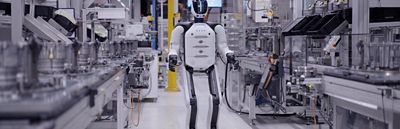
Schaeffler relies on simulation to fulfill a specific vision for motion technology in automotive and industrial settings.
David Kehr sees Schaeffler as a facilitator of motion. As the president of the company’s Humanoid Robotics division, he’s looking to simulation and physical artificial intelligence (AI) — the integration of AI into autonomous systems — to help bring his vision to life.
“We will bring humanoids into our plants,” he says. “We will build assembly lines, develop and industrialize components for them, test equipment for humanoid original equipment manufacturers (OEMs), and we will also participate in the humanoid aftermarket as well with our aftermarket division.”
Schaeffler’s core focus is to develop scalable, reliable components and systems that can be seamlessly integrated into robotics applications, including humanoid robots. This mission aligns with the supplier’s broader commitment to foster innovation and support industries in tackling production system complexities.
Rather than displace human workers, the ultimate goal of this technology is to ensure that robots not only perform repetitive or hazardous tasks but harmonize with human workers and existing infrastructure.
“We’re a motion technology company. We facilitate motion, and humanoids in physical AI are all about motion,” says Kehr. “The future of humanoids depends on production readiness, uptime, and serviceability as physical AI progresses. Schaeffler’s expertise in scalable automotive manufacturing, special machinery, and life cycle services addresses the hardest barriers to adoption, positioning us well in the humanoid and physical AI spheres.”
To this end, the integration of simulation, AI, and humanoid technology is pivotal to Schaeffler’s success.

David Kehr, Schaeffler Global head of robotics
How To Build a Better Robot
Schaeffler has been developing and scaling solutions for automotive and industrial applications for 80 years. Many of these components, including bearings and actuators, were easily adapted to humanoid applications.
“(Our components and systems) are efficient, and they're highly innovative,” says Kehr. “And so really, it's just a perfect fit for Schaeffler to position ourselves in this humanoid market.”
From the outset, however, Kehr admits there was a bit of a learning curve for everyone involved.
“We have to learn along with our OEM partners (who) are also learning because this is not an established field of production,” he says. “We're all learning, we’re taking our expertise that we've established in automotive, and we're applying it where we can on the humanoid side.”
Humanoid robotics development presents a range of technical and operational challenges, particularly in the adaptation of these advanced systems to demanding industrial environments. Some conditions are non-negotiable — navigated, in part, with tools and solvers from Ansys, part of Synopsys.
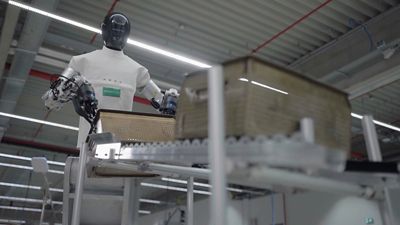
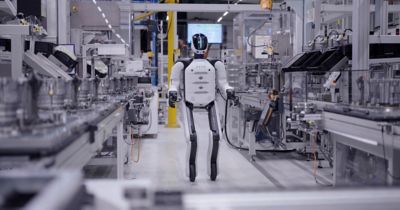
Top left: A Schaeffler humanoid picks up boxes and places them on a conveyor belt.
Top right and bottom: Humanoids will eventually service more complex machinery systems.
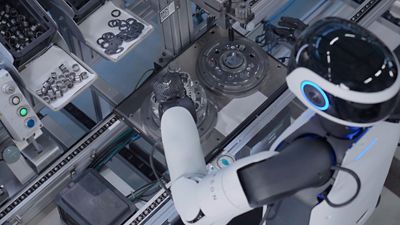
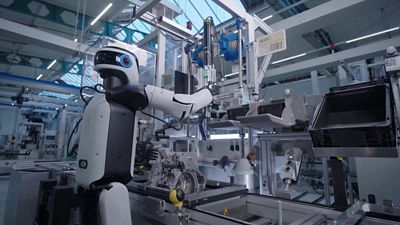
Specifically:
- Robots require some additional space. They need connection to power sources and must work seamlessly with other equipment to comply with safety regulations and standards. Advanced simulation platforms help Schaeffler design robotics systems that work within the constraints of a given manufacturing setup, which reduces downtime and mitigates common integration bottlenecks.
- Robots must perform complex, repetitive tasks with great efficiency. Simulation-led development results in high-torque actuators (devices that control robotic motion) optimized for power consumption that maximize operational efficiency. It also enables lightweighting and performance improvement through innovative material choices and refined designs.
- Robots are expected to operate reliably across thousands of cycles. This necessitates engineering precision to ensure the longevity of parts, like bearings and gearboxes. Using simulation, it’s possible to model stress points and optimize the structural integrity of components before they are built to reduce prototyping and associated costs.
- In the future, the number of robots sharing workspaces with humans will dramatically increase. As such, safety will remain a top priority. Simulation facilitates the integration of sensors and feedback systems into actuators, enhancing control and responsiveness, and ensuring robots can operate effectively while mitigating risks to human coworkers.
Droids in Training
One of the most complex challenges in the implementation of robotics for Schaeffler is training. It requires a combination of advanced simulation and physical AI in NVIDIA Omniverse to achieve the level of machine learning needed to inform more dynamic, capable humanoid applications ready for the shop floor.
“Walking itself is a task that actually takes a fair amount of energy for a humanoid robot,” says Daniel Wuerdinger, R&D manager, Humanoid Robotics at Schaeffler. “(Using simulation), we can derive exact wattage requirements for how much energy consumption we have for simple walking tasks. And then work on algorithms together with the humanoid OEMs and optimize our actuators to minimize that.”
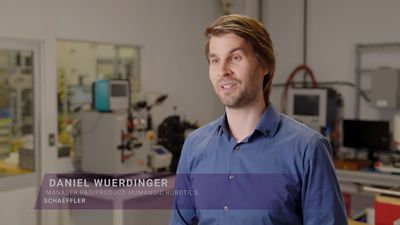
Daniel Wuerdinger, Schaeffler Americas head of robotics R&D
Seems simple enough. Until you think about that humanoid picking up a box. How many steps are involved, and what types of movements are the most efficient? Simulation helps Schaeffler sort out the details to answer these types of questions and make new discoveries along the way.
“Sometimes these simulation-type environments come up with completely new ways of how you would lift a box,” says Wuerdinger. “You see the robot gravitate toward a solution that is not at all humanlike. And maybe it's better, maybe it's worse. But sometimes you have to nudge the robot in the right direction.”
The Humanoids Are Coming
As Kehr sees it, that’s a good thing.
“There are going to be tens of millions of unfilled skilled labor positions by 2030, and Schaeffler is not immune to these demographics,” he says. “And so, we see humanoids as augmenting the human workforce. They will do jobs that are maybe dangerous, maybe not ergonomically advantageous for humans to do, or even mundane or boring that humans don't want to do.”
Did You Know?
Robots don’t learn like humans do. According to Science News Today, they are machines designed to perceive, decide, and then act in an unpredictable physical world. But to truly navigate factory environments and successfully work alongside humans, they must also evolve. And that requires intelligence.
A lot of Schaeffler’s robot training is purely simulation based. But, if you happen to have a robot at your disposal, it’s also possible to fine-tune robotic motion with some real-world examples. Like having a person wear a motion suit and cameras to demonstrate for a robot how an ergonomic pick-and-place task should be done in the real environment.
“(In this case) a human would actually wear a manual glove, for example, to show the robot how to do a certain task, and that data can be funneled into neural networks in the Omniverse as well to train the robot how to do a task,” says Wuerdinger. “Essentially, you're taking the robot by the hand and showing it exactly how something should be picked up.”
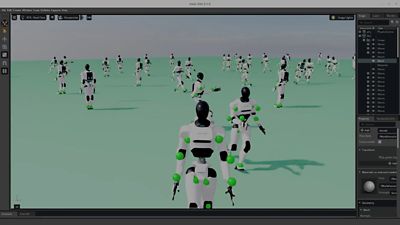
A simulation shows how Schaeffler uses artificial intelligence (AI) models to train humanoids.
In anticipation, Schaeffler has started pilot programs with several OEMs in various countries that are bringing humanoids into their plants for basic testing around machine tending.
“Our vision is to have generalist humanoids that go beyond servicing just one portion of a machine and have them successfully manage more complex system aspects,” Kehr said. “Within the next couple of years, we envision that our humanoids will also be operating, maintaining, or controlling certain core parts of machinery. Physical AI will be part of our DNA in the future.”
Interested in accelerating your industrial robotics design and deployment objectives? Ansys has robotics simulation workflows that can help.

Just for you. We have some additional resources you may enjoy.
“Physical AI will be part of our DNA in the future.”
— David Kehr, president of the humanoid robotics division, Schaeffler


The Advantage Blog
The Ansys Advantage blog, featuring contributions from Ansys and other technology experts, keeps you updated on how Ansys simulation is powering innovation that drives human advancement.