Synopsys and Ansys power the future of innovation—connecting silicon to systems.
-
-
学生向け無料ソフトウェアにアクセス
Ansysは次世代の技術者を支援します
学生は、世界クラスのシミュレーションソフトウェアに無料でアクセスできます。
-
今すぐAnsysに接続!
未来をデザインする
Ansysに接続して、シミュレーションが次のブレークスルーにどのように貢献できるかを確認してください。
無料トライアル
製品およびサービス
リソースとトレーニング
当社について
Back
製品およびサービス
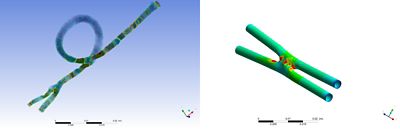
Surgeons go to school and hone their skills for about 13 years before they’re allowed to truly operate on their own. In that time, they spend hours practicing procedures on cadavers, fake skin, and sometimes even fruit. Dr. Balazs Gasz, cardiac surgeon and founder of YourAnastomosis, recognized that modern surgical training lacks consistent, scalable methods to assess and enhance individual performance. In 2018, with the help of the Ansys Startup Program and Ansys Channel Partner eCon Engineering, Gasz founded YourAnastomosis to revolutionize surgical training through innovation and technology. He wanted to move beyond theory and give surgeons the chance to learn by doing in a safe, realistic environment with clear, constructive feedback.
The YourAnastomosis team built hands-on training tools that combine real anatomical models, 3D-printed simulators, and augmented reality to help surgeons prepare for real-life procedures. The unique feedback system, which is based on healing predictions, enables students to understand how they performed and the clinical outcomes they can expect from their technique. As part of the 10-year anniversary of the Ansys Startup Program, we sat down with Gasz to discuss how computational modeling and simulation (CM&S) and the Startup Program were game changers for YourAnastomosis.
Can you give a bit of background about YourAnastomosis?
Gasz: Vascular and cardiac surgeons do suture lines every day on vessels and structures like valves, but there is no real feedback. Often decades later you see the patient again, and you try to figure out what happened and how the sutures held up. During my residency, I wrote operative reports for my supervisor after cases I assisted. He always added one extra detail: he rated every anastomosis or suture with 1 to 5 stars. When I asked why, he said that if he saw the patient again, he could relate outcomes to the quality of the sutures, because otherwise that’s often the only feedback surgeons receive.
Surgery relies heavily on tacit knowledge — instincts and experience that are hard to explain or measure. So the entire story with YourAnastomosis started with that; we wanted to visualize surgical performance to let the residents see what they did, how it looks, and the things that could be better.
How did simulation play a role in creating YourAnastomosis?
Gasz: Surgical education has traditionally lacked effective methods to assess performance and predict outcomes, which are critical for training and feedback. Expertise develops through two loops: structured debriefing immediately after surgery to analyze decisions and errors, and long-term patient follow-up to assess outcomes. Simulation tools like computational fluid dynamics (CFD) and finite element analysis (FEA) enhance these processes by offering predictive insights shortly after surgery, reducing reliance on delayed feedback. This approach enables personalized, data-driven training that connects surgical technique to physiological consequences based on patient-specific anatomy. Beyond education, integrating performance analysis with CFD, finite element methods (FEM), and anatomy-specific data allows for the study of surgical variability, the identification of mechanisms leading to outcomes, and the establishment of meaningful performance benchmarks. The goal is to integrate platform-based, data-driven feedback systems into surgical training and workflows, improving both education and clinical practice.
What innovative technologies does YourAnastomosis use?
Gasz: It's mostly finite element models and how we can reflect morphology. I mean, high-resolution 3D models are the entire story. Our first application was with Ansys Fluent fluid simulation software and Ansys CFX CFD software to show how the blood would flow inside vessels, valves, and such. We of course still use that now, but we have started to modify it a lot. We have done a lot of studies trying to simplify our models to maintain the high quality and scale up the models. But it started with Fluent software to show flow dynamics to the surgeons in a really simplified way.
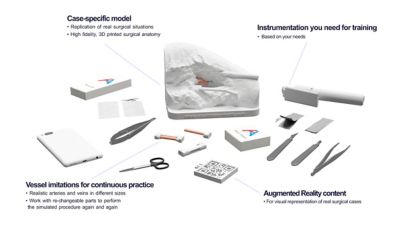
A YourAnastomosis product package
What has surprised you most about using simulation in surgical training and procedure modeling?
Gasz: Every single simulation is a surprise for me (still after 6,000 anastomoses analyzed). Every vascular structure is unique, like a fingerprint, and even the smallest changes can alter the outcome. When surgeons see these simulations, we can discuss them for hours or even days, because it helps us see what actually happened. Visualizing the suture lines gives physicians a greater understanding of what they’re doing and how it will impact the function of vascular system. Complex structural modifications become predictably assessable only with finite element modelling; for practicing surgeons and trainees, this provides a first, actionable link between technical execution and functional outcome prediction. With Fluent software, we can see many more perspectives than before, including fluid structure interactions, which helps explain not just what was done, but why it behaves the way it does.
Why do you think that more physicians and clinicians don't use simulation?
Gasz: I think the main reason is access. Many clinicians don’t know how to use simulation, and to an average surgeon it can feel like a nice technology that’s mainly used for scientific papers. It's not really common — it's mostly used in certain centers or by surgeons who already have access through research. But simulation is actually very useful and very approachable. Simulation makes it clear what can happen with the vascular structior or any suture, implant, or after any intervention, and there are clinical decision questions that a single simulation model can answer. I think it could be a mission to show that it’s really useful and really approachable for every single clinical problem. And also the first step toward patient-specific therapies, which is now approaching reality in clinical practice.
How did you get started with the Ansys Startup Program, and how did eCon Engineering help facilitate the relationship?
Gasz: Initially, we compared different technological options to visualize and analyze vascular structures for training and debriefing. Flow dynamics was always a key goal, but at the time we were unsure whether it would be technically feasible — or practical enough to deliver in a simple, clinician-friendly way. And at first, we genuinely thought Ansys was too expensive. But then we talked to eCon Engineering and got enrolled in the Ansys Startup Program, so it’s not as expensive. We get great support to help make the simulations and give advice for future plans.
It is a good tool because even we as surgeons can understand and use it without much help from IT. So it's really helpful. But it's great that a physician can use it and make simulations without any background in engineering.
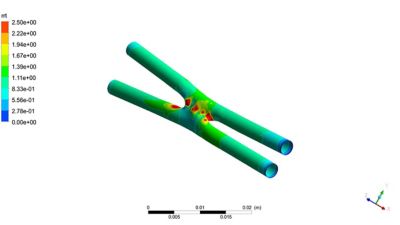
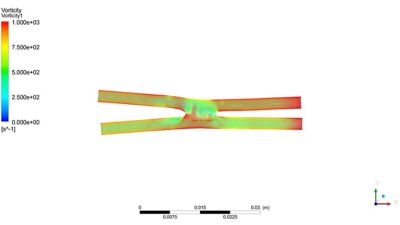
YourAnastomosis models in Ansys simulation software
How much of a role did Ansys play for you at the very beginning?
Gasz: It's an interesting question because from one end I would say everything — because simulation opened the door for us to build many things on top of it. From the other end, I would say we are surgeons with limited information about simulation and engineering and at first we just needed to know the morphology of the models.
But the simulation provides something extra. What we say to the residents for education is always built on simulation, and we made the entire scoring system based on the simulation results. As we generated more simulation data across different structures, we were then able to build AI tools on top of that data to support scoring and predictive understanding.
"Through the Ansys Startup Program, the team launched the project early and discovered new applications, including simulation physics and expanded training use-cases. This partnership enabled the use of high-performance computing, designs of experiments, and CFD to validate use-cases and enhance workflows effectively."
— Dr. Balazs Gasz, cardiac surgeon and founder of YourAnastomosis
How do you think YourAnastomosis’ business path would differ if you didn't have access to simulation?
Gasz: Without simulation, we could show residents morphological understanding — what something looks like — but we couldn’t show predictive outcomes. Simulation allows us to demonstrate how a specific surgical technique may influence future function.
The value of the company is really interconnected with simulation results because now we have the data and even the tools for simulation data for many structural analyses, many suture lines, and many comparative studies of the different devices and materials. That data goes beyond supporting training — it forms the basis for how we continue to build and develop what we do.
Now, new insights into novel procedures and training pathway characteristics can be anchored to these data. In simulation-based education, this opens a new pathway for optimized training in minimally invasive and robotic-assisted surgery.
Looking ahead, how do you see simulation continuing to shape the future of surgical training and YourAnastomosis over the next several years?
Gasz: Generalized simulation is evolving as a critical tool in surgical planning, moving from generic preparation to case-specific optimization. By integrating digital twins, patient-specific anatomy, surgical workflows, and performance data, simulations can predict the interaction between the patient, procedure, and surgical team. This is particularly effective in minimally invasive and robotic surgeries, where platform-based and data-rich environments facilitate real-time feedback and optimization. CFD and FEA enhance these simulations, enabling functional insights into patient-specific anatomy, physiological consequences, and surgical outcomes. These technologies also compress feedback timelines by providing predictions shortly after surgery rather than waiting for long-term results.
Beyond training, combining performance analysis with CFD and finite element methods allows the study of technique variability, outcome mechanisms, and the development of meaningful benchmarks. Ultimately, the goal is to establish data-driven, platform-based training and workflow improvements as standard practice in surgery and education.
Would you confidently recommend the Ansys Startup Program based on your experience?
Gasz: Definitely. Econ Engineering provided exceptional support, transforming a complex simulation platform into a user-friendly tool for clinical and research teams. Even without prior simulation experience, structured tutorials, workshops, and accessible guidance allowed for smooth integration into real workflows. The collaboration went beyond a typical distributor model, evolving into a true partnership with shared problem-solving and ongoing support.
Through the Ansys Startup Program, the team launched the project early and discovered new applications, including simulation physics and expanded training use-cases. This partnership enabled the use of high-performance computing, designs of experiments, and CFD to validate use-cases and enhance workflows effectively. The user-friendly platform and professional guidance fostered confidence in implementing, testing, and expanding simulations into new areas. By combining innovative technology with expert collaboration, the team built a solid foundation to continue evolving their processes, ensuring success in both clinical and research applications.
Learn more about how the Ansys Startup Program can help with your startup needs.

Just for you. We have some additional resources you may enjoy.
To learn how Ansys can support your early-to-mid-stage business, visit the Ansys Startup Program.

The Advantage Blog
The Ansys Advantage blog, featuring contributions from Ansys and other technology experts, keeps you updated on how Ansys simulation is powering innovation that drives human advancement.