Synopsys and Ansys power the future of innovation—connecting silicon to systems.
-
-
Access Free Student Software
Ansys empowers the next generation of engineers
Students get free access to world-class simulation software.
-
Connect with Ansys Now!
Design your future
Connect with Ansys to explore how simulation can power your next breakthrough.
Free Trials
Products & Services
Learn
About
Back
Products & Services
Back
Learn
Ansys empowers the next generation of engineers
Students get free access to world-class simulation software.
Back
About
Design your future
Connect with Ansys to explore how simulation can power your next breakthrough.
Free Trials
TOPIC DETAILS
What is Optoelectronics?
Far from being merely a subset of photonics, optoelectronics (also known as optronics) is a key discipline at the intersection of optics and electronics, powering innovations across communication, imaging, sensing, and energy. Optoelectronics sits at the interface of the two fields but is its own unique class of devices involved with either the emission or detection of light.
In this regard, optoelectronic devices either harness light and convert it into an electronic output or they take an electronic input and convert it into light. Optoelectronic devices can also be classified as transducers because they change one type of energy into another.
Optoelectronic devices are crucial for a number of high-technology industries, including the automotive, military and defense, aerospace, energy, medical, consumer electronics, and telecommunication sectors. Some of the main optoelectronic components used today are:
- Photodiodes
- Laser diodes
- Light-emitting diodes (LEDs) and micro-LEDs
- Photoresistors
- Solar cells (photovoltaics)
- Fiber-optic cables
- Phototransistors
- Photodetectors
Inside these industries, optoelectronic devices are used in a wide range of applications, including:
- Cameras
- Medical imaging/medical sensors (endoscopes, etc.)
- Medical diagnostics (heart rate monitors, etc.)
- Lidar and other automotive sensors
- Displays
- Remote guidance systems
- Lasers
- Everyday electronics, from smartphones and smartwatches to LED lighting, coffee machines, and modern home appliances
- Light-sensitive switching devices
- Laser printers
Optoelectronics vs. Electronics and Optics
Conventional semiconductor electronics and optics transmit electromagnetic information signals using electrons. Optoelectronics differs from conventional electronics as it also contains information originating from light, including ultraviolet, visible light, and infrared wavelengths.
Unlike purely optical systems (like mirrors, lenses, and filters) that passively shape light, optoelectronic devices actively convert light and electrical signals, powering technologies like cameras, fiber optics, lasers, and photodetectors. These devices interact more directly with the electromagnetic field of the light waves passing through the optical components, such as the polarization.
Optoelectronics vs. Electro-Optics
Optoelectronics is also related to electro-optics devices, but there are differences that differentiate the two classes of hybrid optical-electronic devices.
Both optoelectronic and electro-optic devices interact with light waves and electric fields, but they differ in how those interactions take place. Optoelectronic devices convert electrical signals to optical signals and vice versa, whereas electro-optic devices are centered around how electric fields can control, modulate, and manipulate light using the optical properties of the materials in the device. Some examples of electro-optic devices include optical switches, modulators, and high-frequency amplifiers.
Fundamental Mechanisms of Optoelectronic Devices
Multiple fundamental mechanisms underpin optoelectronic devices: the photoelectric effect, the photovoltaic effect, electroluminescence, and stimulated emission.
Photoelectric Effect
The photoelectric effect is the ejection of electrons from a material when light is shined on it. The energy of the photon is directly related to its frequency, and if it exceeds the work function of the material, the energy transferred is sufficient for the electrons to be ejected from the material.
A number of optoelectronic devices rely on the photoelectric effect. For example, photodiodes use it to detect and convert light into an electrical signal, phototransistors use the photoelectric effect to amplify light signals in sensors and switches, and solar cells use this effect as part of the direct conversion of sunlight to electricity.
Photovoltaic Effect
The photovoltaic effect is when electrons remain trapped in the material ― but with a higher energy state than electrons in their natural ground state ― after being irradiated with light. The energy from the light causes the movement of electron and hole charge carriers across a semiconducting junction, leading to the generation of an electrical current that is transferred to an external circuit. It’s an effect used in solar cells to generate voltage and current from sunlight but is also used in photodiodes and phototransistors.
Electroluminescence
Electroluminescence is an optical phenomenon that occurs when a solid material interacts with an electrical field or an electrical current, leading to the emission of light. This phenomenon causes electrons to become excited and release their energy during radiative recombination of electrons and hole charge carriers, where the electrons release their energy as light. Electroluminescence is observed in semiconductor materials and is used in display technologies.
Stimulated Emission
Stimulated emission is an optical process that causes the electrons from an excited atom to interact with photons at specific frequencies. The excited electron lowers its energy level and transfers its energy to the local electromagnetic field. This creates a new photon that has the same polarization and frequency of the incident light wave, making the two photons coherent. This process amplifies optical signals and is often used to create laser light.
Applications of Optoelectronics
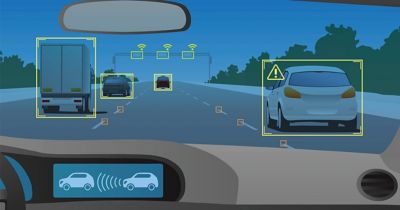
A number of sensors are being integrated into vehicles that rely on optoelectronic components, including:
- Complementary metal oxide semiconductor (CMOS) sensors: used for perceiving the local environment in autonomous vehicles and advanced driver-assistance systems (ADASs)
- Charge-coupled device (CCD) cameras: another imaging camera used in autonomous operations but particularly useful for low-light conditions
- Lidar: tracks obstacles and vehicles to create a 3D map of the local environment around the vehicle — widely used in autonomous vehicles, as well as ADASs
A lot more advanced optical sensors are now being integrated into vehicles as they start to have more autonomous features, such as ADASs, rear-parking cameras, and autopilot. Some of these revolve around visible light, others around transmitting and receiving infrared signals. Both passive and active sensors are used in vehicles nowadays to better understand a vehicle’s surroundings. As the automotive industry moves toward higher-level autonomous vehicles, more sensors based on optoelectronics will be integrated to provide a more advanced perception of the local environment around the vehicle.
Telecommunications
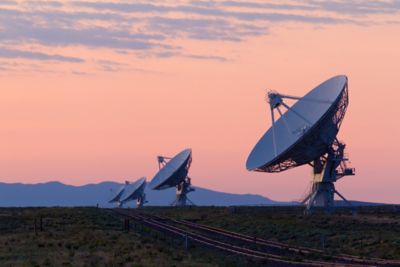
Optoelectronics is key to modern telecommunications, not just through optical fibers but thanks to lasers and photonic integrated circuits (PICs).
In these systems, semiconductor laser diodes turn electronic data into light, which is introduced to the optical fiber as a pulse and travels over long distances. The signals are transmitted along the fiber using the refractive index difference between the core and the cladding of the optical fiber as a guide (a waveguide). At the other end, a transceiver composed of photodetectors converts the light back into electrical signals. This process allows electronic data to be transferred from one location to another using light, as light can move over long distances much faster than electrons.
More and more, these parts — lasers, modulators, and detectors — are being combined into tiny chips, the aforementioned PICs, making networks faster, smaller, and more efficient. This whole setup allows the internet and mobile networks to handle huge amounts of data at high speeds.
Medical Imaging/Cameras
In the medical sector, optoelectronic devices are being used in endoscopes. Optoelectronics is making endoscopes smaller, which means that the procedure is becoming less invasive as optoelectronic technologies continue to miniaturize.
Alongside traditional endoscopy procedures, optoelectronics is also helping in the development of new, more advanced approaches. One example is a pill camera that can be swallowed by a patient. It then takes pictures as it passes through the gastrointestinal system and is a more comfortable process than the typical endoscopy procedure.
Consumer Electronics
Optoelectronics is found in many consumer electronics. Almost any modern-day machine that has integrated lights and displays uses optoelectronics to emit the light. For example:
- LEDs: LEDs are widely used in everyday lighting products; as illumination sources on consumer goods that have aesthetic lighting; and in LED and organic light-emitting diode (OLED) TVs, smartphones, laptops, and computer monitors for their high picture quality and low energy use.
- Image sensors (CCDs, CMOS sensors): These sensors are used in many imaging and video consumer goods, such as digital cameras and webcams.
- Other sensors: There’s a wide range of other optoelectronic sensors used in consumer electronics. Key examples include infrared sensors for remote controls, depth sensors for AR/VR headsets, and optical motion sensors for smart home automation.
- Laser diodes: These are used in communication technologies, optical storage technologies, and barcode scanners.
- Optocouplers (opto-isolators): These optical interconnects use light to transfer electronic signals between integrated circuits while remaining electronically isolated from each other. They’re widely used in power supplies, motors, data acquisition systems, and communication interfaces.
Solar Cells

A solar cell is an optoelectronic device in itself, but it’s also a very big application area, especially in this day and age when many solar panels are being installed and added to the grid to increase its level of decarbonized energy. Solar panels can be installed in residential homes and businesses, as well as in large-scale utility farms as solar panel arrays.
Many types of solar cell exist, from the traditional silicon solar cell to graphene-enhanced solar cells, perovskite solar cells, organic solar cells, flexible and transparent solar cells, and dye sensitized solar cells (DSSCs). Solar cells also use either a single p-n junction or multiple junctions and are available commercially as single panel or bifacial modules.
Advantages and Disadvantages of Optoelectronics
With there being many types of optoelectronic devices, a lot of the advantages are relative to both the individual device and the application it’s integrated with. Examples of the advantages of optoelectronics include:
- Cameras can clearly recognize and identify objects in front of them, whereas purely electronic systems, such as radar, will only detect an object and not identify it.
- There’s no competitor to LEDs for lighting in terms of energy efficiency, brightness, and picture quality.
- Optoelectronics provides a higher bandwidth for communication technologies.
- Optoelectronics consumes less power than many electronic devices.
- Optoelectronics can transmit information and data over much longer distances than electronic systems.
- Optoelectronics is more cost-effective than many electronic devices.
There are disadvantages of optoelectronic devices:
- Radar can work in many environments, including fog, whereas cameras and lidar give false alarms in adverse environmental scenarios.
- Cameras are more expensive than radar.
- Small variations/defects in production can have big impacts on device performance.
- It can be difficult to integrate optoelectronic devices into existing architecture depending on the application.
- Heat can be a big issue in optoelectronic devices. As optoelectronic components become even smaller with higher power requirements, new thermal management options are needed to ensure they don’t overheat and break.
Simulating Optoelectronic Design
The fabrication of optoelectronic devices is crucial. Any specks of dust on the optical components can render sensors incapable of detecting their environment, and any imperfections in the semiconductor electronics can cause processing errors when converting between optical and electronic signals.
To overcome the need for continuous prototyping, simulations can help to:
- Create products with integrated optoelectronic components and validate their functions
- Determine the best choice of material
- Simulate how light waves interact with the device
- See how the optical components fit into the wider electronic system
- Design optical components and see the mechanical effects, such as birefringence, that happen when optical components are integrated into mechanical supports
- See the impact of environmental stimuli, such as heat, airflow, or liquid flow, on the optoelectronic device
- Save money and time for engineers designing and manufacturing optoelectronic devices
- Discover behaviors that might not be deducible by experimental approaches alone
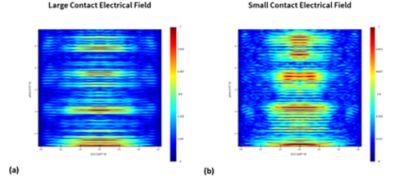
2D lateral electrical field distributions in simulated vertical photodetectors with (a) large and (b) small electrical contacts, respectively, in Ansys Lumerical FDTD advanced 3D electromagnetic FDTD simulation software
Ansys offers the following tools for simulating optoelectronic devices:
Ansys Lumerical software: Lumerical software focuses on the nanophotonic behavior of optoelectronic devices. It looks at how the wavelengths of light are absorbed and interact with the optical components.
Ansys Zemax OpticStudio optical system design and analysis software: OpticStudio software is used to design and analyze optical systems, including lenses, waveguides, and photonic circuits, to control and direct light. It’s widely used for optical communications and PICs.
Ansys Speos CAD integrated optical and lighting simulation software: Speos software simulates how light behaves in real-world environments, helping evaluate optical performance at the system level. It uses the information generated in OpticStudio software to see the effects and behaviors of the optoelectronic device in complex application scenarios, such as a camera integrated into a car or an AR display in a cockpit.
Ansys Mechanical structural finite element analysis software: Mechanical software looks at the properties of the materials used in the optoelectronic devices, the thermal information of the system, and any potential mechanical problems.
The Future of Optoelectronics
Original equipment manufacturers (OEMs) are continuing to develop new and more advanced optoelectronic components for a range of industries. Optoelectronics will continue to be miniaturized, and many devices in the future will likely be 100% photonic systems that can meet the size demands of modern technology. Quantum optoelectronics is another area that could emerge in the coming years, building on the current successes in the quantum electronics and quantum optics fields.
Another area that will continue to develop is improved sustainability in optoelectronic design. As many of the world’s finite natural materials become harder to obtain, turning to eco-friendlier or recycled materials is going to become more important. However, the main consideration will be obtaining the same accuracy and/or performance with fewer raw materials or newer, more sustainable materials.
If you’d like to find out how simulation-based approaches can help you to design more robust and high-performance optoelectronic devices, then get in touch with our technical team.
Related Resources
Let’s Get Started
If you're facing engineering challenges, our team is here to assist. With a wealth of experience and a commitment to innovation, we invite you to reach out to us. Let's collaborate to turn your engineering obstacles into opportunities for growth and success. Contact us today to start the conversation.