Synopsys and Ansys power the future of innovation—connecting silicon to systems.
-
-
Access Free Student Software
Ansys empowers the next generation of engineers
Students get free access to world-class simulation software.
-
Connect with Ansys Now!
Design your future
Connect with Ansys to explore how simulation can power your next breakthrough.
Free Trials
Products & Services
Learn
About
Back
Products & Services
Back
Learn
Ansys empowers the next generation of engineers
Students get free access to world-class simulation software.
Back
About
Design your future
Connect with Ansys to explore how simulation can power your next breakthrough.
Free Trials

The battery market is heating up. In the United States, the Inflation Reduction Act has added to the growing momentum by offering electric-car tax credits as well as making billions of dollars available to battery startups through last year’s infrastructure bill and Energy Department loans. While electric vehicles (EVs) are just one part of the story, with increasing interest in electricity storage as well as electric trucks and planes, they are an important part and an excellent example of why battery management systems (BMS) are so necessary.
BMS are complex, and oversee criteria and disciplines such as thermal input, electrical, hydraulic, and controls to ensure that the battery is optimized for performance, operates safely, has a long lifespan, and more.
What Is a Battery Management System?
A BMS is a collection of hardware and software technology dedicated to the oversight of a battery pack, which is itself an assembly of cells combined into modules and electrically organized into rows and column matrix configurations. What makes battery management so challenging is that battery packs can contain hundreds to thousands of cells. These cells need to deliver a specific range of voltage and current for a pre-determined duration of time against expected load scenarios and environmental conditions.
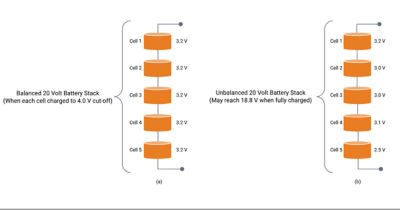
A mismatch between adjacent cells usually creates issues when attempting to charge up a stack.
To ensure that the battery can operate in these varying scenarios, a BMS will:
- Monitor the battery to detect when conditions may be changing.
- Provide protection to the battery in harsh environments.
- Estimate the battery’s operational state.
- Optimize the performance of the battery in changing conditions.
- Report the battery’s operational status to other related devices.
- Communicate with the outside world.
- Log event data so that battery behavior, performance, and safety can be improved in future iterations.
For example, think about a battery in an electric vehicle. Before the vehicle hits the road, it is put in many different environments where it needs to start up and function. The vehicle might be driven into the mountains where it sits overnight at below-freezing temperatures. Or it might be driven down the road in Southern California in sweltering conditions for hours at a time during a family road trip. In either scenario, the battery must be kept in a Goldilocks temperature zone for optimal performance and longevity.
The Importance of a BMS
The primary benefits of a BMS include functional safety and performance. First, let’s discuss safety. In a large battery pack operation, there are lethal levels of current and voltage that need to be managed to ensure that the integrity of the pack is maintained in the face of adverse operating circumstances. In the EV example that we shared above, a BMS is also vital to manage the safety of the battery, and the driver, if the vehicle were to get in a crash by disconnecting it from the vehicle.
In terms of performance, each of the cells needs to be maintained in good form relative to one another; the cells cannot be overcharged or over-discharged because that would impact the longevity of the pack. Due to manufacturing inconsistencies, none of the cells in the battery pack are completely identical even if they were made in the same factory. While these differences are minute initially, as the battery operates it can sharply diminish its own capacity in a short amount of time if not managed properly. As certain cells weaken, they can create “hot spots” in the battery pack when they overcharge. The BMS acts like an oversight committee to prevent this.
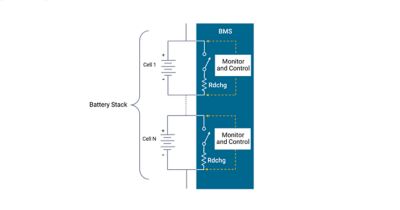
A BMS monitors each cell and leverages a transistor switch and an appropriately sized discharge resistor in parallel with each cell.
Overall, battery pack protection management ensures the cells are taken care of against aggressive usage and fast charging and discharging cycles, which means that the system is much more stable and will likely provide many more years of service.
Types of Battery Management Systems
BMS, like batteries themselves, can be simple or very complex depending on how they are employed and the different ways they are needed to safeguard and optimize the battery.
While there are many methods to categorize BMS, today we’ll classify them based on how they are installed and operate on the cells or modules across the battery pack.
- Centralized BMS architecture: This architecture is characterized by one central BMS in the battery pack assembly that all the battery packages are connected to. The benefits of a centralized BMS include its compact nature and lower price point. However, this BMS needs a lot of ports to connect with all the battery packages so the maintenance and troubleshooting become more cumbersome.
- Modular BMS topology: Like the above architecture, this BMS is divided into several duplicated modules that are connected to an adjacent section of a battery stack. While costs for modular BMS topology are higher than a centralized module, troubleshooting and maintenance are easier, and extending to larger battery packs is a simple process.
- Primary and subordinate BMS: In this related architecture, the subordinate modules are restricted to only relaying measurement data to the master module, while the master module makes computations and handles controls as well as external communication. The costs for this architecture are usually lower given the simple functionality of the subordinate modules.
- Distributed BMS architecture: This architecture differs the most from the above three because it incorporates all the electronic hardware on a control board placed directly on the cell or module that is being monitored, removing the need for bulky cabling and making each BMS more self-contained. However, this does make troubleshooting and maintenance more difficult, and costs more as there are more BMS in the overall battery pack structure.
How Battery Management Has Evolved
Over the past several decades, battery management has evolved in parallel with how batteries are designed. It used to be that all battery packs had units that would supervise all the cells that were part of the battery pack, a local management unit for sub communication, and a junction box to communicate with the other battery packs. This type of architecture requires a lot of wiring and cabling.
The trend today is moving toward a more centralized, wireless BMS concept that alleviates the bulk of cabling required in older architectures. Not only does this make maintenance easier, but it also removes a lot of weight from the battery pack, which directly translates to energy savings. In an EV, this can lead to longer ranges before it needs to be charged and also decreases the time it takes the system to charge.
Another trend that we will continue to move toward is using simulation for BMS design because of how complex batteries are and all the challenges that come with hardware development, prototyping, and testing. Simulation and virtual prototyping enable battery pack engineers to validate specifications earlier in the design process when the architecture pack and the electrical load, such asclock, traction motor, and ongoing charging module, have not been fully defined and is subject to change. That’s where Ansys, part of Synopsys, comes in with development and characterization tools, which allow virtual controller platforms for efficient development of software against virtual hardware prototypes and more.
One such tool is Ansys SaberRD power electronics and system simulation, which gives engineers access to electrical, digital, control, and thermal hydraulic model libraries that enable them to quickly generate models from basic datasheet specs and measurement curves for many electronic devices and different battery chemistry types, including lithium-ion. Statistical, stress, and fault analyses permit verification across spectrums of the operating region, including boundary areas, to ensure overall BMS reliability. Tools like these shorten the hardware prototype cycle significantly, which saves money in the design process itself and avoids potentially costly warranty callbacks. Software is taking an increasingly critical role in the operation of the vehicle. Battery management systems can benefit from an automotive electronics digital twin enabling the simulation of complete systems from controller hardware and software to the full multi-domain battery and power electronics.
In conclusion, the world of batteries is moving quickly to keep up with increased demand for electric vehicles, new innovations in electricity storage for energy derived from sustainable energy sources, electric planes and trucks, and more. Battery management systems are advancing with modern batteries to ensure the safety of the end users, increase the reliability of these batteries, continue the march toward increased range, and reduce costs so that batteries are even more ubiquitous and effective in tomorrow’s world.
Learn more about how Ansys Saber software can help with your battery manafement systems.




The Advantage Blog
The Ansys Advantage blog, featuring contributions from Ansys and other technology experts, keeps you updated on how Ansys simulation is powering innovation that drives human advancement.