Synopsys and Ansys power the future of innovation—connecting silicon to systems.
-
-
Access Free Student Software
Ansys empowers the next generation of engineers
Students get free access to world-class simulation software.
-
Connect with Ansys Now!
Design your future
Connect with Ansys to explore how simulation can power your next breakthrough.
Free Trials
Products & Services
Learn
About
Back
Products & Services
Back
Learn
Ansys empowers the next generation of engineers
Students get free access to world-class simulation software.
Back
About
Design your future
Connect with Ansys to explore how simulation can power your next breakthrough.
Free Trials

The term “virtual worlds” might seem abstract, even slightly sci-fi. But growing capabilities from Ansys, part of Synopsys — enabled by its partnership with NVIDIA — are making the benefits real and attainable for Ansys customers.
Terms like virtual reality, augmented reality, and digital twins have been tossed around for years. But what real-world, practical benefits do they have for the average business? Most of us associate virtual reality with consumer applications, such as gaming, where the landscape is an imaginary battleground or racetrack — and the stakes are low.
But what if a virtual world represented a product in motion like an autonomous car driving on a 200-mile trip over varying terrain and in all kinds of weather? Or a robotic vacuum cleaner navigating sofa legs and other features of a typical living room? What if the virtual world simulated an autonomous spacecraft headed for a distant planet or a cancer-targeting drug that moves through the human body on its own?
What if the stakes — and the benefits — of virtual world modeling were far greater than we ever imagined?
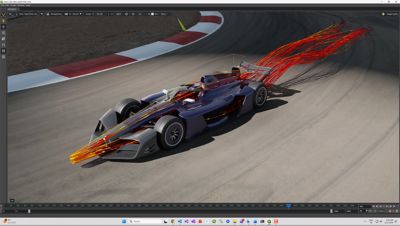
Simulation results from Ansys Discovery 3D product simulation software, which integrates with NVIDIA CUDA-X, graphics processing unit (GPU) acceleration, and Omniverse libraries for accelerated simulation and photorealistic visualization
Modeling Not Only the Product But Its Landscape
It’s not just our imaginations that have been constrained. Until recently, the construction of enormous, extremely detailed virtual worlds for product development has been limited by computing power, bandwidth, time, budget, staffing, and other factors.
It’s already challenging and numerically complex to model a moving race car, a launching spacecraft, or a breathing human body in exacting detail.
Now imagine also constructing the entire virtual world in which that system exists. Physical forces and temperature changes act upon it, continuously and relentlessly. Its shape changes over time as fatigue and wear set in. It encounters other physical objects and systems moving in the same three-dimensional space. Maybe it travels thousands of miles, which means that the virtual world must accurately replicate all that physical geography.
The concept of creating this kind of highly detailed, transient, and numerically immense virtual world isn’t for the faint of heart. But Ansys is committed to making this ambitious vision a reality.
“Virtual world modeling is imperative to take product development to a new level of certainty — where surgical results, automotive crash resilience, aircraft maintenance needs, drug delivery pathways, and other critical performance outcomes can be predicted accurately, from the earliest stages of design,” says Larry Williams, R&D engineering, scientist, at Ansys, part of Synopsys. “As product development teams work on the most challenging concepts we’ve ever seen as an industry, including autonomous system design, we need to replicate real-world performance at a new scale and with a new level of fidelity.”
Industry experts agree that virtual world modeling holds incredible promise. But a key obstacle has historically held our industry back. How do we actually get there? How do we overcome real-world constraints like computing power and setup time?
Ansys Powered by NVIDIA: Making the Impossible Possible
The growing partnership between Ansys and NVIDIA is opening a new universe of opportunities for the world’s product development teams.
Ansys works closely with NVIDIA to develop artificial intelligence (AI) infrastructure-powered solvers, algorithms, and graphics solutions that place virtual world modeling within reach using NVIDIA CUDA-X, PhysicsNeMo, and Omniverse libraries. Ansys and NVIDIA actively collaborate to ensure that the Ansys workflow of model building, post-processing, and visualization is accomplished at optimal levels of performance, speed, and accuracy — and at scale.
Today, through the integration of NVIDIA CUDA-X, PhysicsNeMo, and Omniverse libraries into its simulation software, Ansys is empowering every product development team to generate large, complex virtual models to optimize product performance, achieve higher-fidelity results, and train autonomous product systems quickly and precisely.
Using NVIDIA’s deep expertise in accelerated computing and AI, CUDA-X and Omniverse libraries, as well as AI physics, enable Ansys users to automate modeling workflows across diverse computer-aided engineering (CAE) tools for greater speed and efficiency when constructing large models that span multiple physics and timescales.
How do the NVIDIA Omniverse libraries and Ansys software work together? It’s surprisingly straightforward. Ansys technology uses Universal Scene Description (OpenUSD) to integrate seamlessly with Omniverse technologies — enabling accessible, smooth workflows, data interoperability, physics modeling, and rendering across diverse simulation applications. By leveraging Omniverse libraries directly from the Ansys interface, product development teams can work faster and more intuitively as they build virtual world models.
Engineers can not only build virtual worlds faster but automate scenario generation and design exploration. That means they can confidently validate their product designs for safety, precision, efficiency, and reliability while still managing real-world cost, time, and computing constraints. Engineers can more easily visualize product dynamics in fully realized, physically-based digital environments for faster, more intuitive design optimization.
“The mandate is clear: Modern product development teams need an expanded virtual environment that allows them to simulate, visualize, iterate, and collaborate at unprecedented speed and scale,” Williams says. “By integrating advanced NVIDIA technologies and libraries, our customers can drive true innovation via simulation-led workflows while still meeting design milestones and development budgets.”

By combining NVIDIA Omniverse libraries with the spatial computing capabilities of Apple Vision Pro, high-fidelity, physics-based simulations can be executed in the cloud and streamed directly into augmented reality. This simulation was performed using Discovery software.
At NVIDIA GTC 2026, Synopsys, in collaboration with MHP, presented a new paradigm for engineering: immersive, real-time interaction with simulation data.
By combining NVIDIA Omniverse libraries with the spatial computing capabilities of Apple Vision Pro, high-fidelity, physics-based simulations can be executed in the cloud and streamed directly into augmented reality.
This enables engineers and designers to explore complex systems at full scale, interact with them using natural gestures, and collaborate in shared, immersive environments far beyond the limits of traditional screen-based tools.
The result is a seamless integration of simulation, visualization, and interaction, enabling faster understanding of complex systems, improved collaboration, and more efficient product development.
Beyond individual products, this approach extends to entire factories through digital twins.
In essence, this shift transforms engineering from a process of observing models into one of experiencing them, unlocking a new level of speed, insight, and innovation.
Real-World Applications Bring the Benefits to Life
The benefits of virtual worlds may seem slightly out of reach or even unreal for the typical product development team. But they’ve already been proven.
One example of the joint work between Ansys and NVIDIA is PyAnsys-Heart. This digital twin of the human heart is unlocking transformative insights through a user-friendly, intuitive speech-to-text interface that requires minimal engineering expertise. It’s enabled by the PyAnsys pythonic access tool for Ansys software, a proprietary platform built using NVIDIA Omniverse libraries. This family of Python packages enables Ansys users to customize and automate simulations in their own applications.
By combining AI-enabled, large-scale modeling via NVIDIA NIM with the power of Ansys LS-DYNA nonlinear dynamics structural simulation software, PyAnsys-Heart enables users to replicate critical heart functions — such as electrical activation, tissue contraction, and blood flow — in a virtual world. Engineered to support diverse user needs and skill levels, the PyAnsys-Heart platform offers a modular framework to generate highly complex heart models.
The Path Forward: Expanding the Possibilities
In addition to accessing the existing PyAnsys-Heart platform, customers can soon leverage the combined strengths of Ansys software and NVIDIA CUDA-X, AI physics, and Omniverse libraries for other applications, beginning with computational fluid dynamics (CFD) modeling and autonomous systems design.
“Virtual world modeling is critical to large CFD applications simply because of the extreme complexity and transient nature of fluid behaviors,” Williams notes. “Visualizing fluid dynamics in a large-scale, physically detailed digital environment enables engineers to analyze complex datasets more intuitively. They can realize smarter, faster design optimization for even the most challenging CFD engineering studies.”
Additionally, the Ansys-NVIDIA integration empowers engineers of autonomous systems with high-fidelity outputs, making it easier to develop, train, test, and validate these systems with greater speed and confidence. The inclusion of NVIDIA Omniverse libraries helps ensure that mission-critical autonomous systems are continuously validated for safety, precision, efficiency, and reliability.
NVIDIA Omniverse libraries are planned to be integrated across the Ansys software portfolio, driving significant advancements in virtual modeling for other physics solvers.
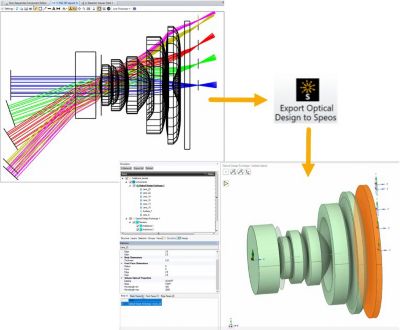
Integrated optical workflows in Ansys Zemax OpticStudio optical system design and analysis software connect system-level design with downstream stray light analysis in Ansys Speos computer-aided design (CAD) integrated optical and lighting simulation software.
Connect Optical Simulation to the Virtual World
More and more, engineers must simulate optical systems in complex 3D environments or 3D scenes. This is very difficult considering only computer-aided design (CAD) assemblies and is especially true for camera sensor validation, augmented/virtual reality, and automotive lighting, in which predictive rendering in a 3D-realistic environment is crucial.
That is why Ansys Speos CAD integrated optical and lighting simulation software supports glTF import, making it simple to bring in models from 3D design modeling tools like Blender, Autodesk 3ds Max, or any application built using NVIDIA Omniverse libraries.
This maintains not just geometry but textures and material properties, ensuring physically accurate simulations. Engineers can assess image quality, glare, and illumination effects in fully detailed virtual scenes, whether a nighttime urban street or a headset in a living room.
Speos software is all about bringing real-world context to optical design through its integration with Ansys Zemax OpticStudio optical system design and analysis software, where the core optical design originates. Speos software then improves the design by adding real-world simulation capabilities, enabling extensive evaluation of optical performance in realistic environments. For OpticStudio users, virtual worlds extend optical system design beyond idealized test conditions, enabling validation of image quality, stray light, and sensor performance in realistic, physics-based environments. By sharing data with 3D design tools and platforms, Ansys enables visualization-driven design where engineers can iterate, test, and validate their systems faster and more creatively than before.
Committed to Practical Innovation
Ansys is committed to innovation, and its partnership with NVIDIA demonstrates that commitment. Ansys software and service innovations are always focused on delivering real-world, practical benefits to its global customer community. Virtual worlds might be an intangible concept for some customers today, but Ansys is dedicated to making the benefits tangible in every customer’s product development efforts.
Ansys unceasingly works on exciting developments and partnerships that ramp up the speed, power, and impact of Ansys simulation software. Contact Ansys to discover the real benefits of virtual worlds and other innovations for your product development efforts.

Just for you. We have some additional resources you may enjoy.
“Virtual world modeling is imperative to take product development to a new level of certainty — where surgical results, automotive crash resilience, aircraft maintenance needs, drug delivery pathways, and other critical performance outcomes can be predicted accurately, from the earliest stages of design.”
— Larry Williams, R&D engineering, scientist, Ansys, part of Synopsys
The Advantage Blog
The Ansys Advantage blog, featuring contributions from Ansys and other technology experts, keeps you updated on how Ansys simulation is powering innovation that drives human advancement.