Synopsys and Ansys power the future of innovation—connecting silicon to systems.
-
-
Access Free Student Software
Ansys empowers the next generation of engineers
Students get free access to world-class simulation software.
-
Connect with Ansys Now!
Design your future
Connect with Ansys to explore how simulation can power your next breakthrough.
Free Trials
Products & Services
Learn
About
Back
Products & Services
Back
Learn
Ansys empowers the next generation of engineers
Students get free access to world-class simulation software.
Back
About
Design your future
Connect with Ansys to explore how simulation can power your next breakthrough.
Free Trials
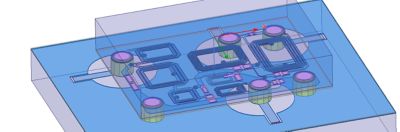
Imagine this: Your smartwatch prompts you to stand up. Later, your car automatically adjusts its speed to maintain a safe distance from the vehicle in front of you. Finally, your laptop stays cool during yet another video meeting.
Behind these everyday conveniences are microchips — the tiny, powerful engines of modern life. But designing these intricate circuits isn’t simple. It involves numerous variables, high-frequency signals, and complex simulations that must balance performance, cost, and reliability.
Global semiconductor leader STMicroelectronics is the innovative force behind many of those chips. While shaping everything from smart cars to renewable energy systems, the company has relied on simulation from Ansys, part of Synopsys, specifically Ansys’ scripting capability, PyAnsys, to streamline its simulation process dedicated to advancing wireless communication. In doing so, it has dramatically increased efficiency, consistency, and accessibility for its engineers.
Everyday Impact, Extraordinary Innovation
ST’s mission isn’t just to make powerful chips; it’s to create technology that improves lives. And that philosophy extends deep into how the company designs its products, including the simulation tools that make those designs possible.
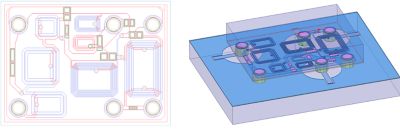
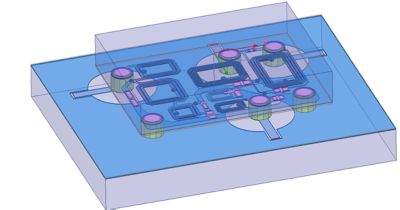
2D and 3D automated flow simulated in Ansys HFSS high-frequency electromagnetic simulation software
The Challenge: From 2D Blueprints to 3D Reality
At an ST site in Tours, France, engineers develop radio frequency (RF) solutions that integrate passive components — capacitors, inductors, filters, and couplers — on high-resistivity substrates. These elements are essential in applications where cost sensitivity, efficiency, and performance are critical, such as wireless communication and automotive radar.
But designing RF components isn’t simple. Engineers face significant challenges, including handling complex 3D geometries, achieving high meshing accuracy at high frequencies, and accounting for thermal effects that impact performance and reliability.
Each simulation step — from layout to thermal analysis — used to take hours, even for expert engineers. Every manual setup introduced the potential for inconsistencies. As devices have become smaller and have operated under tighter constraints, ST has leveraged PyAnsys capabilities to enhance speed, accuracy, and accessibility for a wider range of users.
The Solution: An Automated, Smarter Design Flow
To overcome these challenges, ST developed a complete automated process called VLE2EMS — short for Virtuoso Layout Editor to Electromagnetic Solver. This workflow bridges the gap between 2D circuit layouts and 3D electromagnetic models, automating the transition from concept to simulation-ready design.
At the center of this workflow is PyAnsys, a Python-based scripting ecosystem that extends the power of Ansys simulation tools like Ansys HFSS high-frequency electromagnetic simulation software and Ansys Mechanical structural finite element analysis software.
The process begins in the Virtuoso Layout Editor, where designers use a custom interface called the VLE2EMS GUI to configure key design details — for example, whether the configuration employs flip-chip or wire bonding and which technology options are applicable. In this interface, they can draw ports, choose mesh levels (Lite, Medium, or Secure), and adjust frequency sweeps.
Once the layout is ready, a Skill script exports the geometry and metadata. From there, a Python script powered by PyAnsys steps in. Using JavaScript Object Notation (JSON) files that define the geometry, materials, mesh, and tolerances, the script automatically:
- Imports the GDS layout
- Builds and elevates the 3D structure
- Assigns materials and thicknesses
- Creates ports and applies meshing
- Defines analyses and boundary conditions
- Adds a radiation box for simulation
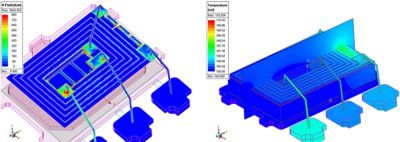
Plot H Field and temperature in HFSS software and Ansys Mechanical structural finite element analysis software
To improve accuracy, the workflow also includes thermal analysis in conjunction with electromagnetic simulation. PyAnsys capabilities automatically transfer 3D structures from HFSS to Mechanical software, apply electrical losses, identify air-exchange surfaces, and set up the temperature analyses.
This ensures that both electrical and thermal behavior are modeled correctly, an essential feature for today’s compact, high-power devices. Every step in the process is automatically logged, providing complete traceability and consistency across projects.
“Thanks to this automated process, what once took hours can now be done in minutes, a 70% reduction in design preparation time,” says Emmanuel Picard, engineer, CAD development, STMicroelectronics.
Bringing Automation to Life: The Electro-Thermal Workflow
The electro-thermal workflow is where PyAnsys truly shines. By automating complex interactions between HFSS and Mechanical software, ST engineers can quickly analyze how heat impacts electrical performance — a key factor in the longevity and efficiency of RF devices.
This setup automatically handles repetitive tasks, such as:
- Copying 3D structures between tools
- Assigning material properties and electrical losses
- Detecting and modeling heat exchange surfaces
- Defining volumes, excitations, and frequency analyses
Automation reduces human error and accelerates the process, freeing engineers to focus on optimization and innovation rather than manual setup. The result is a more streamlined, accurate, and energy-efficient design process — all powered by PyAnsys scripting.
Making Advanced Simulation Accessible to All
Traditionally, running electromagnetic simulations required specialized expertise — understanding meshing strategies, matrix orders, and solver configurations. But PyAnsys has changed that.
With automation now embedded into ST’s workflows, novices can confidently run simulations without diving into the technical details that once required years of experience.
This shift has fostered greater collaboration across engineering teams, breaking down silos among circuit designers, thermal analysts, and system engineers. Everyone now works from the same streamlined process, speaking the same digital language.
In essence, PyAnsys capabilities have democratized simulation, turning what was once a highly technical process into an intuitive, accessible experience for the entire design team.
By combining speed with consistency, ST has not only boosted productivity, but increased product reliability.
A Culture of Innovation and Collaboration
Behind every technical advancement at ST is a strong culture of collaboration and continuous learning. For more than three decades, the company has prioritized sustainability, integrity, and excellence — values that naturally extend into its digital transformation journey.
By embracing automation through PyAnsys scripting capabilities, ST is empowering a new generation of engineers to use simulation creatively and confidently. These tools encourage cross-disciplinary collaboration, enabling teams to analyze everything from electromagnetic performance to thermal management and mechanical strength in a single, cohesive environment.
The integration of HFSS and Mechanical software under the PyAnsys ecosystem has effectively blurred the lines between domains, fostering a holistic design mindset that considers every aspect of performance before a single prototype is built.
Efficiency Meets Sustainability
Efficiency isn’t just about speed; it’s also about sustainability. By drastically reducing design time and minimizing the need for physical prototypes, ST’s automated workflows contribute to lower material usage, reduced waste, and less energy consumption.
This digital-first approach highlights ST’s commitment to sustainability. By making simulations faster and more accurate, the company can explore greener design alternatives early in the process, improving both product quality and environmental impact.
It’s a virtuous cycle: Greater efficiency leads to fewer prototypes, which reduces waste, which in turn supports ST’s long-standing mission to build technology that’s both high-performing and eco-conscious.
Engineering the Future, One Script at a Time
As the world accelerates toward electric mobility, 5G networks, and intelligent connected systems, the need for reliable, energy-efficient electronics is greater than ever. By blending expert automation with accessibility, ST has created a design environment that’s not only faster but smarter, more collaborative, and more sustainable. It’s a glimpse into the future of engineering — where digital tools amplify human creativity rather than replace it.
From hours to minutes, from manual to automated, and from experts-only to everyone — ST’s journey with PyAnsys demonstrates how digital transformation can turn complexity into clarity.
By merging its semiconductor expertise with the scripting power of PyAnsys, ST has built a design process that’s efficient, reliable, and sustainable — proving that the future of engineering lies not just in inventing things but in finding smarter ways to make them.
Learn more about how you can accelerate your design process with PyAnsys capabilities.

“Thanks to this automated process, what once took hours can now be done in minutes, a 70% reduction in design preparation time.”
— Emmanuel Picard, engineer CAD development, STMicroelectronics

The Advantage Blog
The Ansys Advantage blog, featuring contributions from Ansys and other technology experts, keeps you updated on how Ansys simulation is powering innovation that drives human advancement.