Synopsys and Ansys power the future of innovation—connecting silicon to systems.
-
-
Access Free Student Software
Ansys empowers the next generation of engineers
Students get free access to world-class simulation software.
-
Connect with Ansys Now!
Design your future
Connect with Ansys to explore how simulation can power your next breakthrough.
Free Trials
Products & Services
Learn
About
Back
Products & Services
Back
Learn
Ansys empowers the next generation of engineers
Students get free access to world-class simulation software.
Back
About
Design your future
Connect with Ansys to explore how simulation can power your next breakthrough.
Free Trials

Discover how partnering with Ansys, part of Synopsys, helps one automotive tech company build a strong, future‑proof simulation framework that supports its strategic direction.
According to Data Insights Market, the global automotive simulation software market is expected to reach $8 billion in 2026, fueled by a compound annual growth rate (CAGR) of 15.8%.
There’s a reason for this. As competitive pressures grow, automakers must find ways to stay ahead of the curve, from development to launch. Simulation helps them quickly differentiate with new technologies and key features, despite any outside disruptions caused by technological and geopolitical shifts or changing consumer priorities.
In a market defined by intense innovation and an increasingly competitive landscape, how do you know which solution is right for you? When you’re responsible for more than 300 colleagues supporting over 55,000 users in the delivery of a single, seamless tool chain, the answer might be complicated.
Unless you are Aurora Sere‑Schneider. She’s the vice president of automotive IT engineering applications at AUMOVIO, an automotive technology company specializing in vehicle electronics and software-defined systems, among other mobility solutions.
We had the chance to talk to Sere-Schneider about her responsibilities, including what it’s like to run AUMOVIO’s global IT department, what goes into the software selection process, and which Ansys solutions made the cut.
Could you share a bit about yourself and your background at AUMOVIO?
Sere-Schneider: Sure. I bring more than 25 years of experience across R&D, systems engineering, and digital transformation to AUMOVIO. I’ve worked with incredible international teams and led innovation programs in safe mobility, smart infrastructure, and high‑performance computing.

Aurora Sere-Schneider, vice president of automotive IT engineering applications at AUMOVIO
During my time here, there are two career milestones that have shaped me deeply. The first is building an engineering hub in Romania from the ground up. The second: founding our Vehicle Systems Architecture department, where I introduced Automotive Ethernet and established a long‑term architecture road map for AUMOVIO.
How was it moving from the business side into IT?
Sere-Schneider: It was certainly an important moment in my career. It allowed me to connect two worlds that often speak different languages: R&D and IT. When you bring these worlds together on strong, scalable foundations, real transformation becomes possible.

The vehicle of the future relies on cross-domain high-performance computing.
Can you explain AUMOVIO’s mission and how your job supports it from an IT perspective?
Sere-Schneider: AUMOVIO is undergoing a major transformation as a newly independent company (as a spinoff of Continental’s automotive division in 2025). We build on a long automotive heritage, but our ambition is clearly future‑oriented — that is, shaping mobility that is safer, more exciting, connected, and increasingly autonomous.
For engineering applications, it means that IT plays a dual role. We are an enabler providing the digital foundations that allow engineering to innovate. And at the same time, we’re a service organization, where efficiency, stability, standardization, and security matter just as much as innovation.
Our responsibility is to maintain a flexible, mature engineering tool chain that supports fast‑changing business needs without introducing complexity. When we do this well, we help AUMOVIO bring products to market faster, improve quality, and operate more predictably across the regions we serve.
What business priorities are assigned to your team?
Sere-Schneider: Delivering high‑quality solutions on time, ensuring compliance, and guaranteeing security are deeply embedded in how we operate. These fundamentals make the engineering environment stable and predictable.
We also provide mature, clearly defined services that keep workflows consistent globally, allowing engineers to focus on innovation rather than tools. At the same time, we are strengthening early engagement with our business partners to anticipate needs even sooner, especially as we shift increasingly toward software‑defined mobility.
Another key focus is true TCO (total cost of ownership) thinking. Looking only at IT cost can be misleading. The real value appears when you consider the entire engineering chain, from life cycle cost to efficiency gains, to scalability, and then to global reusability. This is where we shift mindsets from “IT cost” to “value creation.”

AUMOVIO headquarters in Frankfurt, Germany
Can you describe the IT environment supporting AUMOVIO simulation activities?
Sere-Schneider: Engineering at AUMOVIO relies on a broad spectrum of infrastructure. These include cloud environments, virtual desktop infrastructure (VDI), virtual and physical desktops, and high‑performance computing with GPU acceleration for demanding simulation tasks.
We also support AI‑enhanced environments, such as Ansys SimAI and PyAnsys solutions, that enable automation and AI/ML‑supported workflows.
From an engineering applications perspective, our role is to ensure that the engineering tool chain runs on the most appropriate infrastructure — namely, the setup that fits AUMOVIO’s business needs, performance expectations, and efficiency goals.
How do these environments enable successful product development?
Sere-Schneider: Our IT infrastructure enables early digital prototyping, reduces physical prototypes, and accelerates development cycles. It also supports planned and unplanned workloads globally and consistently so engineers can focus on their work rather than navigating the technology supporting it.
Ultimately, the strength of our infrastructure lies in its diversity and maturity, and we make sure our tool chain takes advantage of both in the smartest way possible.
Let’s pivot to AUMOVIO’s engineering tool chain. What is it, and how do you evaluate the new simulation tools needed to support it?
Sere-Schneider: Our tool chain covers the full R&D spectrum, including architecture, product life cycle management (PLM), application life cycle management (ALM), software and hardware engineering environments, and collaborative platforms. Together, they form the digital backbone of our development landscape.
When evaluating simulation tools, we start with one question, specifically “Does it meet the business need?” A tool that doesn’t match our use case won’t create value.
We then look at maturity with respect to performance, stability, global usability, openness, interoperability, compliance, cybersecurity, and the availability of strong support. Finally, we evaluate the full TCO across the entire life cycle, not just licensing cost: integration, maintenance, training, scalability, and overall efficiency.
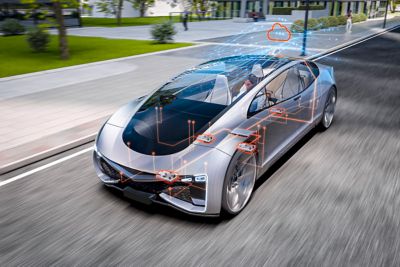
Software-defined vehicles are reshaping E/E architectures and reducing complexity.
How does Ansys software align with these objectives, including standardization and legacy tool management?
Sere-Schneider: Ansys tools integrate smoothly into our environment, perform reliably, and enable seamless data exchange within our tool chain. We also value how closely Ansys collaborates with us. Your teams are receptive to our requirements, from architecture to performance and compliance, enabling us to continuously improve the integration together.
The Ansys portfolio gives us flexibility to choose the right solver for the right use case without forcing a one‑size‑fits‑all approach. The key to managing this variety is standardization: validated versions, approved configurations, and shared templates. Tools like Ansys Granta ensure consistency across materials data.
We continue to support legacy tools where projects require them, giving engineers continuity without compromising global alignment. Ansys’ investments in HPC and GPU‑accelerated solvers also help us run more simulations faster, translating directly into quicker iterations and better decisions.
Are there any additional Ansys products you are exploring?
Sere-Schneider: The team is continuously assessing solutions that strengthen workflow orchestration, data governance, optimization, and cloud elasticity. Deep PLM integration remains essential as we do not run separate simulation data management systems.
We are exploring SimAI Python‑based AI/ML integrations and cybersecurity and functional safety solutions like Ansys medini analyze. All are important building blocks for a robust, future‑ready development landscape at AUMOVIO.
We want to thank Sere‑Schneider for taking time to share how Ansys solutions support her organization’s IT infrastructure. Interested in finding out more about our multiphysics offerings? Visit our site for all the details.

Just for you. We have some additional resources you may enjoy.
“Ansys tools integrate smoothly into our environment, perform reliably, and enable seamless data exchange within our tool chain.”
— Aurora Sere‑Schneider, vice president of automotive IT engineering applications, AUMOVIO

The Advantage Blog
The Ansys Advantage blog, featuring contributions from Ansys and other technology experts, keeps you updated on how Ansys simulation is powering innovation that drives human advancement.