-
-
Access Free Student Software
Ansys empowers the next generation of engineers
Students get free access to world-class simulation software.
-
Connect with Ansys Now!
Design your future
Connect with Ansys to explore how simulation can power your next breakthrough.
Countries & Regions
Free Trials
Products & Services
Learn
About
Back
Products & Services
Back
Learn
Ansys empowers the next generation of engineers
Students get free access to world-class simulation software.
Back
About
Design your future
Connect with Ansys to explore how simulation can power your next breakthrough.
Free Trials
ANSYS BLOG
April 8, 2026
What Is Pump Cavitation and How To Prevent It
Pumps, impellers, and propellers are fundamental parts of everyday infrastructure. They serve a wide range of functions, including handling waste and wastewater, supporting power generation, and running heating, ventilation, and air conditioning (HVAC) systems for facilities, such as data centers. They are widely used across industries, such as mining, oil and gas, marine, and chemical production.
A major concern for the engineers who design and use these machines is to avoid cavitation — the point at which the fluid undergoes sudden phase changes that can reduce hydraulic performance and physically damage mechanisms.
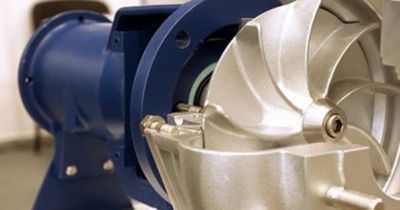
Pump cavitation can harm internal mechanisms.
To prevent this, engineers need to ensure that the right equipment is installed in the right system. Simulations are a cost-effective solution to optimize pump designs and configurations to avoid inadvertent phase changes.
What Is Pump Cavitation, and What Causes It?
Cavitation happens when bubbles, or voids, form in a fluid because the pressure quickly drops below the vapor pressure. When the bubbles experience higher pressures, they collapse, creating small shock waves that, over time, damage parts. When these pressure waves punch tiny holes in parts, it’s called pitting.
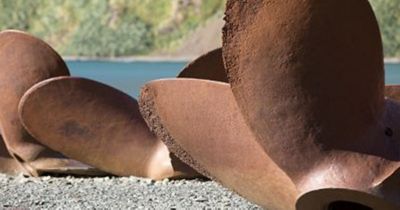
Propellers pitted from cavitation
Pumps are closed systems, so operators cannot see when cavitation occurs. Noise, vibration, and reduced performance are indicators of pump cavitation, but the extent of cavitation is difficult to quantify. When these warning signs start, engineers should inspect the equipment for any issues.
Impacts of Cavitation on a Pump
The effects of pump cavitation are significant, such as pitting, which is a primary concern for engineers. Pitting and erosion damage components, lower efficiency, and reduce lifespan while hydraulic issues lead to instability, reduced head, torque changes, and motor strain. These problems increase maintenance and downtime. Structural reliability is also compromised as vibrations and thrust variations wear out bearings and seals. Together, these factors undermine the pump’s performance and increase the likelihood of operational failures. In addition, since pump cavitation also affects a design’s flow rate and efficiency, engineers will have to increase power consumption to maintain throughput. This leads to increased greenhouse gases and fuel costs.
How To Prevent Pump Cavitation
The best way to prevent pumps from experiencing cavitation is to increase the pressure upstream from the pump’s impeller. This pressure is known as the net positive suction head (NPSH).
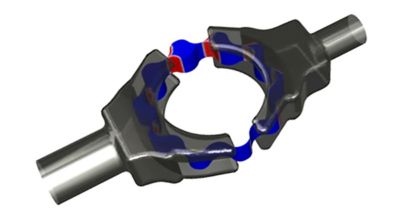
An Ansys EnSight software visualization of oil volume in a gerotor pump shows the extent of cavitation in red on the gear wall.
Some ways that engineers can increase NPSH:
- Increase the upstream reservoir’s water level
- Add an inducer to the pump inlet
- Optimize impeller design
- Minimize upstream flow losses
- Operate the pump at lower flow rates
In the design phase, engineers are unlikely to know how a pump will be set up in a given installation. Therefore, they use calculations and simulations to test various configurations to provide the end users with appropriate NPSH ratings. These ratings help pair a pump to an installation.
One of the most widely used models to simulate bubble formation is the Rayleigh-Plesset cavitation model. However, one challenge is that these results are empirical and can return unrealistic outcomes if input parameters were improperly tuned.
Alternatively, engineers can use an equilibrium phase change model in Ansys CFX computational fluid dynamics software to simulate cavitation. It uses material properties to predict the formation of bubbles without empirical data. As a result, it doesn’t require the tuning of the Rayleigh-Plesset cavitation model to produce accurate results.
Engineers can then parameterize the simulation so they can quickly cycle their designs through various configurations to produce NPSH ratings. They can also create a chart that shows how reductions in NPSH will reduce the head generated by the pump due to sudden phase changes.
Discover simulation tools to support your pump designs at Industrial Processes and Equipment Simulation Software Solutions from Ansys, part of Synopsys.