-
-
Access Free Student Software
Ansys empowers the next generation of engineers
Students get free access to world-class simulation software.
-
Connect with Ansys Now!
Design your future
Connect with Ansys to explore how simulation can power your next breakthrough.
Countries & Regions
Free Trials
Products & Services
Learn
About
Back
Products & Services
Back
Learn
Ansys empowers the next generation of engineers
Students get free access to world-class simulation software.
Back
About
Design your future
Connect with Ansys to explore how simulation can power your next breakthrough.
Free Trials

Developing safety-critical systems has become increasingly complex, especially as the demands on embedded software and systems engineering continue to grow. From automotive to aerospace and defense and rail, systems architects and embedded software engineers must meet expectations for safety, reliability, and performance while navigating the pressure to accelerate timelines and ensure compliance with industry standards.
Greater complexity calls for model-based systems engineering (MBSE) solutions that not only capture high-level architectures but can also connect seamlessly to downstream development solutions. Yet many teams struggle to connect the overall system design with embedded software solutions when adapting to new demands, particularly when working with multiple tools and specialized modeling languages.
To address these challenges, the Ansys System Architecture Modeler (SAM) Enterprise capability, a SysML v2 web platform, is a new MBSE solution designed for cross-tool interoperability and streamlined workflows. The SAM Enterprise capability also includes Ansys Scade One software, a model-based solution that helps teams bridge the gap between systems and embedded software engineering to ensure end-to-end consistency and reduce risk across the development cycle.
Demonstration of the Ansys Scade One model-based embedded software development solution
Navigating Siloed Engineering and Increasing System Complexity
Historically, it’s common for architects, software developers, and hardware engineers within a single team to take a siloed approach to development, with each looking to unique processes and solutions to define their individual contributions. However, this fragmentation can lead to late-stage issues, especially when it comes to software’s impact on system behavior.
One frequent problem is the mismatch at the hardware-software interface, in which design assumptions get lost in translation. Important aspects like signal transformations or energy consumption may be overlooked until late-stage development.
Issues like these are particularly critical in applications like autonomous vehicles or electric aircraft, in which software efficiency directly impacts mission success and battery life.
Further, many industries are increasing their reliance on software-defined systems. This shift amplifies the need for stronger alignment between system-level architecture and embedded software development.
“For every system engineer, the impact of design decisions across various aspects, specifically electrical, hardware, mechanical, as well as software, needs to be understood and synthesized during development,” said Michael Soden, senior manager, product management at Ansys, part of Synopsys. “Engineers responsible for isolated embedded software development, for instance, might not always be aware of how control algorithms really impact the overall system design.”
Inconsistent communication between hardware and software teams can further stymie development. “I have often seen a mismatch in the hardware-software interface,” says Soden, “as sometimes these interactions are not well documented or well managed early on. As a result, issues tend to surface late in development.”
Ansys’ Next-Generation System Modeling Tool Builds on the SysML v2 Standard
The SAM capability is Ansys’ solution for system architects seeking a modern, collaborative, and interoperable way to design system architectures and overcome challenges that lead to late-stage development failures. Built on the SysML v2 standard, the SAM capability enables users to define architectures with the right level of abstraction while ensuring traceability across the entire engineering workflow.
The SysML v2 language is a major evolution in systems modeling and addresses the interoperability limitations of its predecessor. Through its standardized application programming interface (API), SysML v2 facilitates integration with third-party solutions. This enables teams to collaborate more effectively and work from a shared source of truth.
The integration of the SAM capability with Ansys’ broader simulation and safety solutions enables consistent and efficient collaboration. “The goal is to find inconsistencies early and shift left as early as possible in the development cycle," says Thierry Le Sergent, product marketing manager at Ansys. “Everything we can now do with the SAM capability, people used to do before, but not with the same efficiency.”
Further, the SAM capability supports real-time multi-user collaboration, enabling distributed engineering teams to work concurrently on the same model. The software features version control and configuration management features that ensure scalability for larger projects.
“The SAM capability helps establish a system architecture upfront and connects embedded software, safety, reliability, simulation, and testing workflows consistently to that architecture,” says Soden. “That’s the only way a system engineer can make the right design decisions across different physical and dynamic aspects.”
Soden also emphasized the role of SysML v2 in improving compatibility between tools: “SysML v2 is the new language we believe offers the right abstraction level for system engineers. Unlike SysML v1, v2 has a standardized API that makes data exchange and tool interoperability much easier.”
Traditional approaches often involve disconnected solutions and manual updates, which result in rework and misalignment. “Teams often work differently for good reasons,” says Vincent Rossignol, senior manager, product management at Ansys. “With the SAM capability and Scade One software, we support feature-based development and offer customizable transformation scripts between solutions using Python.”
By contrast, the SAM capability enables teams to manage system-level requirements, architectures, and interface definitions collaboratively. These assets can then be reused downstream — for example, in safety analysis solutions like Ansys medini analyze software — without redundant effort. Soden pointed out this benefit: “If you want to update your safety analysis in medini analyze software, for example, you can press a button and automatically sync it with the latest system design. This avoids costly delays.”
This integration often extends beyond the SAM capability. Yet with Scade One software, users can move from systems models to embedded software with fewer obstacles. It also enables systems engineers to refine requirements and interfaces early in the process, helping prevent costly surprises later. Ultimately, the SAM capability acts as the backbone of this connected ecosystem, enabling each engineering team to use specialized solutions while maintaining alignment.
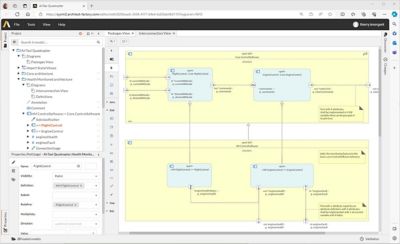
Software architecture in the Ansys System Architecture Modeler (SAM) Enterprise capability, automatically imported into the Scade One solution
Scade One Software: Embedded Software Built for Safety and Speed
Scade One software is Ansys’ next-generation environment for safety-critical embedded software development. Built on a legacy of industrial-grade reliability, it offers improved modeling, testing, and user experience. What makes this software especially powerful, however, is its role in prototyping and refining software in the early development stages.
“Many customers use the SCADE platform not just for code generation but also for software prototyping and requirements validation,” says Cedric Pasteur, product manager at Ansys.
“Interfaces and blocks defined at the system level can be reused in the software domain,” adds Rossignol. “Automating that transition brings real value to customers.”
Scade One software’s connection with the SAM capability ensures a smooth transition from system architecture to embedded software. Interfaces and requirements defined in the SAM capability can be imported and extended in Scade One software, eliminating manual duplications and ensuring consistency.
The integration also supports customizable transformation scripts, enabling organizations to tailor the workflow to their specific development practices. Soden noted that this integration is part of a broader vision. “The SAM Enterprise solution enables workflows like software prototyping, but it’s just one of many engineering workflows tied together by a consistent methodology.”
Moving From Software-Defined Vehicles to Autonomous Systems
The integration of the SAM capability with Scade One software is already proving valuable across a range of industries facing rapid transformation. In automotive, for example, the rise of software-defined vehicles (SDVs) is pushing companies to rethink traditional approaches.
“Automotive systems are transforming from hardware-centric to software-centric architectures,” says Rossignol. “Engineers can benefit from solutions like the SAM capability to efficiently manage this shift, especially when complemented by embedded software solutions like Scade One software.”
Similarly, in autonomous systems such as drones, mobile robots, and automated driving functions, the SAM capability enables system architects to model complex interactions and manage dependencies among control logic, environment models, and mission objectives. “Autonomous systems are a growing use case. These systems must interact dynamically with their environment,” says Soden. “The SAM capability is already enabling parts of that through SysML v2.”
Defense applications are another key area. “Modern defense systems are increasingly systems-of-systems,” said Rossignol. “The SAM capability excels at defining and simulating individual subsystems in support of mission-level modeling solutions like Ansys Systems Tool Kit (STK) software.”
Soden suggested that future standards may further bridge these worlds: “SysML v2 might eventually support more abstract mission modeling, similar to architecture frameworks from the United Architecture Framework (UAF), U.S. Department of Defense (DODAF), and the British Ministry of Defense (MODAF).”
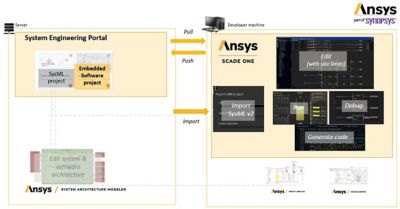
Scade One software with the SAM Enterprise capability is accelerating software prototyping from architecture to implementation.
Addressing System Complexity Together With Ansys
As the demands for more complex safety-critical systems grow, software and systems engineers are increasingly challenged to meet accelerating development timelines while navigating a sea of ever-changing requirements. To satisfy these demands calls for pragmatic MBSE strategies that can bridge the gap between hardware and software development and make connections to other development solutions downstream.
The SAM capability and Scade One software are laying the foundation for a new era of model-based development where system design, simulation, and embedded software engineering are no longer separate tasks but part of one continuous digital thread.
For a deeper dive, make sure to catch our new webinar SAM Enterprise: System Modeling to Seamless Software Prototyping.

Just for you. We have some additional resources you may enjoy.
“Teams often work differently for good reasons. With the SAM capability and Scade One software, we support feature-based development and offer customizable transformation scripts between solutions using Python.”
— Vincent Rossignol, senior manager, product management, Ansys, part of Synopsys




The Advantage Blog
The Ansys Advantage blog, featuring contributions from Ansys and other technology experts, keeps you updated on how Ansys simulation is powering innovation that drives human advancement.