Synopsys and Ansys power the future of innovation—connecting silicon to systems.
-
-
Access Free Student Software
Ansys empowers the next generation of engineers
Students get free access to world-class simulation software.
-
Connect with Ansys Now!
Design your future
Connect with Ansys to explore how simulation can power your next breakthrough.
Free Trials
Products & Services
Learn
About
Back
Products & Services
Back
Learn
Ansys empowers the next generation of engineers
Students get free access to world-class simulation software.
Back
About
Design your future
Connect with Ansys to explore how simulation can power your next breakthrough.
Free Trials
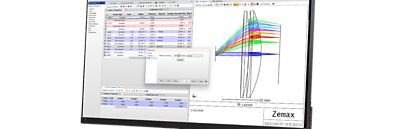
You have a promising optical design. Initial performance looks strong, optimization is complete, and the project is moving forward. But before signing off, there are still important questions to answer. How will the system perform when manufacturing variations are introduced? What happens when tolerances stack up in unexpected ways? What design alternatives haven’t been explored because the simulations simply take too long to run?
These are increasingly common challenges for optical engineers. As optical systems grow more sophisticated, the computational demands required to validate them continue to rise. Freeform optics, wider fields of view, higher-resolution sensors, tighter tolerances, and multispectral imaging requirements all increase the amount of simulation needed before a design can move forward.
Whether developing a machine vision lens, wafer-level camera, augmented reality (AR) waveguide, lithography subsystem, or long-range imager, engineers must balance simulation fidelity, analysis resolution, and project timelines. Too often, limited computing resources force trade-offs that can leave performance issues undiscovered until later in development.
Reducing ray counts, coarsening sampling, running fewer Monte Carlo tolerance studies, or evaluating fewer design alternatives can shorten runtimes, but these shortcuts may also limit insight into real-world performance. For supported workloads, the latest high-performance computing (HPC) capabilities in Ansys Zemax OpticStudio optical system design and analysis software help engineers overcome these constraints, enabling more comprehensive analyses, broader design exploration, and greater confidence in design decisions.
OpticStudio HPC software accelerates selected compute-intensive OpticStudio workflows by offloading jobs from the OpticStudio interface to a customer-managed compute cluster. Initial support includes Monte Carlo tolerancing, Hammer and Global Optimization, and nonsequential ray tracing — enabling optical engineers to tackle larger simulation workloads while maintaining the familiar OpticStudio experience.
Solving the Real Bottleneck in Optical Design
Optical design is iterative: Teams repeatedly refine the design, evaluate performance, check manufacturability, and assess tolerance behavior before committing to a final direction. Each cycle adds compute demand as engineers increase ray counts, sampling density, configurations, or study size. Higher fidelity improves confidence, but it also extends runtime and can force teams to trade analysis depth for schedule.
The most scalable OpticStudio HPC use cases are calculations that can be distributed across compute resources: optimization candidate evaluations, nonsequential ray tracing, and Monte Carlo tolerancing. This matters because desktop workflows are constrained not only by available cores but by the practical scaling limits of local workstations. As central processing unit (CPU) development has shifted from clock-speed gains toward more cores and threads, parallel processing has become increasingly important for compute-heavy optical simulation.
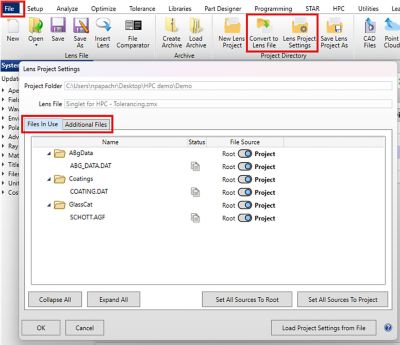
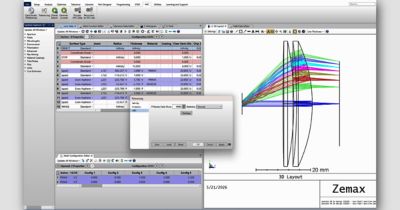
Lens Project Settings streamlines high-performance computing (HPC) job deployment by consolidating all design dependencies into a single portable workspace.
Many HPC environments are designed to take advantage of modern CPU architectures and shared compute infrastructure, including on-premises and cloud clusters. The OpticStudio HPC feature enables optical engineers to submit supported jobs from the OpticStudio user interface to a customer-managed remote compute cluster, helping to reduce analysis runtime and accelerate selected optical design workflows.
This is why faster execution matters most when teams need to evaluate many design cases — not just a single nominal model. A design team may need to compare architectures, run optimization searches, evaluate nonsequential ray-tracing results, and check tolerance behavior before selecting a final design direction. By distributing those jobs across available cluster resources, OpticStudio HPC software can help lens designers increase analysis throughput, evaluate more design variations, and validate robustness while the design is still within schedule.
That throughput becomes especially important in the analyses most sensitive to study size and fidelity: tolerance analysis and nonsequential ray tracing.
A robust tolerance or nonsequential analysis can involve large trial populations, high ray counts, multiple configurations, and detailed detector or path-statistics outputs. HPC accelerates supported workloads by distributing computation across cluster resources, enabling optical engineers to increase study size or fidelity while maintaining practical analysis turnaround times. This helps teams better understand performance risks before design decisions become difficult or expensive to change.
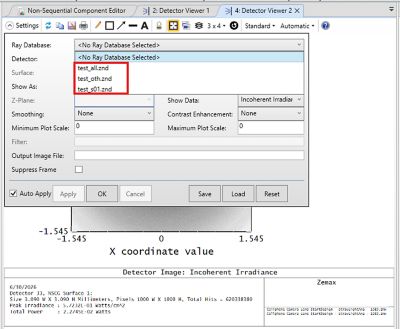
Multiple HPC-generated ray databases can be loaded directly into the Detector Viewer for efficient post-processing and result comparison.
Evaluating Manufacturing Variability at Scale
A high-performing optical design must do more than meet performance targets in simulation — it must continue to perform when manufactured. In practice, variations in radius, thickness, refractive index, alignment, and assembly can all affect image quality and system performance. Understanding how sensitive a design is to those variations is a critical step in reducing risk before production.
Monte Carlo tolerancing helps engineers evaluate how manufacturing and assembly variations are likely to impact real-world performance. By analyzing many possible realizations of an optical system, engineers can better predict production yield and identify potential sensitivity issues before they become costly problems. However, achieving meaningful statistical confidence often requires running large numbers of trials across multiple operating conditions, merit functions, and system configurations.
As study size grows, so does the computational effort required to complete the analysis. OpticStudio HPC software enables optical engineers to evaluate larger Monte Carlo datasets within typical development timelines, permitting more thorough tolerance studies and supporting more informed decisions about manufacturability, performance, and yield.
The need for computational throughput extends beyond tolerancing. Nonsequential ray tracing often benefits from larger ray counts, higher sampling densities, and more detailed detector outputs to accurately evaluate stray light, scattering, and other system-level effects. For supported nonsequential workloads, OpticStudio HPC software helps reduce the trade-off between simulation fidelity and analysis time by distributing computation across cluster resources.
With access to greater compute capacity, optical engineers can explore larger design spaces, evaluate more variables, and gain deeper insight into system behavior before committing to critical design decisions. The result is greater confidence that a design will perform as intended — not only in simulation but production.
Accelerating Validation Across Modern Design Workflows
As artificial intelligence (AI)-assisted design, automated optimization, and emerging optical design tools continue to evolve, engineers can evaluate more design possibilities than ever. But regardless of how a design is generated, every candidate must still be analyzed, validated, and compared before it can become a production-ready solution.
This makes simulation throughput increasingly important. As design teams explore larger design spaces and generate more alternatives, the demand for scalable, physics-based analysis continues to grow. The challenge is no longer just creating design options but evaluating them efficiently enough to support timely engineering decisions.
This is where OpticStudio HPC software can provide significant value. By accelerating supported OpticStudio workflows, including optimization, Monte Carlo tolerancing, and nonsequential ray tracing, OpticStudio HPC software features help engineers evaluate more design scenarios while maintaining confidence in simulation results. Whether designs are created through traditional optimization methods, scripting workflows, machine learning techniques, or future AI-driven approaches, scalable simulation helps teams move more quickly from exploration to validation.
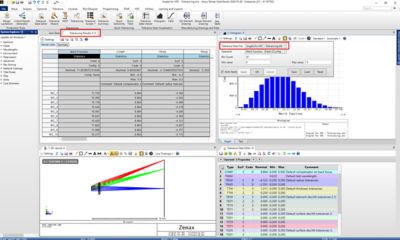
HPC-enabled Monte Carlo tolerancing delivers fast, statistically significant performance and yield analysis for complex optical designs.
As with any new technology, deployment considerations are important. The initial OpticStudio HPC release supports selected OpticStudio workflows and requires a compatible Linux-based cluster environment. Organizations should review workflow compatibility and infrastructure readiness to determine how OpticStudio HPC software fits in their existing design process.
Engineering Throughput Is the New Competitive Advantage
When evaluating optical design platforms, discussions often focus on specific features, algorithms, or individual analyses. Increasingly, however, engineering teams are measuring success through a broader lens: engineering throughput.
The question is no longer just “How quickly can this simulation run?” The question increasingly is “How many confident design decisions can be made in a given development cycle?”
Teams that can evaluate more architectures, explore more tolerance variations, test more configurations, increase simulation fidelity, and perform more comprehensive verification are better positioned to reduce design risk, achieve first-pass success, and avoid costly redesigns later in the development process.
The latest HPC capabilities in OpticStudio software help optical engineers leverage customer-managed cluster resources to accelerate some of the most computationally intensive supported optical design workflows. By reducing the time required for key analyses, engineers can evaluate more design scenarios and gain deeper insight into system performance while staying within project timelines.
For teams that rely on large tolerance studies, extensive optimization searches, or high-ray-count nonsequential simulations, OpticStudio HPC capabilities are more than a performance enhancement. They are a practical capability that helps improve engineering throughput, increase design robustness, and accelerate the path from concept to production-ready optical systems.
Ready To Accelerate Your Optical Design Workflow?
Experience the power of OpticStudio HPC software and run large-scale tolerancing, optimization, and analysis studies in a fraction of the time. Start your free trial today to see how HPC can help you explore more design options, improve yield confidence, and bring innovative optical products to market faster.

Just for you. We have some additional resources you may enjoy.
Learn More
Experience the power of OpticStudio HPC software and run large-scale tolerancing, optimization, and analysis studies in a fraction of the time. Start your free trial today to see how HPC can help you explore more design options, improve yield confidence, and bring innovative optical products to market faster.



The Advantage Blog
The Ansys Advantage blog, featuring contributions from Ansys and other technology experts, keeps you updated on how Ansys simulation is powering innovation that drives human advancement.
Let’s Get Started
If you're facing engineering challenges, our team is here to assist. With a wealth of experience and a commitment to innovation, we invite you to reach out to us. Let's collaborate to turn your engineering obstacles into opportunities for growth and success. Contact us today to start the conversation.