Synopsys and Ansys power the future of innovation—connecting silicon to systems.
-
-
Access Free Student Software
Ansys empowers the next generation of engineers
Students get free access to world-class simulation software.
-
Connect with Ansys Now!
Design your future
Connect with Ansys to explore how simulation can power your next breakthrough.
Free Trials
Products & Services
Learn
About
Back
Products & Services
Back
Learn
Ansys empowers the next generation of engineers
Students get free access to world-class simulation software.
Back
About
Design your future
Connect with Ansys to explore how simulation can power your next breakthrough.
Free Trials

Filling an automatic icemaker with water seems straightforward. However, small details, such as the icemaker mounting angle, surface tension of the materials, and even flow rate, can significantly influence how water fills, drains, and ultimately freezes. Traditional build-and-test approaches often struggle to expose these effects early, especially when materials are difficult to prototype. Ansys FreeFlow smoothed-particle hydrodynamics (SPH) simulation software provides a way to visualize exactly where the water goes to ensure that water fills the mold properly with no residual water droplets left behind along the way.
Ensuring an Even Fill of the Mold
A primary design requirement is achieving an even fill of the mold. This begins with ensuring that the icemaker is mounted at the correct angle. Even slight deviations from level can change how water enters and spreads in the fill cup, leading to uneven distribution and potentially a noticeable variation in cube size.
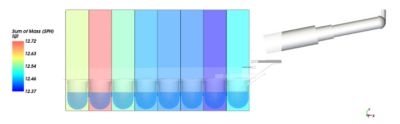
Ice cubes’ mass distribution at a steady state
FreeFlow software enables the effects of the mounting angle to be visualized directly. By observing fill behavior under nonlevel conditions, it becomes clear how sensitive the design is to installation variability. This insight helps define acceptable tolerances and reduces the number of physical prototypes needed to validate basic fill performance.
Time evolution of ice cubes’ mass
Visualizing the Water Path
Beyond simply confirming that the mold fills evenly, it is critical to understand how water moves through the system. Visualizing the full water path from the exit of the waterline into the fill tube, then into the fill cup, and ultimately into the mold reveals flow patterns that are difficult to capture experimentally.
FreeFlow software makes it possible to see how water flows in the fill tube (an area that is not visible in the freezer and would be time-consuming to mock up). These details are especially important when evaluating whether design features unintentionally create areas where water could be retained.
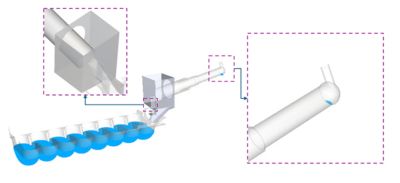
Potential spots for water retention in the ice mold filling device
Comparison between ice model filling simulation (top) and experiments (bottom)
Identifying Water Retention and Areas at Risk for Frost Buildup
A major requirement for water management in the icemaking system is identifying areas along the route to the mold that could potentially retain water after filling. These regions represent a higher risk for frost or ice buildup over repeated cycles.
By visualizing retained water, design changes can be targeted more effectively. For example, the rib in the fill cup below (initially designed to prevent the fill tube from contacting the wall of the cup) also prevents water from fully draining into the mold.
If frost does build up, another key question is whether water flowing around the cup during operation can actively clear frost or ice. Simulation enables evaluation of two important metrics: cumulative wet time on the walls of the cup and local fluid velocity. Longer wet times promote melting while higher velocities can help remove frost mechanically. Together, these parameters provide insight into whether normal operation helps mitigate ice buildup or contributes to it.
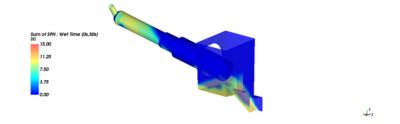
Wall cumulative wet time
Why Simulation Outperforms Prototyping in Early Design
In this application, FreeFlow software offers several advantages over physical prototyping. A simulation showing 15 seconds of flow time takes approximately one hour on an A800 GPU, enabling rapid iteration and comparison of design concepts. This speed makes it practical to explore design options before locking down the design.
Physical prototyping is also challenging due to material constraints. The fill cup material is difficult to replicate accurately with rapid prototyping methods. While 3D printing is possible, parts would require thorough sanding to prevent higher surface roughness from altering water interaction and producing misleading results. Simulation avoids this limitation entirely.
Additionally, FreeFlow visualization provides a level of insight into fluid behavior that is difficult to achieve experimentally. Flow behavior in opaque components and potential water retention areas are now visible, leading to quicker, more confident design decisions.
Simulation-Driven Design
By using FreeFlow software to visualize fill behavior, water retention, and ice clearing potential, design risks can be identified before costly prototypes are built. The result is faster iteration, fewer physical builds, and a more robust final design that performs reliably across real-world conditions.
Learn more about FreeFlow software.


The Advantage Blog
The Ansys Advantage blog, featuring contributions from Ansys and other technology experts, keeps you updated on how Ansys simulation is powering innovation that drives human advancement.