Synopsys and Ansys power the future of innovation—connecting silicon to systems.
-
-
Access Free Student Software
Ansys empowers the next generation of engineers
Students get free access to world-class simulation software.
-
Connect with Ansys Now!
Design your future
Connect with Ansys to explore how simulation can power your next breakthrough.
Free Trials
Products & Services
Learn
About
Back
Products & Services
Back
Learn
Ansys empowers the next generation of engineers
Students get free access to world-class simulation software.
Back
About
Design your future
Connect with Ansys to explore how simulation can power your next breakthrough.
Free Trials

In the automotive industry, lightweighting has become a critical challenge as manufacturers strive to improve fuel efficiency and reduce CO2 emissions. Regardless of the type of powertrain, expectations for car body lightweighting technologies continue to rise. Plastics are used widely in automotive components as they are lightweight, offer high design flexibility, and allow for relatively low molding and secondary processing costs. Traditionally, metals have been the primary choice for components located in the engine compartment or in contact with fuel or other substances due to their superior resistance to both elevated temperatures and chemicals.
However, driven by the demands for lighter vehicles, greater design freedom, and overall cost reduction, the shift toward engineering plastics has accelerated. What is essential here is not simply replacing metal with lighter plastic materials but redesigning multiple performance aspects — such as stiffness; durability; impact absorption; noise, vibration, and harshness (NVH) characteristics; and thermal behavior — because engineering plastics exhibit fundamentally different behaviors from metals. By leveraging multiphysics simulations from Ansys, part of Synopsys, and the extensive polymer property data available in material databases in the Ansys Granta materials information, selection, and data management product collection, engineers can predict a wide range of phenomena associated with material substitution, enabling more efficient and reliable design decisions.
A Streamlined Workflow
The Global Polymers database available in Granta products, such as the Ansys Granta MI materials intelligence platform and Ansys Granta Selector materials selection software, enables users to compare the properties of metals and a wide range of manufacturer-specific engineering plastics. (See the graphics below.) It also includes simulation-ready data, enabling engineers to apply material data to their models with a single click. This streamlined workflow — from material selection to simulation — has made it a highly valuable tool widely adopted by manufacturers across the industry.
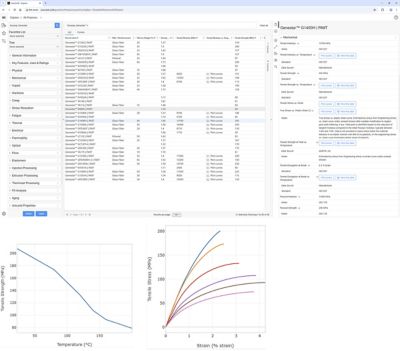
Material property data in the Global Polymers database in the Ansys Granta MI materials intelligence platform, showing an example data sheet and simulation-ready data
All relevant manufacturer grades are also linked to their generic equivalents in the Ansys MaterialUniverse database of materials, which contains even more complete and comparable information on these materials, including mechanical, thermal, electrical, physical, impact, optical, economic, processing, environmental, and chemical durability.
Introduction of GENESTAR™
Among the material manufacturers that supply simulation-ready data to Granta material data offerings is Kuraray Co. Ltd. Kuraray’s high-heat-resistant polyamide resin GENESTAR™ PA9T was developed using the company’s proprietary monomer technology and was targeted to deliver an exceptional balance of heat resistance, low water absorption, and long-term reliability. With outstanding thermal, electrical, mechanical, and chemical stability, Kuraray believes that GENESTAR™ has become a strong candidate to replace metals and conventional resins in a wide range of automotive applications, including electronic components, fuel cell systems, and cooling pipes.
The simulation-ready information on multiple Kuraray’s polymer products, including the GENESTAR™, provided directly by the manufacturer supplements extensive information from other sources in the Global Polymers database (part of the Polymers add-on to Granta products), such as UL Prospector and information from other material manufacturers.
Application Spotlight: Coolant System Applications
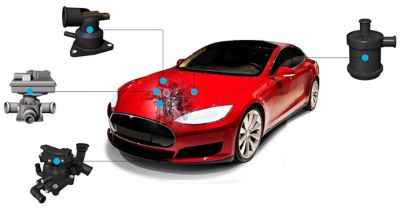
One of the key application areas for GENESTAR™ is automotive cooling system components. Typical examples include thermostat housings, coolant control valves, thermal management modules, refrigerant valves, and water pumps. (See the image below.) Among these, GENESTAR™ G1350A stands out for its excellent resistance to coolant fluids and high-temperature environments while also contributing to overall weight reduction. Its well-balanced combination of moldability and mechanical performance has led to widespread adoption among automakers worldwide. In thermostat housings (where PPS has traditionally been the material of choice), GENESTAR™ can withstand multiple material processing steps, such as forced mold-release molding and laser welding. Notably, its low density enables an estimated 20% weight reduction when switching from PPS to GENESTAR™ G1350A. This weight saving offers significant benefits, such as lower CO₂ emissions over the vehicle's lifetime, extended driving range, reduced system costs, improved component integration, and greater design freedom.
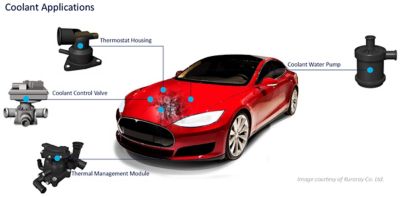
Coolant applications of GENESTAR™
Case Study: Analysis Using Ansys Mechanical Structural Finite Element Analysis Software
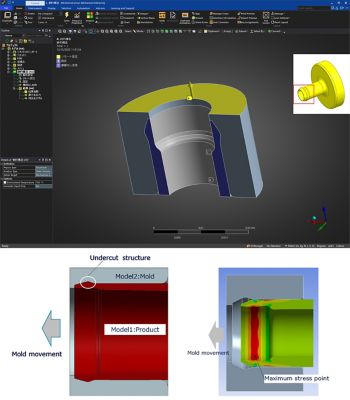
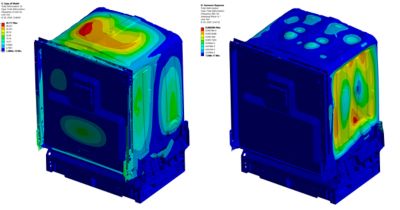
The tip of a cooling component with undercut geometry, plus an analysis model and stress distribution, in Ansys Mechanical structural finite element analysis software using GENESTAR™ polymer data from Granta software
The simulation-ready data for GENESTAR™ G1350A is available in the Global Polymers database in the Granta platform and can be used for analysis in Mechanical software. Users can select appropriate materials according to a variety of criteria and/or graphical methods, compare and contrast their properties, and rapidly identify whether candidate materials are suitable.
In the example of this case study, the Ansys platform was used to optimize the tip geometry of cooling system components. (See the images above.) The tip of the previously introduced cooling component features an undercut structure designed to prevent hose detachment. Because of this geometry, the molded part must be flexed inward during demolding, which generates stress that may lead to surface defects or even part breakage. Therefore, optimizing the undercut geometry to balance both performance and moldability is essential. To address this challenge, we conducted a simulation using Mechanical software, combined with the stress-strain curve of Genestar G1350A at demolding temperature, available in the Granta Global Polymers database. This simulation enabled us to identify an undercut geometry that can be successfully demolded, providing a clear pathway to improving molding-related issues.
Supplementary data on generic engineering materials matching the grades manufactured by Kuraray (for example, PA9T and PMMA) is also available in the MaterialUniverse database, which further facilitates multiphysics and other simulation, including thermal performance and early-stage assessment of the environmental impact of changing materials.
An example of this is shown in the BoM Analyzer module of the Granta MI platform, assessing the environmental impact of a product containing both metallic and polymer components, highlighting the materials, processes, and subcomponents that have the greatest environmental impact.
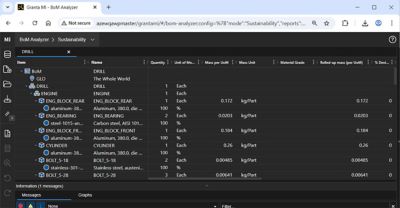
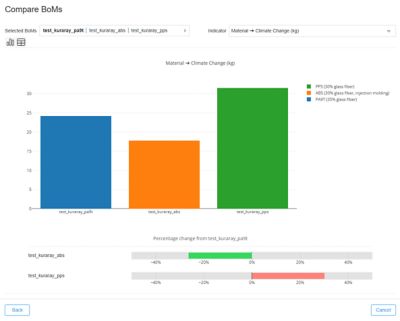
Rapid early-stage analyses of the environmental impact of an industrial component containing metal, polymer, and other materials
Using Simulation-Ready Data
We’ve showcased GENESTAR™ as an example of how simulation-ready data available in the Granta suite of products can be used effectively. By leveraging this data — where materials essential for manufacturing, including those from various suppliers, are organized in a simulation-ready format — engineers can achieve a more seamless and highly accurate simulation experience.
Discover how accurate, reliable, and simulation-ready materials data from Kuraray and other leading providers can help you easily set up precise simulations by visiting our Ansys Granta Materials Data page.



The Advantage Blog
The Ansys Advantage blog, featuring contributions from Ansys and other technology experts, keeps you updated on how Ansys simulation is powering innovation that drives human advancement.