Synopsys and Ansys power the future of innovation—connecting silicon to systems.
-
-
Access Free Student Software
Ansys empowers the next generation of engineers
Students get free access to world-class simulation software.
-
Connect with Ansys Now!
Design your future
Connect with Ansys to explore how simulation can power your next breakthrough.
Free Trials
Products & Services
Learn
About
Back
Products & Services
Back
Learn
Ansys empowers the next generation of engineers
Students get free access to world-class simulation software.
Back
About
Design your future
Connect with Ansys to explore how simulation can power your next breakthrough.
Free Trials

When engineers and designers explore new concepts, they want to quickly understand performance trade‑offs through simulation and optimization. Traditionally, engineers define the design space by choosing a set of explicit computer-aided design (CAD) parameters, such as thicknesses, radii, angles, and other similar dimensions. Then, they sweep or optimize those variables.
This parameterization step is often the real bottleneck. As geometries become more complex, it gets harder to capture meaningful variations with a fixed, hand‑crafted set of variables. The result is a design space that can be costly to build, brittle to maintain, and may miss important shape changes simply because they are difficult to express as independent parameters.
Recent progress in AI‑driven design offers another way to represent and explore latent space.
Expanding the Design Space: From CAD Parameters to Latent Parameters
In many projects, geometry variation is not neatly expressed through a few dimensions. The way forces travel through the part (the load path) changes as the shape evolves, and small geometric changes interact in non‑obvious ways.
As the number of parameters grows, engineers face several challenges, including that:
- Parameter sets become difficult to maintain and interpret
- Each new parameter expands the design space dramatically, making it harder to thoroughly explore
- Optimization focuses on easy-to-define parameters instead of on the shapes that matter most
- The robustness of the parametric model has associated drawbacks since more parameters usually result in a less stable model
In practice, valuable design options may remain unexplored simply because they are hard to describe.
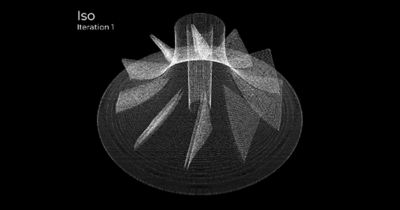
An example of design variations. Credit: Martin Husek.
What Does ‘Latent Space’ Mean in Practice?
Starting from a set of training geometries, the model learns recurring patterns and compresses them into a compact internal representation called the latent space.
When an AI model is trained on a set of existing geometries, it identifies the main patterns that distinguish one design from another. Instead of preserving every geometric detail, the model encodes these patterns into a small number of internal variables, known as latent parameters.
Each combination of latent parameters corresponds to a valid geometry that is consistent with the training data. Moving through the latent space means smoothly transitioning between realistic design variants rather than manually adjusting individual dimensions.
Importantly, these parameters do not map one‑to‑one to physical dimensions. One latent parameter can simultaneously affect several features; for example, it may change the thickness distribution, adjust the overall curvature, and redirect how forces flow through the part (the load path).
A Simple Latent Space Example
Consider a family of structural brackets developed over several design iterations. Each version has subtle variations in CAD parameters: rib layout, length, fillet radius, hole diameter, hole pitch, and more. Capturing all these differences using CAD parameters would be possible, but labor‑intensive and restrictive.
With the Ansys GeomAI artificial intelligence (AI) platform for geometry, these geometries can be used to train an AI model that learns the underlying design space. The result is a latent space that represents the full range of observed variations.
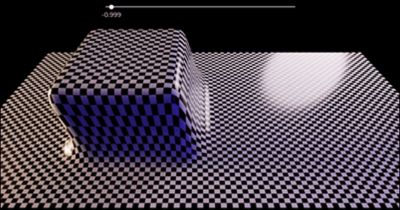
Latent space parameter variations. Credit: Martin Husek.
By adjusting just a few latent parameters, engineers can generate new bracket designs that remain consistent with previous engineering intent while also exploring combinations that were never explicitly created. The generated shapes are not random; they are constrained by real, existing engineering data.
Many geometric constraints are implicitly learned from the training data. For instance, the model naturally preserves bracket hole radii, an effect we describe as soft constraints.
Connecting Latent Space to Simulation
Once a geometry is generated from the latent space, it can be evaluated using pre-existing simulation solutions.
For early exploration, predictive models such as the Ansys SimAI artificial intelligence (AI) platform for simulation, make it possible to assess performance almost instantly. When higher fidelity is required, the same geometry can be passed to full Ansys solvers without changing the workflow.
What changes is the speed at which alternatives can be explored. Latent space removes much of the overhead associated with geometry preparation and parameter management, enabling engineers to focus on performance trends rather than setup effort.
Optimization in Latent Space With Ansys optiSLang Software
Latent space becomes particularly powerful when combined with Ansys optiSLang process integration and design optimization software.
Previously, we focused on optimizing numerous explicit CAD variables by creating parametric models. Now, with optiSLang software, it's possible to directly explore latent parameters instead of handling dozens of individual design variables. This simplifies the optimization problem while still covering a rich and meaningful design space.

A workflow with Ansys optiSLang process integration and design optimization software
Because the latent space is learned from real geometry data, optimization searches remain within feasible and realistic regions of the design space. This helps avoid physically unreasonable designs while still encouraging exploration beyond existing concepts.
Why Latent Space and Simulation Solutions Matter
Traditional parameters describe geometry explicitly. Latent parameters describe geometry implicitly.
Both approaches have their place. CAD parameters remain essential for detailed design and final tuning. Latent space, however, provides a more natural way to explore complex shape variations during early design and concept development.
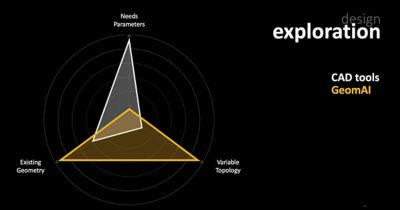
Design exploration. Credit: Martin Husek.
Rather than replacing established workflows, latent space complements them by extending what engineers can reasonably explore.
This matters because engineering teams already generate large amounts of simulation and geometry data. Latent space provides a way to reuse that data more effectively, not just to predict performance faster, but to rethink how design spaces are defined and explored.
With the GeomAI platform and optiSLang software, latent space moves from an abstract AI concept to a practical engineering tool, integrated into familiar simulation and optimization workflows. This results in more informed and automated engineering decisions that are made earlier and with greater confidence.
If you want to learn more, watch this on-demand webinar to find out how the GeomAI platform uses AI-trained geometry models to generate, explore, and optimize innovative design concepts without complex parametric setups.

Just for you. We have some additional resources you may enjoy.



The Advantage Blog
The Ansys Advantage blog, featuring contributions from Ansys and other technology experts, keeps you updated on how Ansys simulation is powering innovation that drives human advancement.