Synopsys and Ansys power the future of innovation—connecting silicon to systems.
-
-
Access Free Student Software
Ansys empowers the next generation of engineers
Students get free access to world-class simulation software.
-
Connect with Ansys Now!
Design your future
Connect with Ansys to explore how simulation can power your next breakthrough.
Free Trials
Products & Services
Learn
About
Back
Products & Services
Back
Learn
Ansys empowers the next generation of engineers
Students get free access to world-class simulation software.
Back
About
Design your future
Connect with Ansys to explore how simulation can power your next breakthrough.
Free Trials

When we flip a light switch, we often don’t think about how the electricity got to our house in the first place — we just expect the lights to come on. But there is a lot involved in getting electricity from a power plant to our houses, businesses, schools, and other critical buildings. To ensure safety and efficiency, transformers are one of the most important aspects of the electricity transmission process. Transformers adjust voltage levels within a power grid, increasing voltage for more efficient transmission through power lines and decreasing it for safe use by consumers.
With decades of engineering expertise, the team at Hitachi Energy is focused on improving transformer performance while addressing the unique challenges posed by different operating conditions. Hitachi Energy uses advanced simulation technologies to streamline the design and testing of transformers, ensuring efficient and reliable energy solutions.
By integrating numerical simulations such as the finite element method (FEM) into their electromagnetic, thermal, and structural analyses, Hitachi Energy can optimize critical aspects of transformer design. These simulations provide insight into key performance factors, such as energy losses, heat distribution, and the ability to withstand physical stresses. Applying simulation strategically enables Hitachi Energy to minimize costly design iterations and reduce the risk of failures during testing and operation.
“Transformers were created 150 years or so ago, when no one knew anything about simulation,” says Irene Woyna, principal R&D engineer at Hitachi Energy. “Now, say we want another 2% of efficiency from a transformer. That requires a lot of effort, which is where simulation comes into play.”
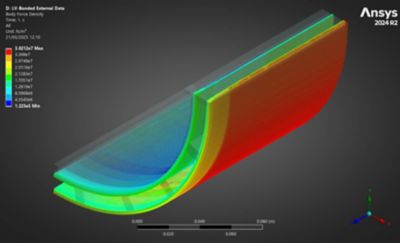
Body force density simulation
Addressing Technical and Safety Challenges
Designing transformers presents a range of challenges that require precise solutions. Over their lifespan of 25-30 years, transformers face exposure to harsh conditions, including rain, snow, extreme temperatures, mechanical damage, and lightning strikes. “We want to be sure we consider all the possible problems that can happen during a transformer’s lifetime and that the transformers comply with industry safety and operational standards,” says Woyna.
Before a transformer leaves the manufacturing facility, it must undergo factory acceptance testing to ensure it meets industry standards. This includes testing for temperature tolerances, structural analyses, current ratings, and more.
“Factory acceptance testing means we guarantee that all these tests set by the standards are passed, so the transformer is good to go,” says Woyna. “Simulation ensures in the early design phases that our transformer will really pass the tests.”
To analyze electromagnetic behavior, Woyna and the Hitachi Energy team use the Ansys Maxwell advanced electromagnetic field solver to determine key electrical parameters such as resistance and inductance. This helps them evaluate how electromagnetic forces affect critical components such as windings. These components are what make voltage conversion possible, but they can face significant mechanical stress during operation.
The team uses Ansys Mechanical structural finite element analysis software to test the structural integrity of transformers under unusual circumstances, such as short-circuit conditions. During these events, electrical current can surge to levels far beyond normal operation, exerting significant mechanical forces on windings and other components. By simulating these scenarios, engineers can refine their designs to ensure components remain intact and functional.
In addition to electromagnetic and structural analysis, the Hitachi team conducts thermal simulations in Ansys Fluent fluid simulation software to study heat distribution and its potential impact on transformer insulation materials and overall efficiency. This is particularly vital for identifying hotspots and ensuring that temperature levels remain within safe operational limits.
The ability to predict and mitigate such challenges early in the development process not only saves time and costs but also reinforces safety and reliability for both the transformers and the systems they support.
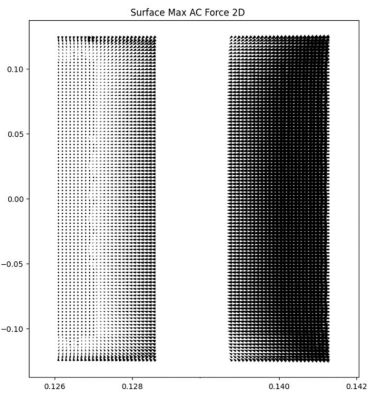
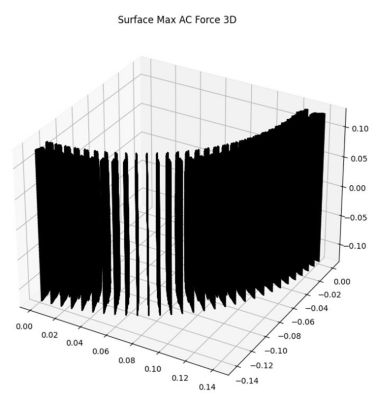
To perform a structural analysis, the 2D force distribution (left) is mapped into 3D (right) using simple coordinate transform in Ansys Maxwell software.
Automating Workflows with PyAnsys
Hitachi Energy has embraced the PyAnsys Pythonic access tool for Ansys software to streamline simulation tasks within transformer development. PyAEDT, a PyAnsys open-source library, integrates directly with the Ansys Electronics Desktop (AEDT) electronics systems design platform, enabling engineers to automate processes such as model creation, simulation setup, and results analysis without needing to become simulation experts.
“One aspect of this is democratizing simulation so that people who are not necessarily experts on electromagnetics or the simulation software have access to simulation so they can run tests,” says Woyna. “This is exactly the strength of PyAEDT — you don't have to be a Python expert to use PyAEDT and to automate your workflows.”
The Hitachi Energy team uses the PyAEDT tool for short-circuit impedance calculations. Engineers use PyAEDT scripts to generate detailed Maxwell models, including geometry, materials, and boundary conditions, based on input data from design platforms. This automation not only accelerates setup but also ensures consistency in simulations across different projects. The team also uses the PyAEDT tool for electrothermal workflows, in which PyAEDT extracts winding loss distributions from electromagnetic simulations. These results can then be seamlessly transferred to thermal analysis tools to help engineers identify critical areas such as hotspots within the transformer. PyAEDT also assists in structural simulation by exporting force distributions derived from electromagnetic analyses, which can aid in evaluating the mechanical integrity of components under stress conditions like short circuits.
The ability to automate key steps enables the inclusion of external tools and datasets, making the design process more adaptable to project requirements. For instance, PyAEDT can integrate with advanced Python libraries for custom pre- and post-processing tasks, giving engineers more flexibility.
By incorporating simulation into their analyses, Hitachi Energy engineers can gain insight into how real-world conditions impact transformers, enabling them to address potential challenges during the early design stages. This helps them create transformers capable of reliable, long-term performance in diverse and demanding environments.
Learn more about how Ansys, part of Synopsys simulation solutions can help with your power electronic needs.

Just for you. We have some additional resources you may enjoy.
"One aspect of this is democratizing simulation so that people who are not necessarily experts on electromagnetics or the simulation software have access to simulation so they can run tests. This is exactly the strength of PyAEDT — you don't have to be a Python expert to use PyAEDT and to automate your workflows.”
— Irene Woyna, principal R&D engineer at Hitachi Energy



The Advantage Blog
The Ansys Advantage blog, featuring contributions from Ansys and other technology experts, keeps you updated on how Ansys simulation is powering innovation that drives human advancement.