Synopsys and Ansys power the future of innovation—connecting silicon to systems.
-
-
Access Free Student Software
Ansys empowers the next generation of engineers
Students get free access to world-class simulation software.
-
Connect with Ansys Now!
Design your future
Connect with Ansys to explore how simulation can power your next breakthrough.
Free Trials
Products & Services
Learn
About
Back
Products & Services
Back
Learn
Ansys empowers the next generation of engineers
Students get free access to world-class simulation software.
Back
About
Design your future
Connect with Ansys to explore how simulation can power your next breakthrough.
Free Trials

Home appliances are no longer just electromechanical products. They are software-driven systems expected to evolve rapidly, support numerous variants, and remain cost‑competitive while meeting stringent safety expectations, such as those defined by IEC 60730. For embedded software engineers, control engineers, and research and development (R&D) teams working on washing machines, refrigerators, dishwashers, or similar products, the real challenge has ceased to be basic functionality and now is managing growing control logic complexity across product lines and generations.
The Ansys Scade One model-based embedded software development solution brings model-based software development to the appliance domain, offering a practical way to design, validate, and generate efficient embedded software that supports disciplined development practices aligned with IEC 60730 while keeping development scalable, maintainable, and accessible — even for teams without deep, low‑level programming expertise.

Connected appliances: a glimpse into the smart home of tomorrow
The Scade One Essential solution makes model-based software development accessible to home appliance teams without the cost or complexity typically associated with safety-critical applications. It delivers the same benefits, tailored for home appliances products:
- Managing functional complexity
- Improved collaboration between disciplines
- Supporting product line variability
- Faster feature development and early validation
- Reduced manual effort through automatic generation of code and documents
- Efficient, standardized implementation for embedded targets
Managing Functional Complexity
Modern washing machines embed a wide range of control logic that must coordinate interacting features. This includes program selection, parameter configuration, conditional adaptations, and sequencing of operations across the washing cycle.
When implemented directly in code, this logic becomes scattered and difficult to reason about as a whole, especially as new features are added.
Model-based software development addresses this by representing behavior explicitly using structured constructs, such as states, transitions, and dataflows. This provides a coherent view of the system, making interactions among features easier to understand and control.

Behind every modern wash: model-based software orchestrating smart, adaptive cycles
Typical functionality involves:
- Multiple washing programs and mode variants
- Configurable parameters (temperature, spin speed, duration, water level)
- Conditional logic based on user input and sensor feedback
- Sequencing operational phases (fill, heat, wash, rinse, spin, drain)
- Sensor-driven adaptation (load, balance, water level, turbidity, temperature)
- Real-time control of actuators (motor, pump, valves, heater, door lock)
- Fault detection, exception handling, and recovery behavior
- Resource optimization under water, energy, time, and noise constraints
- Hardware-software coordination across tightly coupled components
- User interface, feedback, and usability requirements
- Safety, reliability, and regulatory compliance constraints
- Product line variability across models, features, and regions
Improved Collaboration Between Disciplines
The development process involves multiple roles, including system engineers, electronic engineers, software developers, and test engineers. In traditional workflows, system behavior is described in documents and then reinterpreted during implementation, creating potential gaps between specification and execution.
The Scade One solution replaces this separation with a shared, executable model that serves as the central reference for all stakeholders. Software behavior is directly observable and testable, which improves alignment across disciplines and reduces the risk of misinterpretation. As a result, integration becomes smoother and development cycles become more efficient.
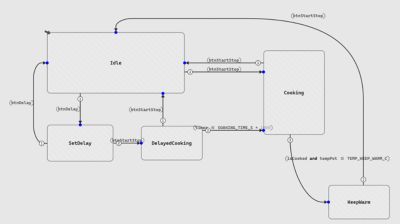
The Ansys Scade One model-based embedded software development solution model of a rice cooker
Faster Feature Development and Early Validation
Consumer appliances evolve continuously, requiring frequent updates to features and behavior. In traditional workflows, changes are implemented directly in code and validated only after integration on the target hardware, making errors costly to detect and fix.
With the Scade One solution, changes are made at the model level and can be validated immediately through simulation. For example, engineers can verify how a washing cycle behaves with different temperature and spin selections or ensure that the sequence of operations is correct without deploying code to the control board.
This enables early validation of system behavior, meaning that design errors are identified and corrected before having the electronic board available. As a result, development iterations are faster and the risk of late-stage rework is significantly reduced.
Reduced Manual Effort Through Automatic Generation
A key advantage of the Scade One solution is that the model becomes the central artifact from which implementation and documentation are derived.
On the implementation side, the Scade One solution automatically generates C code from the model. This eliminates the need to manually translate design into code, ensuring that the implemented behavior is fully consistent with the modeled behavior. Engineers can focus on software design rather than low-level programming, reducing development effort and eliminating coding errors. In fact, the Scade One design language enables non-programmers to describe complex behaviors.
On the documentation side, the model can be used to produce up-to-date descriptions of software behavior, such as state machines, functional descriptions, and interface definitions. Because documentation is derived from the model, it remains consistent with the actual system even as it evolves.
Together, these capabilities reduce manual work and ensure alignment among design, implementation, and documentation.
Efficient, Standardized Implementation for Embedded Targets
Home appliances run on cost-constrained embedded platforms where memory footprint, execution efficiency, and long-term maintainability directly impact product cost and competitiveness.
The Scade One solution addresses these constraints through an optimized code generator that produces compact, predictable, and structured C code directly from the model. The generated code is designed to:
- Be suitable for real-time systems
- Be suitable for low-end microcontrollers
- Ensure efficient time-bounded execution without unnecessary runtime overhead
- Minimize memory footprint
Because the generation process is systematic and optimized, the Scade One solution delivers code that is as efficient and robust as manual implementations. Beyond efficiency, coding discipline remains critical in appliance software. These systems must be:
- Reliable over long operational lifetimes
- Maintainable across product generations
- Portable across hardware platforms
- Testable despite limited on-board debugging capabilities
Poorly structured hand code would directly increase maintenance cost, regression risk, and time to market for new variants. The Scade One solution inherently enforces the following requirements through its code generation. The generated code:
- Is structured and avoids “spaghetti” patterns
- Complies with strict subsets of C aligned with standards, such as MISRA
- Avoids unsafe constructs (for example, uncontrolled pointers or dynamic allocation)
- Ensures consistency across the entire codebase
As a result, coding standards are effectively enforced by the Scade One code generator itself rather than relying solely on manual discipline, leading to more maintainable, reliable, and cost-efficient software implementations.
Compliance With IEC 60730
IEC 60730 is an international safety standard that defines requirements for automatic electrical controls used in household and similar equipment, including appliances; heating, ventilation, and air conditioning (HVAC) systems; and other consumer and industrial products. The standard addresses both hardware and software aspects of safety, with a strong focus on preventing hazardous situations arising from faults in electronic control systems. Through its risk‑based classification of control functions and detailed requirements for design, verification, and validation, IEC 60730 provides a recognized framework to ensure that safety‑related control software is developed and assessed in a structured, predictable, and auditable manner, supporting safe operation throughout the product life cycle.
The Scade One solution strongly supports compliance with IEC 60730 Annex H (Measures to avoid errors) by enabling a disciplined, model‑based software development approach that reduces systematic design and implementation errors. Through its deterministic execution semantics, structured architectural modeling, and precise definition of control flow, data flow, and timing behavior, the solution helps developers control software complexity and achieve clear traceability, from specifications to generated code. Automated, consistent code generation and early model‑level validation further reinforce conformance with IEC 60730 expectations for well‑structured design, rigorous verification, and error avoidance, making the Scade One solution a robust foundation for developing safety‑related control software in accordance with the standard.
The solution fits naturally into the development of software‑driven home appliances designed to meet the intent of IEC 60730. By making control logic explicit, deterministic, and easy to reason about, it helps teams structure their software in a way that supports the safety principles outlined in Annex H. Engineers can design and validate behavior early, keep complexity under control, and generate consistent embedded code without adding heavy process overhead. This approach supports robust safety mechanisms, scales well across product variants, and enables appliance manufacturers to meet IEC 60730 expectations while maintaining development speed and cost efficiency.
For more information, check out Scade One – Democratizing model-based development, and join us for this free session: Model‑Based Design Demystified: A Guided Introduction with Ansys Scade One.

Just for you. We have some additional resources you may enjoy.
Learn More
- Join the discussion: Scade One – Democratizing model-based development
- Watch the webinar: Model‑Based Design Demystified: A Guided Introduction with Ansys Scade One.


The Advantage Blog
The Ansys Advantage blog, featuring contributions from Ansys and other technology experts, keeps you updated on how Ansys simulation is powering innovation that drives human advancement.