Effect of Aspect Ratio on Wing Aerodynamics Using Ansys Fluent Software
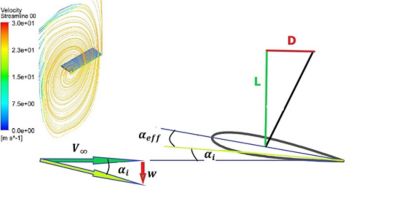
Design and analysis of aerodynamic performance of an aircraft wing is fundamental to modern aviation, enabling researchers to propose and validate new ideas to enhance aerodynamic efficiency. A wing is a structure which produces both drag and lift while moving through air, while the lift is intended, drag is approximately price to be paid. This case study covers how to connect the fundamentals of aerodynamics to better understand the different aspects of 2D vs 3D aerodynamics, associated phenomenon when teaching computational fluid dynamics (CFD) with Ansys Fluent® fluid simulation software. Understanding how finiteness of wing causes modifications in flow behavior and associated drag rise is crucial for aerospace applications, thus connecting fundamentals and application of theoretical aerodynamics. This case study explores the aerodynamic coefficients and spanwise pressure distribution as influenced by aspect ratio, highlighting the effectiveness of CFD in its understanding with the help of flow visualization.
Learning Outcomes
- Understand basic concepts of airfoil and wing aerodynamics.
- Investigate the effect of wing aspect ratio on aerodynamic characteristics of the wing.
- Observe the flow behavior through visualization using contour and vector plots.
Applicable Courses
- Fundamentals of Aerodynamics
- Computational Fluid Dynamics (CFD)
- Finite Wing Aerodynamics
Related Resources
Basics of Computational Fluid Dynamics Simulation with Ansys Fluent Software
Aerodynamics of Multiple Tandem Airfoils in Ansys Fluent Software
Transonic Aerodynamics of NACA 0012 Airfoil using Ansys Fluent Software
Related Resources
Case study document | Case, data, and mesh fines for three ratio cases