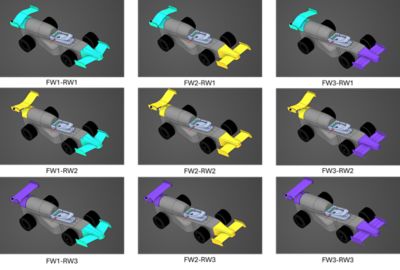
STEM Racing Car Wing Configuration Study in Ansys Discovery Software
This case study investigates the aerodynamic performance of a STEM Racing car by analyzing three front and three rear wing configurations using Ansys Discovery software. The study explores how variations in wing positioning and design influence key aerodynamic forces, namely drag and downforce. By leveraging the rapid simulation capabilities of Ansys Discovery software, the analysis provides insights into the complex interactions between car geometry and airflow. The study demonstrates the software’s effectiveness as a tool for early-stage aerodynamic design, enabling efficient evaluation of multiple configurations and guiding subsequent, more detailed simulations for optimization of the car’s performance.
NOTE: The simulations in this case study are run at 85 m/s (common straight-line speed of a professional race car) to better illustrate the results of wing impacts on design. The CAD file used for these simulations is provided with this case study, if the reader wishes to re-run results at appropriate speeds.
Learning Outcomes
- Understanding the effects of Front wing and rear wing configurations in drag and lift calculations
- Use of Ansys Discovery as an early-stage simulation tool effectively.
Applicable Courses for Use
- Aerodynamics
- Computational Fluid Dynamics
- CAD
- STEM Racing
Downloadable Content
- Case Study Report
- CAD File
Related Resources
Airfoil Turbulence Models in Ansys Fluent | Education Resources
Low Subsonic Speed Delta Wing | Education Resources
Flow around an Airfoil with Ansys Fluent | Education Resource