Designing the James Webb Space Telescope using Ansys Zemax OpticStudio
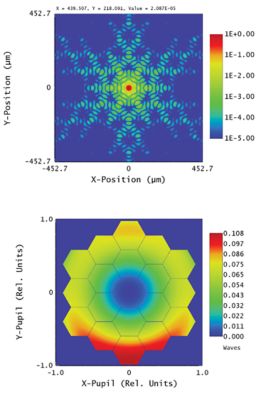
Developed at the University of California San Diego, this tutorial demonstrates how Ansys Zemax OpticStudio®, an optical system design and analysis software, can be used to model and analyze the James Webb Space Telescope (JWST). Starting with a basic three-mirror anastigmat (TMA) design, the tutorial guides users through system optimization using spot diagrams, wavefront maps, layout plots, and point spread functions.
Learners will explore key optical design principles, ray tracing, aberration analysis, and image plane optimization, along with non-sequential modeling techniques and interpreting simulation data in the context of real-world system behavior.
Adapted from UCSD’s ECE 181 course (Physical and Fourier Optics), this hands-on resource bridges theory and simulation, offering deep insights into advanced optical system design with OpticStudio.
Learning Outcomes
- Understand the Optical Design Principles of the JWST
- Optimize the image plane by correcting for field curvature and utilizing optimization wizards.
- Introduce non-sequential components in modeling. Interpret Wavefront and PSF Data.
Applicable Courses for Use
- Introduction to Optics and Photonics
Related Resource(s)
Lens Design in Ansys Zemax OpticStudio | Education Resources
Introduction to Optics with Ansys Tools | Education Resources
Downloadable Content
- Tutorial file PowerPoint