Case Study
-
-
Access Free Student Software
Ansys empowers the next generation of engineers
Students get free access to world-class simulation software.
-
Connect with Ansys Now!
Design your future
Connect with Ansys to explore how simulation can power your next breakthrough.
Free Trials
Products & Services
Learn
About
Back
Products & Services
Back
Learn
Ansys empowers the next generation of engineers
Students get free access to world-class simulation software.
Back
About
Design your future
Connect with Ansys to explore how simulation can power your next breakthrough.
Free Trials
“Thanks to this collaboration with Ansys, we have made a significant step forward in modelling the calendering process. We now have a qualitative tool that helps us better understand how key elements of the process influence calendering behavior and the formation of defects. This insight provides a strong foundation for guiding future process optimization and more physics informed decision making"
— Helen Walker
Senior Process Simulation Engineer / UK Battery Industrialisation Centre (UKBIC)
Calendering, the precise rolling and compressing of electrode materials, is crucial during battery manufacturing to achieve the desired electrode thickness and density. It is the last electrode processing step where performance and mechanical stability can be controlled. Further, it is the state of uniformity realized during calendering that supports optimal electrochemical performance. However, this rolling and compressing process is prone to producing material defects, such as embossing (buckling of the collector foil) and corrugation (contraction or folding of the coating) in proximity to the electrode. For UKBIC, both defects were suspected to be due in large part to roller geometry, process parameters such as web tensions and material variability, resulting in costly process adjustments and material waste.
Challenges
Traditionally, UKBIC quality concerns were managed through live process adjustments and by discarding defective material during calendering. Instead, the team believed it would be more valuable to forecast and mitigate material defects, including embossing and corrugation, in advance of production runs. However, previous methods were found to be ineffective in identifying when and how such defects might emerge during calendering.
Further, the calender rollers on its Industrial Scale-up Line (ISL) — a line designed to support companies in developing and scaling their battery technologies — are not perfectly cylindrical, but instead have a crowning profile, with a slightly larger radius near the center due to the large capital expenditure and time required to procure calendaring rollers with different specifications.
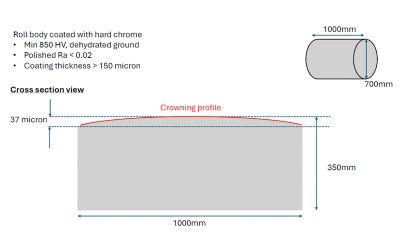
Schematic of UKBIC crowned calendering roller.
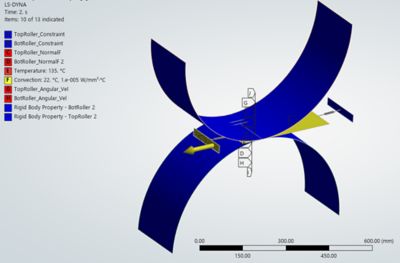
Outline of structural model boundary conditions.
Engineering Solutions
UKBIC, in collaboration with Ansys, part of Synopsys, has developed a thermomechanical model of the calendering process. Ansys Mechanical software was used for mesh generation and the majority of the finite element model setup. LS-DYNA was the software determined best suited to perform the time-explicit structural simulations needed to complete the model setup, solve the numerical model, and post-process results.
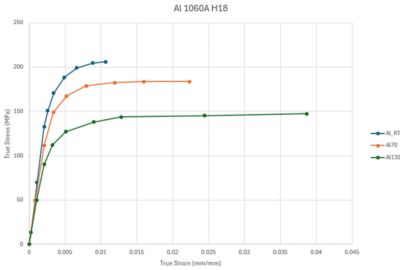
Tensile tests of UKBIC aluminum foil at different temperatures.
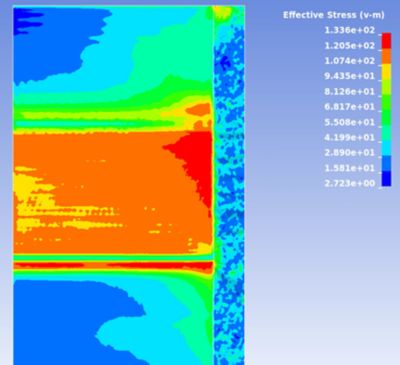
Von Mises Stress plot of the current collector foil. This type of plot is used to graphically represent yield criteria of ma-terials under complex loading conditions to predict at what point a material will yield or fracture.
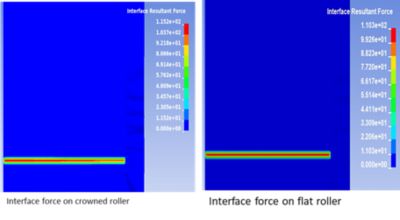
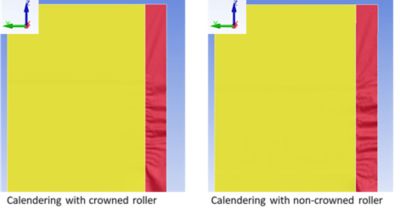
Interface force plot or tip sample interaction on the flat roller (top left) versus the crowned roller (top right). In this comparison, the crowned roller actually reduces the clamping force on edges of the coated region. This makes the mass-free zone less stiff and thus more prone to buckle for the same applied compression force as shown by embossing with the flat roller (bottom left) versus embossing with a crowned roller (bottom right).
Benefits
- A crushable foam, temperature-independent model provided a faster way to assess not only the impact but the physics behind how crowning affects the formation of calendering defects.
- The model was used predict the macroscale buckling behavior of the electrode during and calendering to further understand how defects are initiated.
- Using LS-DYNA software in conjunction with the developed model, UKBIC could predict the local stress and strain field within the electrode as a natural consequence of solving the finite element model.
- Comparing the predicted local stress with material failure strengths, it was possible to determine whether web breaks (foil tear) might occur with a given combination of line load, web tension, and line speed factors.
- Evaluation could be further contextualized according to different geometry configurations, including multi-lane and intermittent coating, coating thickness variability, corrugation coating defects, and the effect of roller dimensions on coating.
- With the given model constraints, a qualitative model was generated enabling web embossing predictions.
In future work, UKBIC plans to couple particle scale simulations performed in Ansys Rocky with the LS DYNA calendering model, enabling investigation of how different binder configurations and electrode chemistries influence process behavior. This approach will allow coating performance to be linked to advanced nonlinear viscoelastic material models in LS DYNA software which capture the complex response of electrode materials under realistic loading conditions.
Other future areas of investigation will involve anisotropic foil material, or substances whose physical properties vary subject to directional measurement, and temperature dependence on material properties.
Let’s Get Started
If you're facing engineering challenges, our team is here to assist. With a wealth of experience and a commitment to innovation, we invite you to reach out to us. Let's collaborate to turn your engineering obstacles into opportunities for growth and success. Contact us today to start the conversation.