Skip to Main Content

Ansys Lumerical FDTD
Simulation of Photonic Components

Ansys Lumerical FDTD is the gold-standard for modeling photonic components, processes, and materials. The integrated design environment provides scripting capability, advanced post-processing, and optimization methods.

ANSYS LUMERICAL FDTD

Industry’s Leading Choice for Versatile and Scalable Photonic Design

Ansys Lumerical FDTD is photonic simulation software that integrates FDTD, RCWA, and STACK solvers in a single design environment. This empowers precise analysis and optimization for various devices, including diffraction gratings, multilayered coatings, uLEDs, CMOS image sensors, metalenses, and metasurfaces, delivering best-in-class performance across diverse applications. Ansys Lumerical FDTD empowers rapid virtual prototyping and verification of thousands of iterations for the most complex designs.

  • Check icon outline
    Advanced photonic with FDTD, RCWA, or STACK
  • Check icon outline
    Multiphysics and Multiscale Workflows
  • Check icon outline
    Scalable HPC, GPU, and Cloud
  • Check icon outline
    Foundry Compatible and Customized Design
ansys lumerical fdtd

Quick Specs

Ansys Lumerical FDTD works seamlessly with Ansys Lumerical CML Compiler, Ansys Multiphysics solvers, Ansys Speos, Ansys Zemax, and third-party electronic-photonic design automation (EPDA) vendors to enable fast, accurate, scalable photonic design.


  • Performance and accuracy with FDTD
  • Periodic structures analysis
  • Multilayer thin films analysis
  • Scale with HPC, GPU, and cloud
  • Connects with multiscale and multiphysics
  • Simulate gratings, polarizers, and coatings
  • Connect with optiSLang for optimization
  • Automation API
  • Particle swarm

March 2026

What's New

The 2026 R1 Release of Ansys Lumerical FDTD enhances photonic and electronic design workflows with Synopsys interoperability, advanced PIC and CMOS sensor capabilities, and Python automation through PyLumerical, delivering scalable, production-ready solutions for semiconductor and telecom industries.

Ansys Lumerical FDTD 2026 R1 Workflow
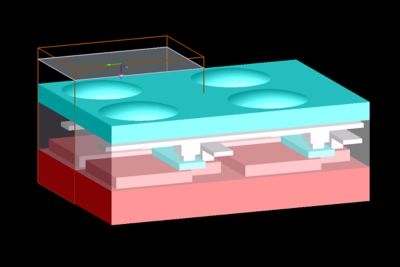
Sentaurus TCAD-Lumerical FDTD Workflow

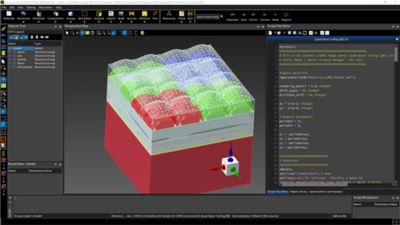
Optimize CMOS Image Sensor design with Ansys Lumerical FDTD. Seamlessly load TCAD structures, simulate optical performance, and export results to SDevice. Address geometry propagation, etch bias, thickness variability, and electro-thermal-optical coupling. Perfect for semiconductor and high-tech industries, this solution ensures accurate simulations for advanced optical and electronic device development.

Py Lumerical FDTD 2026 R1
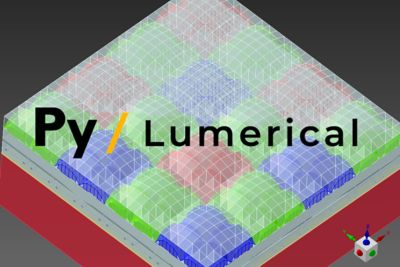
PyLumerical

Automate Lumerical tools seamlessly with PyLumerical, a Python-based solution. Fully compatible with the PyAnsys ecosystem, it integrates with FDTD, MODE, multiphysics, INTERCONNECT, and other Ansys tools like OptiSLang and Speos, plus open-source Python libraries. Simplify workflows and enhance multiphysics simulations with this modern, efficient approach.

Ansys Lumerical FDTD OptoCompiler
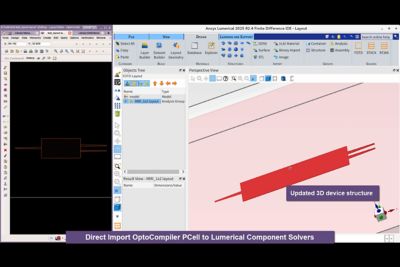
OptoCompiler-Lumerical Synergy

Enhance photonic component design with the seamless synergies of Ansys Lumerical FDTD and Synopsys OptoCompiler. This direct bridge enables photonic VA model generation using CML Compiler for PrimeSim, driving innovation in telecom, semiconductor, and high-tech industries. Boost your design efficiency with this powerful toolset for next-generation photonics.

Ansys Cloud Burst Compute for Ansys Lumerical FDTD
Ansys Cloud Burst Compute for Ansys Lumerical

Experience flexible accelerated simulation workflows with the new features in Ansys Cloud Burst Compute for Ansys Lumerical FDTD. Add jobs easily, perform S-parameter sweeps, and use cost-effective spot instances. Plus, submit and forget—simulations run seamlessly in the cloud, even if you close the application.

Ansys Lumerical GPU Accelerated FDTD Simulations
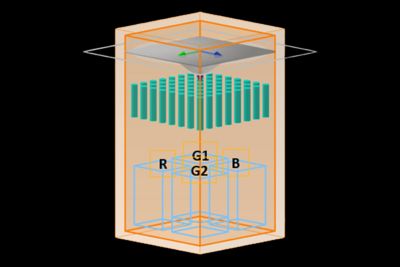
GPU-Accelerated FDTD Simulations

The latest GPU-accelerated features in Ansys Lumerical FDTD include a broadband source for efficient multi-frequency analysis and a volumetric current source optimized for LumOpt tasks. These enhancements streamline simulations, improving performance and enabling precise design optimizations, such as CMOS image sensor development, with GPU-based processing.

Ansys Lumerical FDTD 2026 R1 Modern Viewport Improvements
Modern Viewport Improvements

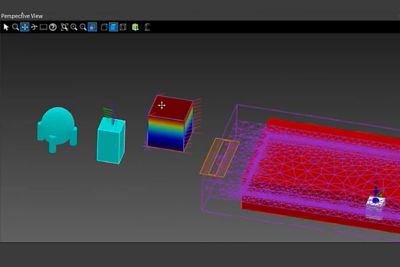
Modern Viewport Improvements in Ansys Lumerical FDTD deliver faster geometry construction, support for simulation ports and image imports, and a streamlined, ergonomic interface. With the modernized 3D CAD Viewport now default at launch, users can experience enhanced performance and functionality for more efficient simulations.

CAPABILITIES

Versatile and Scalable Photonic Design Powered by Lumerical FDTD

Lumerical FDTD is industry’s leading simulation software for design and optimization of a wide range of photonic components. Lumerical FDTD is remarkably versatile and scalable, offering unmatched speed and the ability to harness HPC (CPU and multi-GPU) and cloud resources.


Key Features

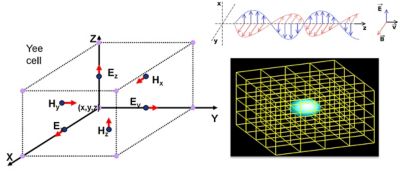
  • FDTD – 3D Electromagnetic Solver
  • RCWA – Rigorous Coupled Wave Analysis
  • STACK – Optical Multilayer Solver
  • Photonic Inverse Design Optimization
  • Scale and Accelerate with HPC and Cloud
  • 3D CAD Environment
  • Layer Builder
  • Lumerical connectors in Ansys OptiSLang
  • Ansys Optics Solution Interoperability

It has high accuracy with options for auto non-uniform meshes. Lumerical FDTD is also foundry compatible and supports automated design processes with its scripting capabilities, advanced post-processing, and optimization routines.

RCWA provides fast simulations of complex multilayer stacks with surface patterning, from capturing the electric and magnetic field distributions to transmitting, reflecting, and evaluating power in each grating order.

It is ideal for rapid prototyping for thin film applications. From capturing microcavity effects and interference to handling dipole illumination and plane wave functions, STACK provides quick simulations of complex thin film multilayer stacks.

Discover non-intuitive geometries that optimize performance, minimize area, and improve manufacturability.

Choose from various nonlinear, negative index, and gain models. Define new material models with flexible material plug-ins.

Automatically generate models from sample data or define the functions yourself.

FDTD’s CAD environment and parameterizable simulation objects allow rapid model iterations for 2D and 3D models. It provides eye comfort with Dark Mode and is fully compatible with 4k high DPI screens and modern 3D views. 

Change the position, ordering, and thickness of each layer. Simulate curved side-angled waveguides, then export the layer configuration, including material data, as a process file (.lbr) that foundries can fabricate.​

Automate multiphysics simulation workflows and benefit from the state-of-the-art sensitivity analysis and optimization algorithms available in optiSLang.

The Lumerical Sub-Wavelength Model (LSWM) plugin allows you to simulate and design coatings, polarizers, and diffraction gratings in OpticStudio and Speos.

Ansys Cloud Burst Compute provides secure, scalable, on-demand HPC access directly within Ansys Lumerical FDTD, eliminating the need for dedicated IT resources or cloud infrastructure maintenance.

rockley-photonics-logo.jpg

Rockley Photonics

Rockley conducted multiple 2D and 3D single time-domain simulations using Lumerical software on Amazon’s Elastic Compute Cloud (EC2) thus allowing for the extraction of high-resolution spectra.

xanadu-logo.jpg

Xanadu

Xanadu builds X8 quantum computing chip with unprecedented low-loss performance while significantly accelerating their design schedule.

Ligentec

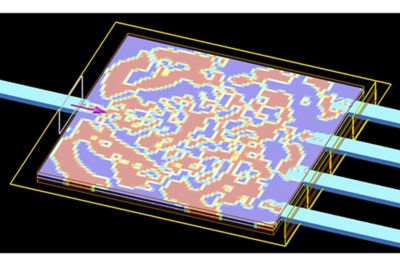
LIGENTEC Leveraged Ansys Lumerical Photonic Inverse Design for a Compact Waveguide Crossing Design

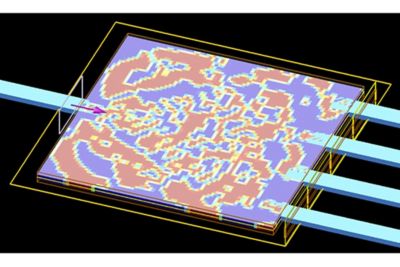
LIGENTEC used Photonic Inverse Design (PID) capabilities in Ansys Lumerical FDTD for the design and optimization of its waveguide crossing.

White Papers

View More

Diffraction

Maximizing Design Flexibility for Multi-layered and Diffractive Optical Components

Learn how the finite-difference time-domain (FDTD), rigorous coupled-wave analysis (RCWA), and STACK solvers in Ansys Lumerical FDTD can be used to simulate nanostructured, multilayered optical components. 

2020-12-white-paper-icon-block.jpg

Designing for Success: A Solver Combination Strategy for Photonic Integrated Components

This white paper discusses approaches for addressing photonic integrated circuit (PIC) component simulation challenges with a combination of optical solvers. 

Videos

Application Gallery

2020-12-application-brief-icon-block.jpg
Application

Photonic Inverse Design Grating Coupler (3D)

In this example, we use the Inverse Design Toolbox (lumopt) to optimize a 3D SOI grating coupler.

2020-12-application-brief-icon-block.jpg
Application

Polarization-sensitive plasmonic reflectors for HUD – Speos Interoperability

or a HUD that needs to reflect polarized lights, here we demonstrate periodic plasmonic nanostructures that could provide significant reflection for certain polarization.

2020-12-application-brief-icon-block.jpg
Application

Micro-LED

In this example, we use the STACK optical solver and FDTD to characterize a cylindrical micro-LED and extract the emitted power and radiation pattern.

2020-12-other-icon-block.jpg

FDTD Product Reference Manual

The FDTD reference manual provides detailed descriptions of product features.

2020-12-other-icon-block.jpg

RCWA Product Reference Manual

The RCWA reference manual provides detailed product descriptions of product features. 

2020-12-other-icon-block.jpg

STACK Product Reference Manual

The STACK reference manual provides detailed descriptions of product features.

Ansys software is accessible

It's vital to Ansys that all users, including those with disabilities, can access our products. As such, we endeavor to follow accessibility requirements based on the US Access Board (Section 508), Web Content Accessibility Guidelines (WCAG), and the current format of the Voluntary Product Accessibility Template (VPAT).

Let’s Get Started

If you're facing engineering challenges, our team is here to assist. With a wealth of experience and a commitment to innovation, we invite you to reach out to us. Let's collaborate to turn your engineering obstacles into opportunities for growth and success. Contact us today to start the conversation.