Skip to Main Content

The Quest for Speed: Simulating the Pedaling Cyclist with Dynamic CFD

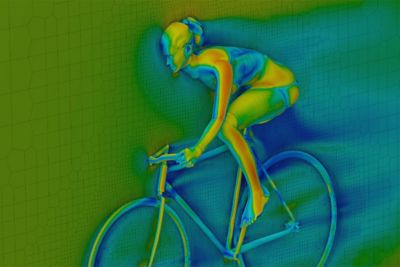
Aerodynamics is one of the most critical factors in time trial performance. To optimize it, the Groupama-FDJ cycling team relies on a combination of three methods: wind tunnel testing, on-road testing, and numerical simulation (CFD). However, previous CFD studies have primarily relied on static cyclist models, which fail to capture the full scope of dynamic aerodynamic effects.

This study tackles this limitation by implementing a pedaling cyclist in our CFD simulations using the overset mesh method in Ansys Fluent. By introducing this dynamic motion, we can accurately simulate the complex airflow around a moving athlete. The results demonstrate a strong correlation with surface data collected from wind tunnel tests, particularly regarding drag coefficients, and enable a deep analysis of the cyclist's transient wake. Ultimately, this successful pilot study validates the overset method for our applications and establishes a robust foundation for exploring more advanced aerodynamic research in the future.
Date/Time:
July 20, 2026
11:00 AM EDT / 4:00 PM GMT / 5:00 PM CEST

Venue:
Virtual

Register Now

This site is protected by reCAPTCHA and the Google Privacy Policy and Terms of Service apply.

About this Event

In time trial cycling, aerodynamics is a key driver of performance, where marginal improvements can lead to significant competitive advantages. Teams like Groupama-FDJ rely on a combination of wind tunnel testing, on-road measurements, and computational fluid dynamics (CFD) to refine their approach—yet many CFD models still depend on static rider positions, limiting their ability to fully capture real-world conditions.

This session introduces a more advanced CFD methodology using Ansys Fluent to simulate a pedaling cyclist through the overset mesh technique. By incorporating dynamic motion, this approach enables a more realistic representation of airflow around the rider and uncovers complex, time-dependent aerodynamic effects.

Join us to see how this method closely matches wind tunnel data, particularly in drag prediction, while providing deeper insight into transient wake behavior. This work establishes a validated foundation for applying dynamic simulation to cycling aerodynamics, opening new opportunities for performance optimization and future research.

What you will learn 

  • Learn how dynamic CFD simulation using a pedaling cyclist improves fidelity over traditional static models in cycling aerodynamics
  • Understand how the overset mesh method in Ansys Fluent captures complex airflow, rider motion, and transient wake effects
  • See how simulation results align with wind tunnel data to support more accurate drag prediction and performance optimization

Speakers

Antoine Dulac - Aerodynamic intern, Groupama-FDJ United Cycling team

Ansys Discovery cycling simulation

Secure Your Place Today