Skip to Main Content

The Type of Team Car Can Determine Who Wins the Individual Time Trial

Earlier, scientific studies by Bert Blocken and his research team in collaboration with Ansys, part of Synopsys, were the first to demonstrate that a team car following a cyclist  can provide a significant aerodynamic advantage to this cyclist. However, up to now this work has been done only for a typical estate car, while the guidelines of the International Cycling Union (UCI) allow other types of cars and some different types have been used in the past. The guidelines also stipulate a minimum distance between car and cyclist of 25 m but this rule is not enforced.

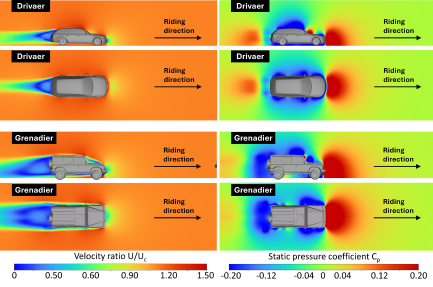
The present new study analyses the impact of the type of the team car on the cyclist aerodynamics. The cars analysed include the small Mercedes Smart, an aerodynamic Jaguar, the academic Drivaer car, the academic AeroSUV, the Grenadier SUV, and three trucks with increasing number of aerodynamic features. It is shown that the drag reduction for the cyclist followed by a Grenadier team car is 1.27, 0.50 and 0.28% higher than with a typical Estate car (Drivaer) for a distance of 5, 10 and 25 m, respectively. This corresponds to extra time savings of about 0.27, 0.12 and 0.05 s per kilometre. For a 25 m time trial, the resulting time gains of 6.7, 3.0 and 1.2 s could determine who wins the race.           
Date/Time:
July 13, 2026
11:00 AM EDT / 4:00 PM GMT / 5:00 PM CEST

Venue:
Virtual

Register Now

This site is protected by reCAPTCHA and the Google Privacy Policy and Terms of Service apply.

About this Event

Aerodynamics is a critical factor in cycling performance, yet the role of team vehicles is often underestimated. Building on pioneering work by Bert Blocken and collaborators with Ansys (part of Synopsys), this session explores how different team car designs influence the aerodynamic drag experienced by riders.

Expanding beyond earlier studies focused on a single vehicle type, this research examines a range of cars—from compact vehicles to SUVs and trucks—within UCI regulations. Using advanced CFD simulations, it reveals how vehicle geometry and following distance shape airflow and can produce measurable performance gains.

Attendees will discover how subtle reductions in drag translate into meaningful time savings in competitive racing. With clear implications for race strategy and engineering design, this session demonstrates how simulation-driven insights are helping teams better understand and optimize cycling aerodynamics.

What you will learn 

  • How team vehicle design and positioning influence cyclist aerodynamic drag and overall performance
  • How CFD simulation reveals airflow interactions between riders and different vehicle types within UCI constraints
  • How small drag reductions translate into measurable time gains and inform race strategy and engineering decisions

Speakers

Professor dr. Bert Blocken - Heriot-Watt University & LUT University

Ansys Discovery cycling simulation

Secure Your Place Today