Skip to Main Content

From Imaging Data to Simulation: Accelerating Patient-Specific Cardiac Solutions with AI - A Synopsys and Ansys Workflow

This webinar presents an automated workflow from imaging data to numerical simulation, integrating Synopsys Simpleware with LS-DYNA Multiphysics solvers. The Simpleware software offers AI/ML-enabled segmentation solutions that are able to convert medical image data, from CT or MRI, to high-quality patient-specific models, extracting regions of interest, performing segmentation, landmarking and generating simulation-ready meshes.

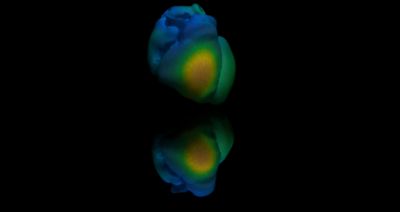
An optimized pipeline has been developed on building numerical models for flow simulation in a pumping heart. Using 4D gated CT scans, the Simpleware generated meshes are translated into heart motions, and input into LS-DYNA for flow modeling with incompressible computational fluid dynamics (ICFD) solver. This fully automated process takes less than 30 minutes and significantly accelerates model preparation for studying hemodynamics in diseased hearts and supporting the design and development of medical devices.

A second workflow has been developed to feed the solid mesh for the heart structure generated from CT scans in Simpleware into PyAnsys-Heart. PyAnsys-Heart completes the mesh into patient-specific geometry LS-DYNA heart models that include electrophysiology and structural.
Watch Presentation

This site is protected by reCAPTCHA and the Google Privacy Policy and Terms of Service apply.

About this Event

This session introduces an end-to-end automated process for turning medical image data into simulation-ready models by linking Synopsys Simpleware with LS-DYNA multiphysics solvers. Leveraging AI/ML-based segmentation, Simpleware rapidly processes CT and MRI scans into accurate, patient-specific geometries by isolating key regions, adding landmarks, and producing high-quality meshes.

One workflow highlights the use of 4D gated CT scans to capture cardiac motion. These datasets are meshed in Simpleware and then applied within LS-DYNA’s incompressible CFD solver to simulate blood flow dynamics in a pumping heart. The pipeline completes in under 30 minutes, offering a major time savings for researchers studying cardiovascular disease or designing novel medical devices.

Another workflow focuses on structural modeling: CT-derived heart meshes are integrated with PyAnsys-Heart, which enriches them into detailed patient-specific LS-DYNA models that incorporate both mechanical behavior and electrophysiology.

Together, these approaches demonstrate how automated imaging-to-simulation pipelines can accelerate the creation of high-fidelity cardiac models, enabling deeper insight into hemodynamics and device performance.

What you will learn 

  • How to streamline patient-specific heart modeling — Learn how advanced tools from Synopsys, Ansys, and PyAnsys Heart reduce simulation setup time.

  • Real-world applications in diagnosis and surgical planning — See how fast, accurate heart simulations might be transforming clinical workflows and improving patient outcomes in the future.

    The future of in silico clinical trials — Discover how scalable virtual heart cohorts can accelerate cardiovascular research and support regulatory decision-making.

Speakers

  • Rebecca Bryan - Senior Staff Product Manager, Synopsys
  • George Hyde-Linaker - Senior Engineer, Synopsys
  • Peggy Huang - R&D Engineer, Synopsys
  • Christoph Mauarth - Lead R&D Engineer, Synopsys
simulation of plane flying