Synopsys and Ansys power the future of innovation—connecting silicon to systems.
-
-
Access Free Student Software
Ansys empowers the next generation of engineers
Students get free access to world-class simulation software.
-
Connect with Ansys Now!
Design your future
Connect with Ansys to explore how simulation can power your next breakthrough.
Free Trials
Products & Services
Learn
About
Back
Products & Services
Back
Learn
Ansys empowers the next generation of engineers
Students get free access to world-class simulation software.
Back
About
Design your future
Connect with Ansys to explore how simulation can power your next breakthrough.
Free Trials
TOPIC DETAILS
What is an Acoustic Vehicle Alerting System (AVAS)?
An acoustic vehicle alerting system (AVAS) is an automotive module that generates unique warning sounds and plays them through loudspeakers mounted in the vehicle body, providing information to other road users about the location, speed, and direction of travel of the vehicle. In response to safety experts and advocates for the visually impaired, the automotive industry developed the technology for electric vehicles (EVs) and hybrid vehicles because people can’t hear them at low speeds.
Generally, automobiles generate sound from three sources:
- Engine Noise: The mechanical systems that provide torque for wheels all generate some noise and the noise level can be very high for internal combustion engines. Various cooling fans can also generate sound, but they are not always on. Electric motors do produce a whine at higher speeds, and fuel cell engines have blowers and pumps that contribute to engine noise.
- Rolling Noise: Tires make a sound as they roll over a road surface. The level of sound depends on the tire design, road surface, and the vehicle’s speed.
- Aerodynamic Noise: Air passing around the vehicle can generate turbulent flow at higher speeds, also creating sound that gives a clue to pedestrians. However, there is very little aerodynamic noise at low speeds.
People walking along or across roads, cyclists, or children near roads, use the vehicle sounds like these as an audible warning that a vehicle is approaching. This is especially important for people who are visually impaired or distracted by other activities, such as looking at their phone or talking to someone else, while walking. When electric cars started joining their noisier counterparts, the lack of sound at low vehicle speeds became a pedestrian safety issue. A 2009 study by the National Highway Traffic Safety Administration (NHTSA) found that hybrid electric vehicles using their electric motor were twice as likely to be involved in a pedestrian crash and 1.7 times more likely to be in a crash with a bicycle. At speeds around 12.4 mph (20 kph), road and aerodynamic noises are loud enough to be heard, so generated sound is no longer needed.
Purpose and Modules Related to Acoustic Vehicle Alerting Systems
Automotive manufacturers incorporate AVAS modules in their electric and hybrid vehicles for three reasons:
- Pedestrian Safety: The warning sounds generated by AVAS reduce the risk of collisions with vulnerable road users, such as pedestrians and cyclists. Common situations addressed by generated noise include people crossing roads in and out of crosswalks, walking around parked cars, or passing behind a car that is backing up.
- Sound Branding: Sound generation for safety at low speeds also presents an opportunity for automobile manufacturers. Automotive manufacturers can create a unique sound for their AVAS solutions to provide a standard for their vehicles.
- Regulatory Compliance: Many countries have mandated the use of AVAS in vehicles that don’t produce engine noise at low speeds. This includes battery electric vehicles (BEVs), plug-in hybrids, gas-electric hybrid vehicles, and some hydrogen fuel-cell cars.
An acoustic vehicle alerting system usually contains the following modules:
- Controller Area Network (CAN) Bus: The AVAS needs input about what the car is doing to produce the proper sounds at the specified volume and frequency combinations. This information comes from the vehicle’s CAN bus, which is connected to sensors and devices that measure or capture vehicle speed, gear setting, accelerator and brake position, ambient noise, and acceleration.
- Processing: This is the brain of the system. It consists of an electronic control unit (ECU), sound engine, amplifier, and CAN bus interface.
- Output: The processing module uses the sensor input to generate sound via the system's output module. The primary components for an AVAS output module are the loudspeakers, wiring, housings, and brackets. Some vehicles use active vibration of existing vehicle panels like the front hood to generate the sound.
Regulations Driving Acoustic Vehicle Alerting Systems
Initial regulations for internal combustion engine-powered vehicle noise focused on reducing noise pollution and improving driver awareness. Now, governing bodies have implemented standards to ensure that EVs and related vehicles produce sounds that enhance safety. The resulting regulations dealing with pedestrian warning systems serve two purposes:
- They provide legal means to protect road users and provide consistent guidelines to vehicle engineers.
- The regulations include measurable quantities that those engineers can design to.
Although each country or region has its own safety standard for AVAS, almost all of them specify the following for specific vehicle speeds:
- Audible: The noise volume at different speeds is loud enough to be heard in real-world situations.
- Recognizable: People near the car can identify the noise as a signal of the vehicle's location and direction over time.
- Relevant: The sounds generated give additional audible clues, such as speed, not moving, or backing up.
Commonly Applied AVAS Regulations
Below are some of the more commonly applied regulations and guidelines that apply to acoustic vehicle alerting systems.
United Nations Regulation No. 138 (UN r138)
This international standard is accepted by the majority of nations, including Japan, the European Union, Australia, and the UK. UN r138 is comprehensive, including information for engineers on volume and frequency as well as testing. The important requirements for covered AVAS systems include:
- Emits sound from start-up to 12 mph (20 kph).
- Generates a recognizable reverse sound at or above a minimum volume when backing up.
- Produces no sound when the vehicle is stationary.
- Emits sound at specific minimum volume levels for different speed ranges.
- Creates a tone that makes at least two frequencies in specific ranges.
- Varies the pitch in the generated sound to indicate acceleration (increase frequency) and deceleration (decrease frequency) at a rate of at least 0.8% for each 1 kph change in speed.
US Federal Motor Vehicle Safety Standard (FMVSS) 141
Hybrid and electric vehicles operating in the US that have a gross vehicle weight rating (GVWR) of 10,000 pounds or less must comply with FMVSS no. 141, “Minimum Sound Requirements for Hybrid and Electric Vehicles.”
The important requirements for covered AVAS modules include:
- Emits sound from start-up to 18.64 mph (30 kph).
- Generates a recognizable reverse sound at or above a minimum volume when backing up.
- Produces a sound when the vehicle is stationary and in gear.
- Emits sound at specific minimum volume levels for different speed ranges and frequency bands.
- Varies the sound volume with acceleration and deceleration by 3 dB for every 10 kph change in speed.
- Creates a tone that creates at least two and up to four frequencies in specific ranges.
- Produces the same sound for a given make, model, model year, body type, and trim level.
China GB/T 37153
The standard in China mostly follows UN r138. However, it mandates a volume level 2 dB louder than the UN standard because of high ambient noise levels in Chinese cities. It also allows operators to turn off the AVAS module using a pause switch.
SAE J2889-1 and ISO 16254
These closely related industry standards are not legally required. They specify accepted methods for measuring the sound created by acoustic vehicle alerting systems. The standards include guidelines for test track surfaces, background noise correction, and microphone placement.
How are AVAS Sounds Designed?
Creating AVAS sounds combines engineering, aesthetics, innovation, efficiency, and safety needs into a single creative effort to produce a product that meets all of these often-conflicting goals. That is why automotive manufacturers call on the expertise of sound designers to drive the design of their AVAS sounds.
Every team approaches the process differently, but they all start with the branding goals, regulations, and additional safety requirements, and then experiment with different sounds. They may use sample sounds, digital effects, musical instruments, or everyday objects to explore unique acoustic combinations that enhance road safety, meet regulatory requirements, and build the company’s brand image.
Where volume and frequency requirements can be specified from the rules, reinforcing the brand image with sound is an iterative process. They start by brainstorming brand-specific symbolism to guide the sound engineers. That could be a natural and organic sound like wind and water. Or they may want a strong and cinematic impression. Some brands may even prefer for their EVs to share the signature rumble of their legacy gas-powered models.
AVAS example 1: soothing and harmonious
AVAS example 2: smooth and whirring
AVAS example 3: sporty and futuristic
Once the team identifies that brand vision, the next step is to look at how the sounds generated by the AVAS interact with the operating sounds of the vehicle. The sounds may complement or mask each other. Another key aspect that sound engineers consider is whether the sound combinations are harmonic or dissonant. They also have to look at how people perceive sounds. A famous example of an unexpected response from pedestrians occurred when Jaguar used a spacecraft-inspired sound for its AVAS, prompting people to look up at the sky.
Driving Better AVAS Sound Designs with Simulation
To account for these complexities, sound designers use simulation software like Ansys Sound post processing sound design software to experiment with, test, optimize, and validate different sound design ideas. They can start with a baseline set of sounds, then vary properties like timbre, pitch, and loudness to sculpt new audible creations. They can then explore how those sounds change with driving parameters like motor RPM, speed, acceleration, and torque. The software makes it easy to change parameters and then hear the sounds in real time in the lab, in a driving simulator, or through the vehicle's AVAS hardware on the vehicle. Using a simulation tool like Ansys Sound allows engineers to iterate quickly and not wait for changes to physical prototypes, which can take weeks.
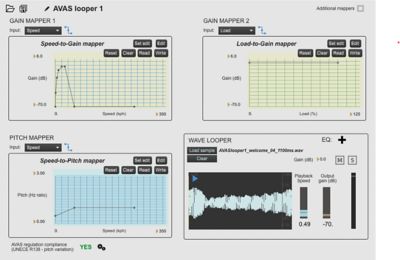
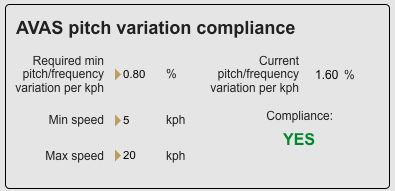
Ansys Sound screenshots showing sound tuning (left) and AVAS compliance checks.
Future Challenges and Opportunities for AVAS
Although acoustic vehicle alerting systems are a well-established safety feature in EVs and hybrid vehicles, the growing adoption of EVs will pose challenges. The most significant is the potential for a new type of noise pollution. As more EVs take to city streets, the sound of all their AVAS loudspeakers may contribute to urban noise pollution. Also, because different brands generate very different sounds at the same time, the combination may distract pedestrians. And, in some cases, the sound of two or more vehicles may clash, sounding annoyingly like a beginner’s school band instead of a seasoned symphony orchestra.
Some of the enhancements being worked on by design teams include:
- Adaptive soundscapes that change based on the environment, such as school zones, hospitals, pedestrian streets, or the countryside.
- Smart city integration, where AVAS interacts with urban sensors or pedestrian smartphones.
- Vehicles sensing the sound of other noise sources, including other vehicles, and adjusting the sounds to be more harmonious.
- Combination of AVAS with visual signals for noisy environments.
At the same time, greater EV adoption and the development of other technology megatrends present opportunities. Autonomous vehicles will need additional warning sounds because there is no driver to honk a horn or alert potential passengers of their arrival. Artificial intelligence (AI) will also allow sound designers to explore and synthesize even more sound options and test them with greater speed and accuracy.
Related Resources
Let’s Get Started
If you're facing engineering challenges, our team is here to assist. With a wealth of experience and a commitment to innovation, we invite you to reach out to us. Let's collaborate to turn your engineering obstacles into opportunities for growth and success. Contact us today to start the conversation.