Case Study
-
-
Access Free Student Software
Ansys empowers the next generation of engineers
Students get free access to world-class simulation software.
-
Connect with Ansys Now!
Design your future
Connect with Ansys to explore how simulation can power your next breakthrough.
Free Trials
Products & Services
Learn
About
Back
Products & Services
Back
Learn
Ansys empowers the next generation of engineers
Students get free access to world-class simulation software.
Back
About
Design your future
Connect with Ansys to explore how simulation can power your next breakthrough.
Free Trials
“Integrating simulation into the design workflow enhances the entire product development process—not only by reducing design cycle time, but also by accounting for manufacturing variability and supporting regulatory validation. Granta MDS helps accelerate the selection and application of appropriate material properties, enabling a more advanced and reliable development workflow for highperformance antenna design.”
— Hino Akihiro
Section Head, Furuno Electronic Co., Ltd., Technical Research Institute, Second Research Department, Radar Laboratory
FURUNO is a global leader in marine radar systems, where antenna performance plays a critical role in both safety and product competitiveness. As performance requirements continue to rise, FURUNO has been advancing its antenna design and validation processes. Historically, development relied heavily on physical testing, but this approach became increasingly insufficient as antenna designs grew more complex. To overcome these challenges, FURUNO adopted a simulation-driven workflow that integrates electromagnetic simulation with accurate material data using Ansys, part of Synopsys, tools. This approach improved digital validation, reduced uncertainty, and accelerated the development of high-performance marine radar antennas.
Challenges
Achieving high performance demands both physical testing and digital simulation. Accurate simulations that reflect real-world behavior enable engineers to understand how design parameters affect performance, leading to efficient optimization, enhanced competitiveness, and reduced development time. A major challenge is the waveguide design, which is essential for radar detection. High-performance antennas require precise models and valid material data, as high gain and low sidelobes significantly influence overall product performance and quality.
Engineering Solutions
- Accurate simulation of waveguide reflection characteristics using HFSS software
- Application of appropriate material properties from Granta MDS software to the waveguide and absorbing components within the simulation model
- Validation of design margins accounting for manufacturing variability
- Design review to ensure compliance with applicable regulations and guidelines
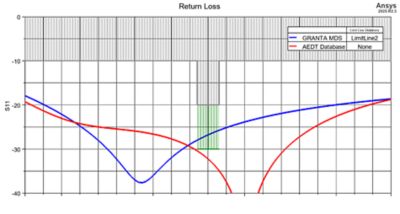
Reflection characteristic of S11: The simulation result using material properties from Granta MDS (blue) reduces the design margin (green) and meets the design requirements (gray), compared with the result using materials from AEDT (red).
Benefits
Accurate material properties enable FURUNO engineers to create credible simulation models that could validate by test results. This enabled simulations for design validation, assessment of manufacturing variability, and review of designs against regulations. Granta MDS software eliminated manual material property matching, streamlined workflows, and enabled engineers to focus on material effects in simulations rather than on experimental outcomes. Consequently, teams identified critical modeling factors more easily, gained valuable insights, enhanced design capabilities, and ultimately reduced product development time.
Let’s Get Started
If you're facing engineering challenges, our team is here to assist. With a wealth of experience and a commitment to innovation, we invite you to reach out to us. Let's collaborate to turn your engineering obstacles into opportunities for growth and success. Contact us today to start the conversation.