Synopsys and Ansys power the future of innovation—connecting silicon to systems.
-
-
Access Free Student Software
Ansys empowers the next generation of engineers
Students get free access to world-class simulation software.
-
Connect with Ansys Now!
Design your future
Connect with Ansys to explore how simulation can power your next breakthrough.
Free Trials
Products & Services
Learn
About
Back
Products & Services
Back
Learn
Ansys empowers the next generation of engineers
Students get free access to world-class simulation software.
Back
About
Design your future
Connect with Ansys to explore how simulation can power your next breakthrough.
Free Trials

Data demand is soaring worldwide as high-resolution video streaming, virtual reality, the Internet of Things (IoT), high-performance computing (HPC), and artificial intelligence and machine learning (AI/ML) drive an insatiable appetite for data. As a result, networks and data centers face increasing pressure to expand bandwidth, reduce latency, and lower power consumption globally.
InfiniLink, an innovative semiconductor startup based in Cairo, is addressing these challenges by developing advanced optical data connectivity chips for AI-driven data centers. InfiniLink designs integrated optical transceiver chiplets (iOTCs), leveraging deep expertise in analog mixed-signal design and silicon photonics. As AI workloads and data-intensive applications escalate, traditional electrical and optical interconnects are hitting their limits in power efficiency and scalability. InfiniLink’s iOTC technology offers a breakthrough — enabling both low-power pluggable transceiver modules and high-bandwidth-density co-packaged optical (CPO) engines.
In optical interconnects for data centers, a serializer/deserializer (SerDes) is a high-speed electrical interface that converts parallel data into serial signals and vice versa. It operates at the host side, enabling high data rates over a small number of electrical lanes. The SerDes interfaces with optical engines, which perform the actual electrical-to-optical (E/O) and optical-to-electrical (O/E) conversion for transmission over fiber.
“Our mission is to enable data connectivity inside next-generation AI data centers — meeting market demands for ultra-high-speed, low-power integrated optical engines with state-of-the-art bandwidth density and energy efficiency,” says Botros George, chief technology officer and co-founder of InfiniLink.
InfiniLink is developing highly integrated optical transceiver chiplets that combine silicon photonics and analog mixed-signal components through advanced packaging technologies. Realizing these sophisticated optical engines relies heavily on multidisciplinary modeling and simulation for design optimization and system-level verification.
Finding the Right Tools for the Job
In 2022, with support from Fluid Codes, a Middle East-based Ansys Apex Channel Partner, InfiniLink joined the Ansys Startup Program, gaining access to industry-leading simulation tools at a cost-efficient scale and leveraging the power of Ansys optics, photonics, and electromagnetics software. Through the program, InfiniLink used products such as Ansys HFSS high-frequency electromagnetic simulation software, Ansys Lumerical FDTD advanced 3D electromagnetic simulation software, and Ansys Lumerical INTERCONNECT photonic integrated circuit design and simulation software.
These tools proved instrumental in designing a wide range of active and passive photonics components, enabling the team to build custom photonics process design kits (PDKs) to optimize, replace, or complement missing elements in standard foundry PDKs.
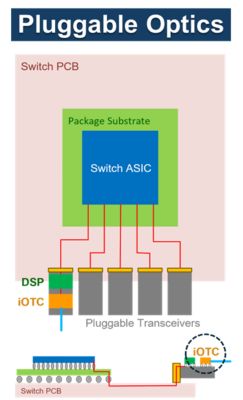
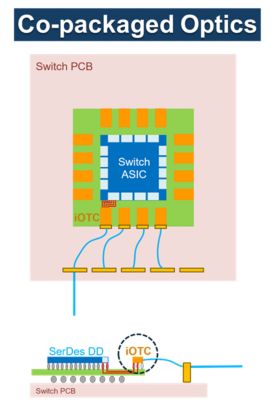
InfiniLink's integrated optical transceiver chiplet (iOTC) in pluggable and co-packaged optics applications
Addressing Complex Multidisciplinary Design Problems
George and his team further explain that the Ansys, part of Synopsys, tool set has proven essential for modeling highly complex, multidisciplinary problems. An example of this is the modeling of high-power nonlinearity and self-heating in micro ring modulators (MRMs) and assessing the impact on complex modulation formats like PAM4. With such comprehensive models, novel solutions were devised.

Simplified modeling flow for high-power nonlinearity and self-heating effects in micro ring modulators (MRMs)
Another key use case involved the design optimization of Traveling Wave Mach-Zehnder modulators (TWMZMs), combining Lumerical software and HFSS software to capture the interaction between the electromagnetic performance of the modulator electrodes with the optical performance of the modulator output.
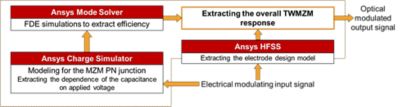
Multiphysics modeling of Traveling Wave Mach-Zehnder modulators (TWMZMs)
Accelerating Design Cycles With HPC
Beyond complex multidisciplinary modeling, Ansys tools brought powerful HPC capabilities, including GPU-accelerated simulations. This computational edge enabled extensive design space exploration of different architectures and yield optimization of individual designs, drastically reducing simulation times by orders of magnitude while providing deeper insights both at the component and system levels.
Driving the Future of Optical Connectivity
“With such multidisciplinary simulation flows, coupled with accelerated computational capabilities of Ansys tools, our models led to a better understanding of the problems and enabled the development of novel, highly optimized solutions. It’s a game changer for our product development cycle,” says George.
As AI workloads and cloud infrastructure continue to grow, the demand for high-speed, low-power data connectivity solutions is only accelerating. Powered by Ansys simulation tools and Fluid Codes’ continued support, InfiniLink is pushing the frontier — engineering the next generation of integrated optical engines that will power tomorrow’s AI-driven data centers.
Learn more about the Ansys Startup Program.

Just for you. We have some additional resources you may enjoy.
“With such multidisciplinary simulation flows, coupled with accelerated computational capabilities of Ansys tools, our models led to a better understanding of the problems and enabled the development of novel, highly optimized solutions. It’s a game changer for our product development cycle.”
— Botros George, chief technology officer and co-founder, InfiniLink

The Advantage Blog
The Ansys Advantage blog, featuring contributions from Ansys and other technology experts, keeps you updated on how Ansys simulation is powering innovation that drives human advancement.