Synopsys and Ansys power the future of innovation—connecting silicon to systems.
-
-
Access Free Student Software
Ansys empowers the next generation of engineers
Students get free access to world-class simulation software.
-
Connect with Ansys Now!
Design your future
Connect with Ansys to explore how simulation can power your next breakthrough.
Free Trials
Products & Services
Learn
About
Back
Products & Services
Back
Learn
Ansys empowers the next generation of engineers
Students get free access to world-class simulation software.
Back
About
Design your future
Connect with Ansys to explore how simulation can power your next breakthrough.
Free Trials
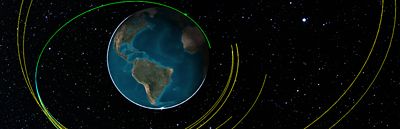
Users of Ansys Systems Tool Kit (STK) digital mission engineering software and Ansys Orbit Determination Tool Kit (ODTK) orbital measurement processing software have long struggled to obtain identical propagation results from these two tools. While both tools have been using what is essentially the same propagator, small differences in the settings of their force models or numerical integrators could add up over time and lead to differences that are larger than acceptable. Matching the propagators of the two tools to within a small tolerance was possible, but it was generally a labor-intensive process to achieve.
Starting with Ansys 2025 R2, achieving consistency between the two software solutions has become much easier. You can now:
- Set an identical initial state which, in addition to position and velocity, also contains properties such as mass, drag and solar radiation pressure (SRP) settings, and their corresponding stochastic parameters.
- Use the same propagator in both tools.
When planning or operating satellite missions, this enables you, for example, to take the exact state from an orbit determined in ODTK software and integrate it into STK software’s Astrogator capability for maneuver planning. Propagation results from the Astrogator tool will then match the propagation results from ODTK software exactly.
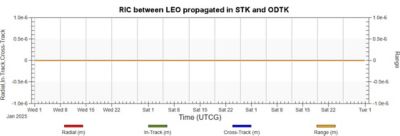
Radial in-track cross-track (RIC) distance between a low Earth orbit (LEO) satellite propagated in Ansys Systems Tool Kit (STK) digital mission engineering software and Ansys Orbit Determination Tool Kit (ODTK) orbital measurement processing software
Using the Component Browser in Ansys ODTK Software
Beginning with 2025 R2, ODTK software contains a component browser just like STK software, and the individual component definitions in both are identical. So, any propagator created in the Astrogator component browser can also be used in ODTK software, and vice versa.
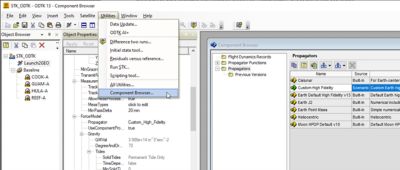
The component browser in ODTK software
Introducing Flight Dynamics Records
While using the same propagator will model the perturbations identically, you must also start out with the same initial state for the propagation results to match.
To capture a complete state, Ansys introduced the flight dynamics records in both STK software and ODTK software. Flight dynamics records contain the entire state and propagation settings of a satellite at a specified time. At a desired epoch, you will hold:
- position and velocity
- mass
- all settings required by the propagator to determine identical results between STK software and ODTK software (including stochastic parameters of the ODTK estimated values)
Because the propagator settings must match the propagator, flight dynamics records also contain the propagator definition itself.
Just like propagators, flight dynamics records live in the component browser and can be transferred between STK software and ODTK software, or two different scenarios within both software solutions.
How To Create and Use Flight Dynamics Records
Flight dynamics records are created using the new “Add Flight Dynamics Record To Component Browser” button in STK software and the “Flight Dynamics Record Creator” utility in ODTK software.
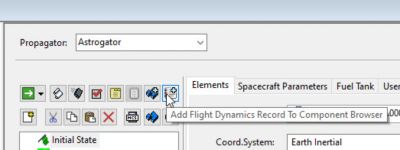
Creating flight dynamics records in the STK Astrogator capability
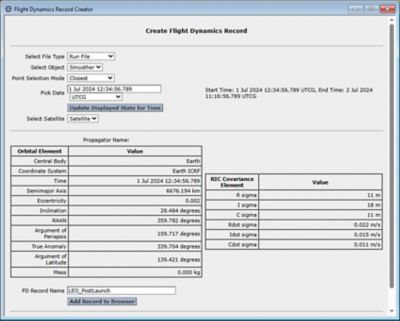
Creating flight dynamics records in ODTK software
To use a flight dynamics record, the initial state tools of both STK software and ODTK software have been updated to allow selection from the component browser. You can also view all flight dynamics record properties in the component browser.
Stochastic Parameters in the STK Astrogator Tool
When ODTK software processes measurements, it estimates corrections to all parameters in its state space, including force model parameters such as the drag or solar radiation pressure (SRP) coefficients. In the absence of measurements, and therefore absence of new estimated corrections, the old corrections will slowly decay back to their nominal values.
In order for STK software and ODTK software to match, stochastic parameters were added to the Astrogator tool in case a user selects a flight dynamics record that starts out with estimated corrections to its nominal values.
Learn More
Despite achieving astrodynamic consistency between STK software’s Astrogator tool and ODTK software, Ansys is committed to continuous improvement by making transferring maneuvers easier between STK software and ODK software, among other updates. Learn more about Ansys’ digital mission engineering solutions.



The Advantage Blog
The Ansys Advantage blog, featuring contributions from Ansys and other technology experts, keeps you updated on how Ansys simulation is powering innovation that drives human advancement.