Synopsys and Ansys power the future of innovation—connecting silicon to systems.
-
-
Access Free Student Software
Ansys empowers the next generation of engineers
Students get free access to world-class simulation software.
-
Connect with Ansys Now!
Design your future
Connect with Ansys to explore how simulation can power your next breakthrough.
Free Trials
Products & Services
Learn
About
Back
Products & Services
Back
Learn
Ansys empowers the next generation of engineers
Students get free access to world-class simulation software.
Back
About
Design your future
Connect with Ansys to explore how simulation can power your next breakthrough.
Free Trials

If you think you’re seeing double, you may be right. Today, digital twins are helping to advance many industries. From pharma and semiconductors to unlocking futuristic retail experiences and understanding more about the sinking of the Titanic, there are many applications for digital twins.
One of the many industries experiencing the benefits of digital twins is the defense industry. One catalyst is the increased demand for digital engineering in this sector. This is “driven by system complexity and the urgent need to accelerate acquisition timelines,” says Steve Bleymaier, chief technology officer (CTO) at Ansys, part of Synopsys. “In defense, recent geopolitical conflicts have transformed the nature of warfare. We now face new challenges, like countering drone swarms and mandates like the U.S. Department of Defense’s (DoD’s) requirement that all new programs after December 2023 adopt digital and mission engineering.”
Simultaneously, artificial intelligence (AI), autonomy, interoperability, and being “adaptable by design” are also becoming increasingly important to those in the defense industry. Clearly, innovating and generating new products quickly is essential, and digital twins are a perfect way to achieve just that.
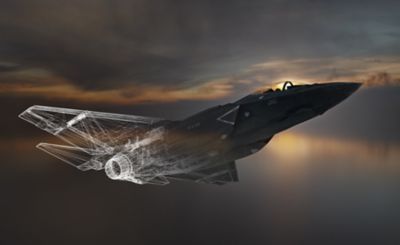
A graphical representation of using a digital twin in the defense industry
But what are digital twins? At its simplest, a digital twin is a virtual model or representation of a real-world product or process that is synchronized at a specified frequency and fidelity. While digital twins were originally used for operations, maintenance, and sustainment, today the benefits of digital twins can be applied much earlier in the process. For instance, digital twins can be used in the design and testing phases to speed up the development process. Then, after deployment, digital twins can be managed in real time for analysis, predictive maintenance scheduling, performance optimization, and more.
“Digital twins are part of a spectrum,” says Vitor Lopes, regional sales manager at Ansys, part of Synopsys. “Their value can be unlocked throughout the life cycle, especially in the context of digital engineering. It’s not just about what happens in the field — it’s about accelerating innovation from day one.”
Such efficiency benefits, which extend throughout the full development cycle, are a perfect fit for the defense industry, which is moving faster than ever before.
What Are the Benefits and Challenges of Using Digital Twins and Digital Engineering in the Defense Industry?
When used in the defense industry, digital twins provide a few concrete advantages that improve mission readiness, predictive maintenance, and overall system performance.
These include:
- Verifying and validating requirements early in the design life cycle
- Supporting test activities digitally
- Revealing key insights on performance, operating ranges, and optimal maintenance intervals, which increases system reliability and asset availability while reducing service needs
- Increasing revenue, such as by creating a high-value service offering revenue stream
- Reducing costs by enabling predictive maintenance and allowing manufacturers to save on warranty and insurance costs by proactively optimizing their product
“Originally, these benefits were limited to the operations phase, but now we’re seeing those advantages brought forward into design and testing, enabling a much more streamlined and integrated life cycle,” says Lopes. As a result, digital twins are empowering those in the defense industry to more efficiently modernize existing systems as well as design new advanced systems.

A digital twin of an F-35 stealth fighter
As for the challenges in this area, these are “truly multifaceted,” says Bleymaier. Adopting newer model-based, collaborative, agile, traceable, and connected technologies into existing traditional and siloed engineering groups can be difficult. “But this isn’t a destination — it’s a journey,” says Bleymaier. “The goal is to achieve a state of perpetual agility, enabling teams to adapt quickly to customer needs or evolving threats.”
As such, Bleymaier suggests that organizations aiming to implement digital engineering tools into their process need to address challenges along the four key areas of:
- People and culture
- Technology
- Processes
- Infrastructure
“Digital engineering requires more than just adopting tools — it requires a comprehensive change management strategy,” says Bleymaier. This involves changing how defense organizations think, work, and develop across the entire company and throughout the whole life cycle, from ideation to deployment.
How Simulation Software Can Help Build Mission-Centric, Open Ecosystems That Use Digital Twins and Digital Engineering to Excel
If implementing tools such as digital twins involves such an extensive process, how can defense companies best approach this?
One solution is to use Ansys simulation software, such as the Ansys Twin Builder simulation-based digital twin platform and Ansys TwinAI AI-powered digital twin software. Engineers in the defense industry can use these solutions to link their design requirements to high-fidelity simulations and digital twins. As a result, engineers can efficiently and accurately manage design and process workflows; integrate with product life cycle management (PLM), application life cycle management (ALM), and enterprise data systems; and enable multidisciplinary design optimization and model-based systems engineering (MBSE).
“With our open architecture, we integrate with legacy infrastructure — be it commercial, government, or in-house solutions — and help customers build a connected, collaborative digital engineering environment,” says Bleymaier.
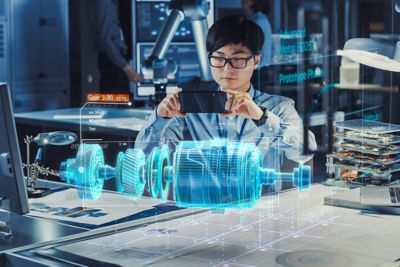
Digital twins can improve mission readiness and enable predictive maintenance to help ensure success
As an example, take a modernization program. This type of program often relies on data sources with known limitations, such as outdated models or data that only covers specific locations or variables. “By combining both in a hybrid modeling approach, we can fill in the gaps and create a much more complete picture,” says Lopes. “This fusion enables better system understanding and supports decisions about operations and modernization. It’s a foundational pillar of today’s hybrid digital twin strategy.”
No matter the specific use case, Ansys digital twin solutions have major benefits, including up to a:
- 2x reduction in the time needed to create an accurate product model when compared to manual methods for typical companies
- 25% improvement in product performance when using Ansys software to verify and optimize product models
- 20% reduction in maintenance costs over a product’s lifetime once a digital twin is connected to a working product
The bottom line? “Ansys helps aerospace and defense (A&D) organizations innovate faster — cutting costs, shortening schedules, and improving readiness,” says Bleymaier.
What Is the Future of Digital Twins in Defense?
With all their potential benefits, it comes as no surprise that digital twins have a bright future. For instance, consulting firm McKinsey predicts that the market for global twin technology will grow to reach $73.5 billion by 2027.
In defense, part of this growth is aided by the fact that government contracts are now mandating digital twin use in some areas. “This is great news because it’s much easier to build digital twins during design and testing, ensuring seamless condition-based maintenance once systems are deployed,” says Bleymaier. “This approach allows for proactive part replacement, reducing downtime, streamlining supply chains, and cutting costs. But, most importantly, it increases readiness and reliability.”
While this process is more challenging to implement for legacy systems, it is still possible to achieve via hybrid twins that fuse historical data, AI, real-time physics, and sensor inputs. “This combination increases prediction accuracy from about 80% (with just analytics) to 98%,” says Bleymaier.
Hybrid twins can be used in operations to enable defense systems to continuously adapt, self-adjust, and maintain fidelity even years into a mission, says Lopes. Another aspect of this growth is the continued expansion of digital twins from just operations to throughout the product life cycle. Additionally, Lopes shares that “for new systems, you’ll see greater interoperability, allowing digital artifacts from different suppliers and tiers to be connected and validated together.”
As time moves on and existing systems develop and change, digital twins will become increasingly imperative. “Digital twins are linked through a connected digital thread, all the way back to the authoritative source of truth — your original design reference mission — so future upgrades can happen faster, with less cost and disruption,” says Bleymaier.
Learn more about the advantages of digital twins, and request a trial of the Ansys Digital Twin platform today.

Just for you. We have some additional resources you may enjoy.
“Digital twins are part of a spectrum. Their value can be unlocked throughout the life cycle, especially in the context of digital engineering. It’s not just about what happens in the field — it’s about accelerating innovation from day one.”
— Vitor Lopes, regional sales manager at Ansys, part of Synopsys


The Advantage Blog
The Ansys Advantage blog, featuring contributions from Ansys and other technology experts, keeps you updated on how Ansys simulation is powering innovation that drives human advancement.