Viscous Forces of Pipe Flow using Ansys Software: CFD vs. Theory
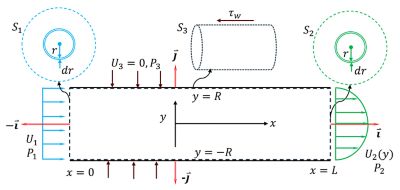
Calculation of friction loss or viscous drag acting on a body (wall) requires knowledge of the near wall velocity gradient over the entire surface. For flows with variable flow regimes, such as developing flow in a pipe, evaluation of flow gradients over the entire surface is a challenge both analytically and experimentally. On the other hand, Reynolds transport theorem (RTT) can provide an estimate of the body forces from the pressure forces and momentum transfer across the inlet and outlet boundaries. In this project, the applicability of RTT in estimating body forces is validated for a pipe flow case, wherein the body force is primarily because of viscous drag. The results show that RTT estimates of viscous forces compared within 0.1% of the CFD predictions generated by Ansys Fluent® fluid simulation software.
Learning Outcomes
- Validation of applicability of Reynolds Transport Theorem in computing frictional drag.
- Understanding the Setup and analysis of pipe flow using Ansys Fluent software
Applicable Courses for Use
- Fluid Mechanics
- Computational Fluid Dynamics (CFD)
- Advanced Fluid Mechanics
Downloadable Content
- Case Study Report
- simulation run files for axisymmetric pipe
Related Resources
Real Internal Flows | Ansys Innovation Course