Ring Resonator Design with Ansys Lumerical Software
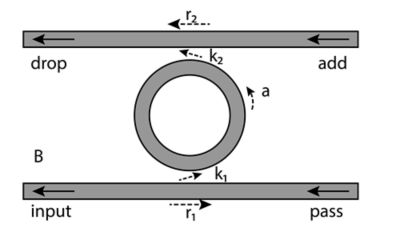
This lab exercise covers the design, simulation, and experimental characterization of an add-drop ring resonator. Using Ansys Lumerical varFDTD™ advanced 3D electromagnetic FDTD simulation software, you will model a silicon-based resonator to achieve a target free-spectral range (FSR) and linewidth, then compare numerical predictions with experimental data. Topics include resonance conditions, coupling coefficients, propagation loss, and the relationship between group index, FSR, finesse, and Q-factor. Instructions guide you through analytical modeling, simulation setup, and parameter sweeps to examine how geometry and coupling gap affect performance. The lab also suggests experimental measurements using an EDFA, optical spectrum analyzer, and polarization control, enabling direct comparison between simulated and measured spectra. Developed at the University of California San Diego for the ECE 184, Optical Information Processing and Holography course, the material integrates theory, simulation, and hands-on testing to investigate integrated photonic resonators.
Learning Outcomes
- Model resonance conditions and performance metrics of add-drop ring resonators.
- Simulate FSR, linewidth, and coupling effects using varFDTD in Ansys Lumerical.
- Compare simulated transmission spectra with experimental measurements and calculated parameters.
Related Resource(s)
- Waveguide Couplers in Ansys Lumerical | Education Resources
- Waveguides with Ansys Lumerical | Education Resources
- MZ Interferometer with Ansys Lumerical | Education Resource
Applicable Courses for Use
- Optical Information Processing and Holography