Skip to Main Content

Ansys HFSS
Best-In-Class 3D High Frequency Structure Simulation Software

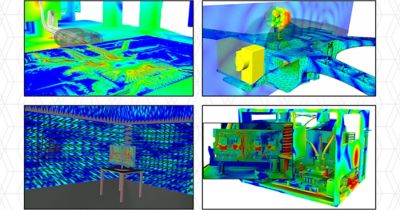
Multipurpose, full wave 3D electromagnetic (EM) simulation software for designing and simulating high-frequency electronic products such as antennas, components, interconnects, connectors, ICs and PCBs.

3D EM SIMULATION SOFTWARE

System-Level Simulation for High-Frequency and High-Speed Electronics

Ansys HFSS is industry‑trusted full‑wave 3D electromagnetic software used to validate and sign off complex electronic designs. Engineers rely on HFSS to analyze antennas, RF and microwave components, IC packages, PCBs, and full systems—leveraging connected, multiphysics workflows that enable system‑aware design from silicon through final system verification.

  • Check icon outline
    Signoff-Grade Accuracy
  • Check icon outline
    Silicon-to-System Scale
  • Check icon outline
    Connected Multiphysics Workflows
  • Check icon outline
    Fully Coupled EM System Solver
  • Check icon outline
    Automatic Adaptive Meshing
  • Check icon outline
    Encrypted Design Sharing

Quick Specs

HFSS enables early electromagnetic insight and rigorous validation across antennas, RF, SI/PI, and EMI/EMC—helping engineers explore design tradeoffs sooner, reduce rework, eliminate uncertainty, and confidently validate fully coupled electronic systems from initial concept through final signoff.

  • Antenna & RF Analysis
  • Chip-package-system Analysis
  • Signal Integrity (SI)
  • Power Integrity (PI)
  • EMI / EMC Analysis
  • Fully Coupled EM
  • Adaptive EM Meshing
  • Multiphysics AEDT Platform
  • Streamlined Setup & Analysis
  • HPC & Cloud Scaling
  • Python Automation APIs
HFSS blog

From Chips to Ships, Solve Them All with HFSS

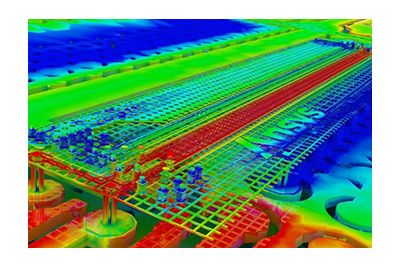
How Ansys HFSS Mesh Fusion solves much larger designs than ever thought possible

HFSS Mesh Fusion’s patented technology enables much more complex designs to be simulated with the same rigor, accuracy and reliability of Ansys HFSS. It accomplishes this by applying targeted meshing technologies within the same design, appropriate to the local geometry.

HFSS Mesh Fusion continues to use the same “electromagnetically aware” adaptive meshing technology as before without compromising accuracy because a fully coupled electromagnetic matrix is solved with each adaptive mesh step and for each point in a frequency sweep.

March 2026

What's New

The 2026 R1 HFSS release delivers major breakthroughs, including GPU‑accelerated solving, high‑capacity 3D power integrity, and reliable rigid‑flex meshing—boosting performance, scalability, and workflow efficiency for SI/PI engineers, RF designers, and electronics system developers.

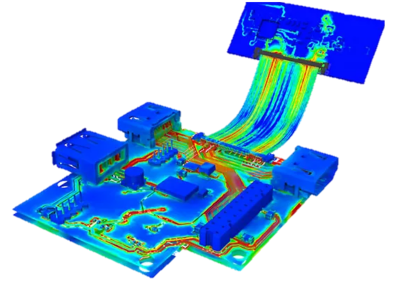
HFSS Power Integrity
Power Integrity at Scale with HFSS-PI

A broadband 3D Power Integrity simulation with the speed, capacity, and accuracy required to meet the challenges of power delivery for IC, Package and Board designs.

HFSS GPU Acceleration
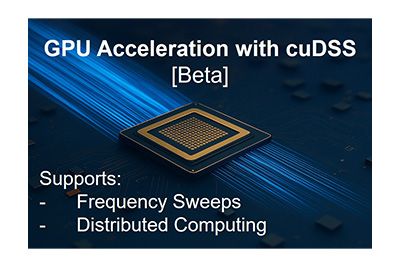
GPU Acceleration with cuDSS [Beta]

HFSS now accelerates frequency sweeps with new cuDSS based GPU solving—enabling faster parallelized field computations and support for multi node distribution to handle larger, more complex simulations efficiently.

HFSS Flex PCB
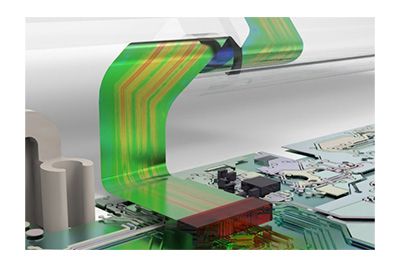
Omega Mesher - Reliably Mesh the Impossible

The new Omega Mesher in HFSS 3D Layout delivers fast, reliable meshing for complex rigid‑flex PCB designs—improving success rates, reducing memory usage, and accelerating overall simulation turnaround.

HFSS Applications

View All Applications

HFSS Case Studies

Ansys Case Study

Live Wire

Researchers designed an unusually compact wearable antenna that covers the entire instrument, scientific and measurement band.

Ansys Case Study

ANYWAVES

ANYWAVES Uses Ansys Simulation Software to Develop Next-Generation Miniature Antennas

HFSS IC overview

Electromagnetic Simulation Enhancing Connector Development

Discover how Dell PowerEdge equipped with AMD EYPC speeds up Ansys HFSS simulations for Hirose Electric.

Ansys Case Study prototyping

Andar Technologies

Virtual prototypes from Ansys HFSS allow Andar to create innovative designs and reduce the amount of physical prototyping to a minimum.

HFSS Application Briefs

2021-09-ansys-og.jpg

Ansys HFSS for Antenna Simulation

Learn about antenna design and simulation with Ansys HFSS, the industry leading 3D electromagnetic simulation tool for high frequency electronic components.

FAQs

Ansys HFSS is a 3D electromagnetic simulation software solution for designing and simulating high-frequency electronic products such as antennas, RF and microwave components, high-speed interconnects, filters, connectors, IC components and packages and printed circuit boards.

To install Ansys HFSS, you must be an Ansys customer and have access to the Customer Portal. Ansys HFSS is included in the Electronics software bundle and is also included in the free Ansys Student bundle.

Yes, STL is an import option in HFSS. For finite element model (FEM) analysis, STL files are converted to the HFSS modeler format. For IE and SBR+ analysis, there is an option to import and directly solve to the STL facets.

To download Ansys HFSS, you must be an Ansys customer and have access to the Customer Portal. Ansys HFSS is included in the Electronics software bundle and is also included in the free Ansys Student bundle.

You can learn about Ansys HFSS in several different ways depending on whether you are an existing customer or a student or non-customer. 

Intro to Ansys HFSS is a free course available on our Ansys Innovation Courses site where you will learn the basics of Ansys HFSS geometry design and the EM simulation workflow. 

These HFSS courses are available to Ansys Customers.


Get step-by-step instructions on designing antennas in Ansys HFSS in this video, which demonstrates how to create the geometry of the dipole antenna and discusses features in HFSS for antenna analysis. "How to Design Antennas in Ansys HFSS."

Silicon to System Electronics Design — Early Exploration through Signoff

Ansys HFSS delivers signoff-grade electromagnetic simulation from IC to package, PCB, and full system. Physics-driven adaptive meshing automatically ensures accuracy without manual tuning, letting engineers focus on design. Full coupled solvers support multi-scale RF and microwave design, EMI/EMC, signal integrity, and broadband power integrity at scale with HFSS-PI — enabling early insight and confident validation across today's most complex electronic systems.


Key Features

HFSS is the premier EM tool for R&D and virtual design prototyping. It reduces design cycle time and boosts your product’s reliability and performance.

  • EMI/EMC analysis
  • Radio Frequency Interference (RFI) in complex environments
  • Installed antenna and RF cosite analysis
  • RF systems and circuits analysis
  • Signal and Power Integrity analysis
  • Ansys Cloud Burst Compute

Users can take advantage of the seamless workflow in Electronics Desktop, which includes advanced electromagnetic field solvers, and dynamically link them to power circuit simulators to predict EMI/EMC performance of electrical devices. These integrated workflows avoid repetitive design iterations and costly recurrent EMC certification tests. Multiple EM solvers intended to address diverse electromagnetic problems, as well as the circuit simulators in Electronics Desktop, help engineers assess the overall performance of their electrical devices and create interference-free designs. These diverse problems range from radiated and conducted emissions, susceptibility, crosstalk, RF desense, RF coexistence, cosite, electrostatic discharge, electric fast transients (EFT), burst, lightning strike effects, high intensity fields (HIRF), radiation hazards (RADHAZ), electromagnetic environmental effects (EEE), electromagnetic pulse (EMP) to shielding effectiveness and other EMC applications.

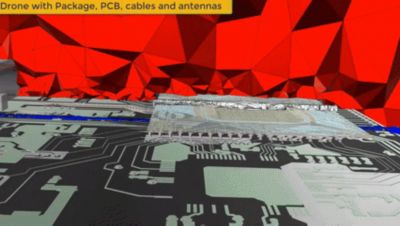
EMIT’s powerful analysis engine computes all important RF interactions including non-linear system component effects. Diagnosing RFI in complex environments is notoriously difficult and expensive to perform in a testing environment, but with EMIT’s dynamic linked results views, the identification of the root-cause of any interference is rapidly accomplished via graphical signal trace-back and diagnostic summaries that show the exact origin and path that interfering signals take to each receiver. Once the cause of interference is uncovered, EMIT enables rapid evaluation of various RFI mitigation measures in order to arrive at the optimum solution. The new HFSS/EMIT Datalink allows the model for RFI analysis to be created in EMIT directly from the physical 3D model of the installed antennas in HFSS. This provides a seamless end-to-end workflow for a complete RFI solution for RF environments ranging from large platform cosite interference to receiver desense in electronic devices.

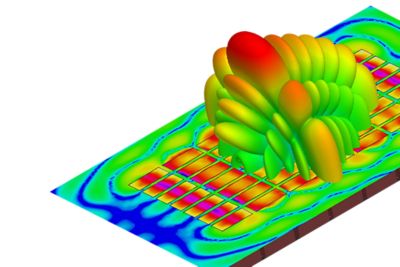
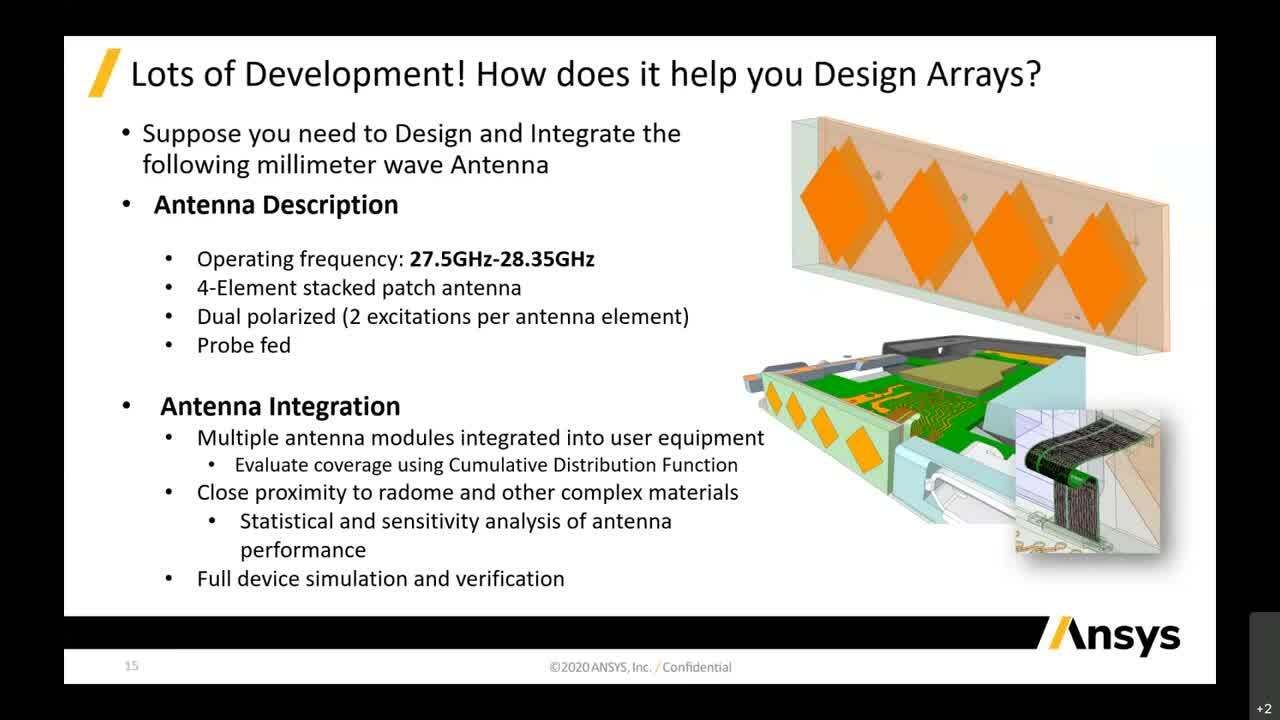
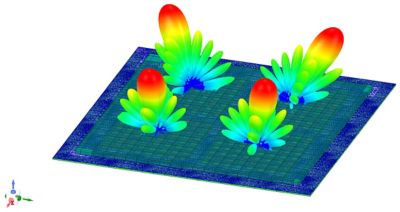
A candidate array design can examine input impedances of all elements under any beam scan condition. Phased array antennas can be optimized for performance at the element, subarray or complete array level based on element match (passive or driven) far-field and near-field pattern behavior over any scan condition of interest. Infinite array modeling involves one or more antenna elements placed within a unit cell. The cell contains periodic boundary conditions on the surrounding walls to mirror fields, creating an infinite number of elements. Element scan impedance and embedded element radiation patterns can be computed, including all mutual coupling effects. The method is especially useful for predicting array-blind scan angles that can occur under certain array beam steering conditions. Finite array simulation technology leverages domain decomposition with the unit cell to obtain a fast solution for large finite-sized arrays. This technology makes it possible to perform complete array analysis to predict all mutual coupling, scan impedance, element patterns, array patterns and array edge effects.

It includes EMIT, a unique multi-fidelity approach for predicting RF system performance in complex RF environments with multiple sources of interference. EMIT also provides the diagnostic tools needed to quickly identify root-cause RFI issues and mitigate problems early in the design cycle.

HFSS with SI Circuits can handle the complexity of modern interconnect design from die-to-die across ICs, packages, connectors and PCBs. By leveraging the HFSS advanced electromagnetic field simulation capability dynamically linked to powerful circuit and system simulation, engineers can understand the performance of high-speed electronic products long before building a prototype in hardware.

The ability to simulate encrypted HFSS 3D components means that you no longer need to compromise on accuracy. Designers are no longer forced to use circuit-level components (e.g., S-parameter models) vs. true 3D models into their design, impacting the overall simulation accuracy.

It enables prospective customers of vendors to use encrypted 3D Components in a full system design. The end user receives more confidence in the validity of results by rigorously considering coupling effects of the integration while also protecting the vendor’s design IP. In addition, it also provides full, uncompromised simulation fidelity for encrypted 3D components with HFSS and adaptive meshing delivering its gold-standard accuracy.

HFSS multipaction solver is based on a finite-element particle-in-cell (PIC) method. HFSS provides the multipaction analysis as a postprocessing of the frequency-domain field solutions. With few steps to set up the excitations and boundary conditions for charged particle simulation, you can check whether your design meets the standard for multipaction breakdown prevention.

Ansys Cloud Burst Compute provides secure, scalable, on-demand HPC access directly within Ansys HFSS, eliminating the need for dedicated IT resources or cloud infrastructure maintenance.

HFSS RESOURCES & EVENTS

Featured Webinars

Webinar Series
HFSS 3D Layout Webinar Series

This webinar series shows you how the HFSS adaptive meshing technology handles massive PCB layout geometries and gives you the most accurate results using real customer examples.

On Demand Webinar
Using HPC Capabilities in Ansys HFSS
Novel, Efficient Antenna System Design Using HPC Capabilities in Ansys HFSS

This webinar will chart the progress of HFSS with respect to antenna design and how it has evolved into the established leader in the field.

On Demand Webinar
Ansys webinar
Mastering 3D-IC Design Through Advanced Simulation

Learn how Ansys HFSS-IC can assist you in simulating complex interposers and 3D-IC designs and improve design cycles, as well as product performance.

card-2024-signal-and-power-integrity-workflow.jpg
Automating Signal and Power Integrity Workflow with PyAEDT

Discover how automation reduces Si/PI simulation setup times from hours to seconds, enabling faster design iterations and more efficient high-speed electronics design using Ansys tools and PyAEDT.

Enabling 6G Technologies

Discover how to implement accurate physics-based digital twins by leveraging the NVIDIA Aerial Omniverse Digital Twin (AODT) platform with Ansys Perceive EM to extract AI/ML Synthetic Data for 6G communications research and design.

On Demand Webinar
Ansys Webinar
Base-Station Antenna Placement and Operations for 5G/6G Communications

Learn more about how Ansys tools can aid engineers in assessing base-station antenna placement and operations.


White Papers & Articles

2021-09-ANSYS-og.jpg

Physics-based Synthetic Data for Real World Radar Applications

In this technical paper, Ansys subject matter expert Arien Sligar explains the use of electromagnetic simulation technology derived from Ansys HFSS along with a digital engineering methodology for generating synthetic data to train an ML algorithm for automotive radar.


Videos


Ansys software is accessible

It's vital to Ansys that all users, including those with disabilities, can access our products. As such, we endeavor to follow accessibility requirements based on the US Access Board (Section 508), Web Content Accessibility Guidelines (WCAG), and the current format of the Voluntary Product Accessibility Template (VPAT).

Let’s Get Started

If you're facing engineering challenges, our team is here to assist. With a wealth of experience and a commitment to innovation, we invite you to reach out to us. Let's collaborate to turn your engineering obstacles into opportunities for growth and success. Contact us today to start the conversation.