Automotive cybersecurity is the practice of protecting all electronic systems used in, or connected to, an automotive vehicle from unauthorized access, manipulation, malicious modification, or damage across the entire vehicle life cycle. Protected systems include electronic devices, data, networks, control algorithms, and software.
Cybersecurity challenges began with the introduction of electronic control units (ECUs) in the 1960s. However, the growth of electric vehicles (EVs), hybrid systems, advanced driver-assistance systems (ADAS), smart vehicle systems, and connectivity across the automotive industry since then has made dealing with cyber threats a priority. These concerns are increasing dramatically as software-defined vehicles (SDVs) and semi- and fully autonomous driving systems enter the market.
With the evolving vehicle connectivity landscape, any company involved in the automotive industry needs to be aware of what automotive cybersecurity is and the associated threats. And if they are directly involved with components that might be susceptible to cybersecurity risks, they need to adhere to the guidelines found in automotive cybersecurity standards.
The primary cybersecurity risks include:
Almost every modern vehicle contains some sort of electronic component functioning as an information system that is vulnerable to access and compromise. From seat heaters to collision sensors, these modules present a challenge for cybersecurity engineering. In addition, any connection between systems in the car or to outside systems presents a cyberthreat that engineers must address.
The most common automotive information systems with cybersecurity challenges are:
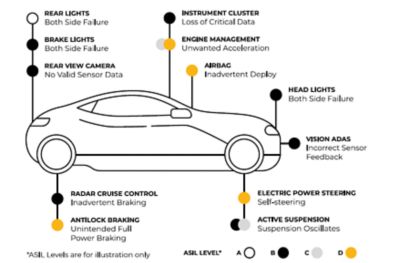
A summary of some of the most common smart systems in modern vehicles and the level of automation that applies to them
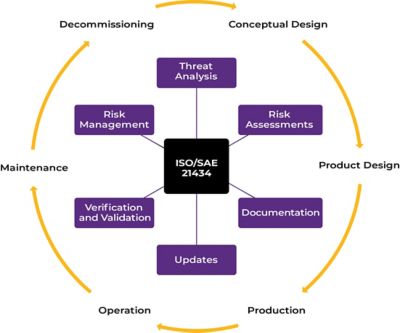
Although closely related to and complementary with functional safety under the ISO 26262 standard, what automotive cybersecurity is and how to manage it has its own international standard. The ISO/SAE 21434 standard for cybersecurity risk management spans “concept, product development, production, operation, maintenance, and decommissioning of electrical and electronic (E/E) systems in road vehicles, including their components and interfaces."
Key aspects of ISO/SAE 21434 standard for automotive cybersecurity
The ISO/SAE 21434 standard is not a prescriptive solution and does not mandate specific requirements, technologies, or solutions. Instead, it offers a process-oriented framework and guidelines for managing cybersecurity. Key aspects of the standard include:
Both original equipment manufacturers (OEMs) and suppliers in the automotive supply chain can effectively integrate cybersecurity measures into their vehicle development life cycles by adopting the following suggestions from the ISO/SAE 21434 standard.
Compliant organizations build a layered approach under the assumption that vehicle subsystems could be compromised. They put measures in place to reduce the chances of a successful attack. Multiple layers of protection minimize the damage done if threat actors gain unauthorized access.
Once a layered approach is adopted, teams that develop vehicle control systems should implement industry-proven best practices that eliminate risks when possible, build early detection and response to cybersecurity issues in the design, and include security solutions that allow rapid recovery. In addition, leadership should prioritize product cybersecurity throughout their organization and supply chain, and develop and maintain a comprehensive cybersecurity management system with the assistance of all stakeholders. Finally, teams should share any lessons learned with the broader ecosystem.
Technical cybersecurity best practices start with using Threat Analysis and Risk Assessment tools early in the design process. Once teams document threats and risks, they can deploy specific security solutions, such as limiting access to vehicle computing resources, using cryptographic techniques, improving authentication processes, and employing network segmentation. Then, as development continues, engineers need to design and carry out verification and validation through simulation and testing before production. Further activities during post-production include continuous monitoring, establishing and using incident response plans, and constantly implementing vulnerability management.
Members of the automotive supply chain, from component manufacturers to OEMs, use simulation at every step of their product’s life cycle to guide design, identify threats, assess risks, verify solutions, and validate features. The value of simulation is just as strong for cybersecurity as it is for functional safety, performance, durability, and efficiency.
A useful way to see where simulation can best help meet specific cybersecurity needs is to look at a few of the more common engineering tasks in a vehicle’s life cycle.
The automotive cybersecurity standards emphasize the importance of considering cybersecurity during the conceptual design phase of any vehicle component or system. A tool like Ansys System Architecture Modeler (SAM) is ideal to visualize, design, and manage complex systems, with cybersecurity concerns addressed at every step. Embracing a model-based system engineering (MBSE) approach at the conceptual stage will help with every portion of cybersecurity engineering.
Once the design teams reach component design, they can utilize simulation to investigate and resolve any physical, electromagnetic, or software vulnerabilities before moving to physical prototypes. The Ansys Maxwell advanced electromagnetic field solver and Ansys HFSS high-frequency electromagnetic simulation software can be used to check for signal vulnerabilities in networks or in electronic devices. For firmware software development for embedded systems, the Ansys SCADE embedded software product collection is a fantastic example of a standards-based development and testing solution with cybersecurity features built in. Another significant way to use simulation to assist in component design is by using Ansys Optics tools for sensor design, validation, and verification.
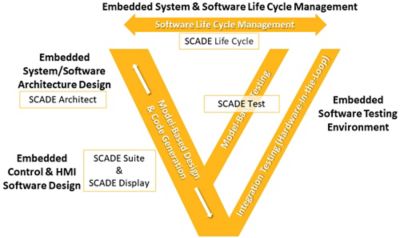
The V-diagram for embedded system and software life cycle management using Ansys SCADE
The integrated nature of electronics, software, and mechanical systems make automotive system design and integration an ideal application for MBSE. Cybersecurity aspects are no exception. Suppliers and OEMs can assess vulnerabilities by modeling systems with a tool like Ansys ModelCenter model-based systems engineering software. In addition, security analysis tools like Ansys Medini Cybersecurity SE are ideal for conducting TARA as an integrated part of the design process.
Virtualized testing is a growing part of the increased use of digital engineering across industries, especially in the automotive industry. The goal of using simulation to supplement physical testing is to replace expensive and time-consuming laboratory testing with virtual representations. For cybersecurity, a digital model in Ansys SCADE software is an excellent example of how something like penetration testing can be done in parallel and with automation.
When a cybersecurity incident occurs in the field, it is the responsibility of the OEM or the supplier to understand what happened and develop solutions. Simulation tools are a fast and effective way to automate the investigation process and quickly test solutions without having to engage in expensive and time-consuming physical testing. For example, Ansys medini Cybersecurity SE software supports this with its vulnerability management and monitoring capabilities.
如果您面臨工程挑戰,我們的團隊將隨時為您提供協助。憑藉豐富的經驗和對創新的承諾,我們邀請您與我們聯絡。讓我們共同合作,將您的工程障礙轉化為成長和成功的機會。立即與我們聯絡,開始對話。