Synopsys and Ansys power the future of innovation—connecting silicon to systems.

Recreating the process that powers stars has been and remains one of the most formidable engineering challenges humankind has encountered. Fusion energy occurs when hydrogen isotopes — deuterium and tritium — are combined under extreme heat and pressure to form helium and release significant amounts of energy in the form of neutrons. Once actualized, fusion energy promises a safe, carbon-free, nearly limitless energy source. Unlike current nuclear power methods, fusion produces no long-lived radioactive waste and can be easily shut down. The necessary fuel, deuterium, is abundant in seawater, and tritium can be generated in the reactor to create a self-sustaining process, making it a sustainable energy option. However, achieving these reactions on Earth requires extreme temperatures and precise conditions, comparable to those found at the Sun’s core. Scientists, including those at the United Kingdom Atomic Energy Authority (UKAEA), are focusing on recreating these conditions using advanced technologies and rigorous testing environments.
UKAEA is a world leader in fusion research and development (R&D), including plasma and tritium science, robotics, and materials testing and development. Its scientists and engineers collaborate with partners worldwide to develop fusion as a sustainable energy source for future generations. With years of R&D put into the Mega-Amp Spherical Tokamak (MAST), the Joint European Torus (JET), and now bringing it together for the project, the Spherical Tokamak for Energy Production (STEP), where UKAEA aims to bring fusion closer to commercial feasibility, addressing the growing demand for clean, reliable energy solutions.
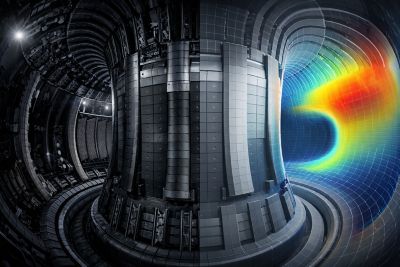
A rendering of a tokamak reactor. Courtesy of the United Kingdom Atomic Energy Authority (UKAEA).
A Multiphysics Endeavor
Replicating the conditions necessary for fusion on Earth presents intricate engineering difficulties. Fusion reactors must handle extraordinary temperatures reaching hundreds of millions of degrees, alongside immense thermal and mechanical stresses. The integration of multiple physics phenomena, such as plasma behavior, neutron transport, electromagnetic fields, and material interactions, requires advanced modeling and precision engineering.
“None of these individual challenges are unique,” explains Jacob Eldred, Applied Simulation R&D team lead at UKAEA. “They’ve all been done before. The uniqueness that fusion brings is that it puts them all in one system.”
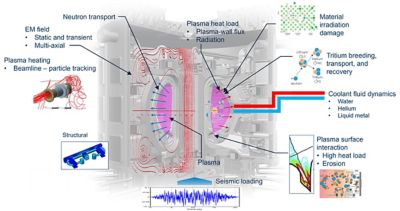
An example of the different multiphysics needed for fusion energy. Courtesy of UKAEA.
When designing different aspects of the reactor, engineers must consider the design as a whole and not just the individual parts. But since this has never been done, there is limited experimental data to base designs on.
“Other industries can refine their designs with test data,” says Eldred. “Fusion doesn’t have that luxury. We can’t replicate a reactor environment until we build one.”
Consequently, researchers rely heavily on high-fidelity simulations to model complex interactions and predict performance. The inability to test full-scale systems under real-world conditions makes probabilistic and stochastic modeling essential to fusion energy development. By modeling the multiphysics phenomena, UKAEA engineers can identify and address potential weaknesses in reactor components and materials.
“One of the benefits of Ansys is that there’s such a big suite of tools that all work together in different ways,” says Eldred. “It means you can cover all the physics that you might need through Ansys.”
The integration of thermal and electromagnetic simulations in the Ansys Maxwell advanced electromagnetic field solver and Ansys Mechanical structural simulation software enables UKAEA to understand how heat transfer and magnetic fields affect structural stability, enabling more robust designs. Ansys Fluent fluid simulation software enables engineers to understand the complex behaviors of the coolant systems while Ansys optiSLang process integration and design optimization software brings all the workflows together. These advanced tools support the evaluation of design performance under realistic fusion conditions, offering data-driven approaches to refining reactor designs.
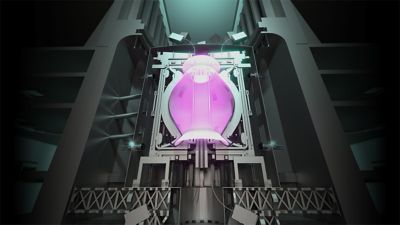
A rendering of the Spherical Tokamak for Energy Production (STEP). Courtesy of UKAEA.
Collaboration Is Key
UKAEA collaborates with industry leaders and software developers to address the unique demands of fusion energy systems. By defining fusion-relevant case studies, these partnerships aim to validate existing simulation tools in the context of fusion and identify areas where new capabilities are needed. Using expertise across sectors, UKAEA works to ensure that simulation software can effectively model the complex physical phenomena inherent to fusion reactors. This collaboration fosters the development of advanced tools capable of addressing multiphysics interactions, aiding in the refinement of designs and operational strategies. Such partnerships are instrumental in bridging technological gaps and advancing simulation methodologies tailored to the challenges of achieving sustainable and commercially viable fusion energy.
The journey to practical fusion energy represents a significant stride toward addressing the global energy challenge. By harnessing advanced simulation tools, UKAEA is making substantial progress in refining reactor designs, improving material resilience, and enhancing operational safety. The integration of digital twins and collaborative efforts with industry stakeholders accelerate the development of innovative solutions tailored to fusion’s unique demands. These advancements not only optimize testing processes but build confidence in the feasibility of commercial fusion reactors. As research continues to advance, overcoming technical and regulatory hurdles will be critical to achieving scalable, cost-effective fusion energy. UKAEA’s commitment underscores the importance of continued innovation and partnership in realizing fusion’s potential as a sustainable energy source.
Learn more about how Ansys can help with your energy needs.

Just for you. We have some additional resources you may enjoy.
“One of the benefits of Ansys is that there’s such a big suite of tools that all work together in different ways. It means you can cover all the physics that you might need through Ansys.”
— Jacob Eldred, Applied Simulation R&D team lead at UKAEA


The Advantage Blog
The Ansys Advantage blog, featuring contributions from Ansys and other technology experts, keeps you updated on how Ansys simulation is powering innovation that drives human advancement.