More manufacturers are moving toward digitalization, and there are good reasons why. McKinsey & Co. reports that advanced data and analytics, artificial intelligence and machine learning (AI/ML), and other technologies enable solutions that, if integrated successfully, can drive a 30-50% reduction in machine downtime, 10-30% increase in throughput, 15-30% increase in labor productivity, and 85% more accurate forecasting.
Danfoss Drives, a subsidiary of energy-efficiency powerhouse Danfoss, leverages Ansys simulation solutions and Industry 5.0 technologies to increase efficiency during the production of its signature alternating current (AC) drives. The benefits of operational efficiency extend to the environment, too, with less energy consumption and fewer machine emissions.
By leveraging Ansys multiphysics simulation solutions, including AI/ML and Python-based tools to create simulation apps, the company democratizes simulation for its team and streamlines design and development. As a result, Danfoss Drives reduces physical prototypes, cuts costs, and saves time while meeting customer needs and supporting sustainability.
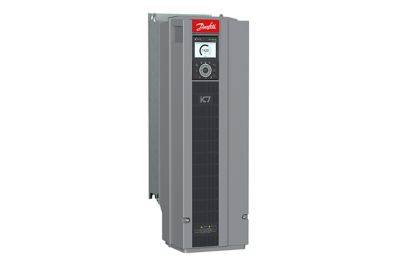
Danfoss Drives’ iC7-Automation is a low-voltage drive designed for a wide range of constant power/torque applications.
AC drives help control the speed of electrical motors to match load demand and are used in a wide range of industries, from material handling and processing to food and beverage. They can enhance process control, reduce energy usage, decrease mechanical stress on motor control applications, and optimize the operation of applications that rely on electrical motors.
Danfoss Drives has been integrating Ansys solutions for over a decade. Some of the team’s go-to multiphysics simulation tools include:
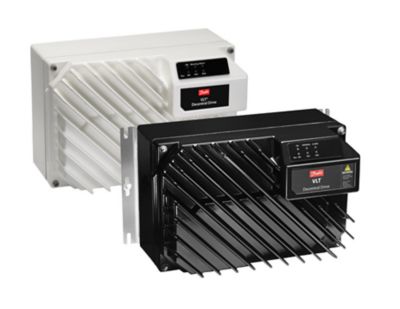
Danfoss Drives’ VLT® Decentral Drive FCD 302 eliminates the need for space-consuming control cabinets and is ideal for widely distributed applications with numerous drives, such as in the food and beverage and materials-handling industries.
Most recently, Danfoss Drives’ Power Electronics and Drives division adopted additional Ansys solutions into its workflow, including the PyAnsys pythonic access tool for Ansys software.
The PyAnsys suite — including the PyFluent tool, PyAEDT tool, and PyEDB tool — enables engineers to script easy-to-use simulation apps for users at all levels.
“We want people, such as design engineers who are not simulation experts, to make decisions based on simulation results,” says Michael Laursen, head of virtual design, test, and optimization at Danfoss Drives. “So, we are creating simulation apps tailored for specific simulations that can be used by team members who are not simulation experts.”
The apps are automated, so simulations run in the background. Users can easily log onto a webpage and choose the app they want to use.
The team is also exploring Ansys’ AI solutions, including the AnsysGPT AI-powered virtual assistant and the Ansys SimAI cloud-enabled AI platform for knowledge retrieval and validation.
“That’s part of our digitalization journey, where we have focused more on knowledge retrieval agents, which we are looking at right now, to more agentic frameworks where we want to use multiple agents working together,” Laursen says. “Our vision, more in the long term, is that we have an agent that is a simulation expert so we can somehow bridge from the virtual environment close to the physical environment and get a good idea if it’s actually on the right path for finding those solutions.”
Trained using Ansys data, the AnsysGPT assistant provides 24/7 technical support and generates tailored, applicable responses drawn from reliable Ansys resources, including Ansys Innovation Courses, technical documentation, blog articles, and how-to videos.
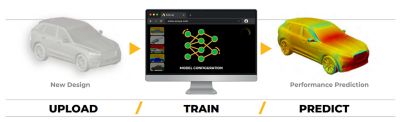
The SimAI solution is a physics-agnostic and cloud-native platform in which you can train an AI model using previously generated data from Ansys products or other sources and assess the performance of a new design within minutes. The software-as-a-service (SaaS) application combines the predictive accuracy of Ansys simulation with the speed of generative AI via the cloud — a combination that boosts model performance by 10-100X across all design phases for computation-heavy projects.
The Ansys SimAI workflow is engaged in three simple steps: upload data, train model, and predict.
The team evaluated the tool in a recent pilot project to assess its performance and accuracy in two use cases.
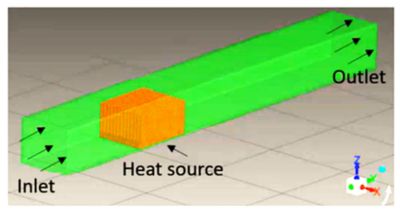
The first use case featured a heat sink. Using Fluent software and Ansys optiSLang process integration and design optimization software, the team created and trained an AI model in the SimAI platform using approximately 86 different geometry variations with six geometry parameters. These included heat sink width, heat sink length, fin height, base plate thickness, fin thickness, and number of fins.
Danfoss Drives’ Power Electronics and Drives division evaluated SimAI software in two use cases, including a heat sink.
The SimAI model accurately predicted maximum and average temperature, with a maximum relative error of less than 0.6%. The model generalized well to new geometric variations, maintaining high prediction accuracy.
The second use case featured a pallet drop test simulation. Using Mechanical software and Ansys LS-DYNA nonlinear dynamics structural simulation software, the team created and trained an AI model in the SimAI platform using existing simulation data of displacement and stress fields.
The SimAI model results closely matched traditional solver results, especially for average and maximum displacement and stress values, demonstrating high accuracy — often under 5% deviation from previous simulations. The outcome was a successful proof of concept showing how the SimAI tool can speed up simulation tasks, reduce costs, and be deployed widely, even by nonexpert users.
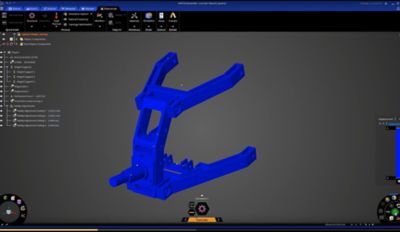
In Ansys Discovery software, you can evaluate several design ideas in seconds and analyze materials to find the best structural fit.
Laursen and his team incorporate simulation early to speed up design iterations.
“That’s the whole key here — we want to stay in the virtual environment and simulation environment as long as possible because then you can actually do agile product development,” he says. “If you start putting real hardware into the loop, you need to order parts, wait for the parts, then put things together, then go to the lab to test it — that’s a very long development loop and cycle. In the virtual environment, you don't have all those constraints of the physical world, making it much easier to do many more design iterations.”
Danfoss Drives’ customers also see the advantages of digital workflows.
“We are clearly hearing from customers that we are not relevant as a supplier if we are not able to support them with digital models and those kinds of technologies going forward,” Laursen says.
In addition to boosting design iteration and customer satisfaction, one of Danfoss Drives’ top goals is to reduce physical prototypes, which has already resulted in significant savings.
“Normally, we had four prototype design iterations: one concept prototype, two detailed design prototypes, and one production prototype,” Laursen says. “With Ansys simulation, we have been able to take one detailed design prototype iteration out of the loop, and that saves us six to nine months in development time and a lot of money. Time is super important, but the cost of early prototypes is also significant.”
Laursen plans to expand virtual prototyping, with the team’s ultimate goal being to have just one physical prototype.
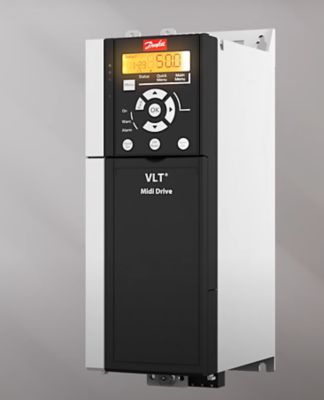
Danfoss Drives’ VLT® Midi Drive FC 280 provides precise and efficient motor control for machine builders in industries such as food and beverage and material handling and processing.
Discover how Ansys can support your operations by visiting our Industrial Processes and Equipment Simulation Software Solutions page.
Read more about Danfoss Drives’ digitalization journey in the blog “Danfoss Drives Supports Sustainability and Digital Transformation With Simulation.”
“We are creating simulation apps tailored for specific simulations that can be used by team members who are not simulation experts.”
— Michael Laursen, head of virtual design, test, and optimization, Danfoss Drives
The Ansys Advantage blog, featuring contributions from Ansys and other technology experts, keeps you updated on how Ansys simulation is powering innovation that drives human advancement.