Synopsys and Ansys power the future of innovation—connecting silicon to systems.

Engineering innovation is accelerating faster than ever. From electrification and advanced mobility to next-generation aerospace, energy transition, and life-changing healthcare technologies, today’s breakthrough products rely on deeper physics, larger design spaces, and faster iteration cycles.
To meet this moment, engineering teams increasingly turn to high-performance computing (HPC), cutting-edge graphics processing units (GPUs), and artificial intelligence (AI)-augmented simulation workflows. Together, these technologies amplify productivity, unlock unprecedented fidelity, and compress development timelines, all while reducing physical testing and minimizing cost and environmental impact.
Supercomputing 2025 (SC25) brings together the world’s leaders in computational science November 16-21 in St. Louis, Missouri. Ansys, part of Synopsys, is proud to be at the forefront of this transformation.
Engineering at Hyperscale
At Synopsys, we continue to push the limits of scalable simulation and analysis across structural mechanics, fluids, electromagnetics, and multiphysics domains. Our collaboration with leading hardware partners — including NVIDIA, AMD, Intel, Amazon Web Services (AWS), Microsoft Azure, HPE, and others — ensures that engineering organizations can fully exploit the capabilities of modern and emerging architectures.
From petascale to exascale-class workflows and with hybrid-cloud flexibility, engineers can explore more design variants, evaluate higher-fidelity models, and converge on optimal solutions faster than ever.
"The Ansys HPC packs and cores take simulation runtime from a few hours down to minutes," says Spencer Jackson, founder and CEO of Critical Energy. "We set it up in a cloud cluster to run very quickly, enabling our small team to move faster." Critical Energy is redefining how geothermal energy is harnessed and delivered. By developing factory-made, modular power plants, they offer a revolutionary approach to convert geothermal heat into electricity.
AI Data Center Innovations on Display
Mohammad Ahmadian, a postdoctoral researcher at Villanova University, will be at the Synopsys booth to present on the Omnicool project, a joint venture with Synopsys, Vertiv, Villanova, and NVIDIA. This study showcases how advanced 3D two-phase computational fluid dynamics (CFD) modeling can accurately predict and optimize the performance of skived-fin cold plates for high-power electronics cooling. The results highlight CFD’s superior accuracy over empirical methods — proving it to be a powerful engineering tool for designing next-generation, high-efficiency two-phase cooling solutions. Ahmadian’s presentation will take place Nov. 18 at 3 p.m.
Also presenting in the Synopsys booth is Rebellions, a pioneering AI chip company based in South Korea. It is developing inference-oriented neural processing unit (NPU) systems on a chip (SoCs). Join us at the Synopsys booth Nov. 19 at 1 p.m. to hear Sanggyu Park, verification leader at Rebellions, explain how the company went from first silicon arrival to live demonstration in just five weeks. By leveraging Synopsys VCS, ZeBu, and Virtualizer, as well as the Verification Continuum, the team accelerated presilicon validation and enabled seamless hardware-software co-development across on-premises and cloud platforms.
Making Quiet Supersonic Travel and Other Innovations a Reality With HPC
Cutting-edge engineering demands not just smarter tools but faster ones. In recent aerospace workflows, the Ansys Fluent GPU solver demonstrated just how transformative modern HPC systems can be:
- A complex mesh of 172 million elements around an advanced aircraft geometry was generated in only 11 minutes on 192 central processing unit (CPU) cores.
- Using eight AMD Instinct MI300X GPUs in single precision, the solver simulated five seconds of physical flow time in just 3.7 hours.
- Switching to double precision on 16 GPUs, the analysis still completed in under 4.4 hours. On traditional CPU-only systems, this workload would have taken weeks.
These results show how next-generation HPC and solver architectures enable engineers to perform high-fidelity, large-scale simulations in hours rather than days or weeks — unlocking more design iterations, earlier insights, and faster time to innovation.
Accelerating Structural Simulation With Ansys Mechanical HPC
Bold advances in product development require not only fluid dynamics at scale but equally powerful structural simulation. Ansys Mechanical structural finite element analysis (FEA) software continues to deliver breakthrough solver performance across CPU- and GPU-accelerated architectures, enabling engineering teams to analyze larger, more detailed models with faster turnaround.
Recent benchmarks and customer deployments demonstrate significant performance gains through modern HPC best practices, including scalable domain decomposition, optimized solver settings, and hybrid compute strategies. Engineers are achieving dramatic reductions in wall-clock time for nonlinear contact, modal, and explicit crash simulations. In many cases, this compresses days of computation into hours while improving model fidelity and throughput.
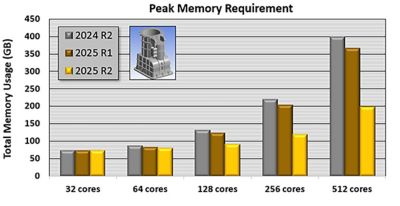
Peak memory reduction of a PCG solver from Ansys 2024 R2 to 2025 R2 across core counts (V24iter-3 benchmark, 25 million degrees of freedom, modal analysis using the PCG Lanczos eigensolver requesting 10 mode shapes). Tests were run on a Linux cluster with compute nodes featuring dual Intel Xeon Gold 6448H CPUs and 1024 GB RAM.
With support for high-memory nodes, next-generation GPUs, and cloud-native HPC environments, Mechanical software unlocks faster design exploration, higher-order meshing, and improved convergence on industry-scale assemblies. Whether evaluating electric vehicle (EV) battery enclosures, lightweight aerospace structures, or high-cycle fatigue behavior, Mechanical HPC continues to push the limits of structural simulation at scale, empowering teams to deliver safer, lighter, and more innovative products faster than ever.
Join Our Expert Panels at SC25
At SC25, we will host four expert panels with leaders in engineering, cloud, and research to explore how next-generation compute, simulation, and AI are shaping the future of product development.
Cloud Computing for Engineering Simulation
Featuring experts from AWS, Microsoft Azure, NVIDIA, and Rescale, this session explores how on-demand cloud HPC accelerates engineering — from scaling complex multiphysics workloads to managing simulation data and connecting to product life cycle management (PLM) and AI services. Panelists will also share financial and operational considerations when transitioning from on-premises systems to cloud environments.
Revolutionizing Simulation With AI and HPC
With leaders from Accenture, Microsoft, and NVIDIA, this panel examines how AI and accelerated computing are transforming simulation workflows. The discussion highlights AI-augmented physics models, secure cloud-based AI adoption, and strategies to make high-fidelity engineering more accessible across teams.
Future Trends in HPC for Engineering Simulation
Joined by innovative leaders from Ford, Rolls-Royce, AMD, and HPE, this panel explores exascale-ready architectures, GPUs and accelerated processing units (APUs) for simulation, and sustainable HPC strategies. Speakers will also discuss the role of quantum computing and AI in pushing the limits of engineering scale, speed, and fidelity.
Building the Future of Energy-Efficient HPC Data Centers
This session brings insights from NVIDIA, Microsoft Azure, ORNL, and Vertiv on designing ultradense, energy-efficient compute environments. Topics include liquid and hybrid cooling, digital twins for thermal optimization, and lessons from large-scale GPU deployments in the face of rising power and sustainability demands.
Join Us at SC25
We invite you to meet our experts, view live demos, explore benchmark results, and experience how Ansys is shaping the future of simulation, HPC, and AI-driven engineering.
Visit the Ansys Supercomputing 2025 page to register, explore our sessions, and plan your visit.




The Advantage Blog
The Ansys Advantage blog, featuring contributions from Ansys and other technology experts, keeps you updated on how Ansys simulation is powering innovation that drives human advancement.