Synopsys and Ansys power the future of innovation—connecting silicon to systems.

The Supercomputing 2025 (SC25) conference brought together leading voices from across the high-performance computing (HPC) community. During a panel I hosted and moderated, experts from Rolls-Royce, HPE, and AMD shared their perspectives on how emerging technologies, new architectures, and the rise of exascale computing are reshaping the future of engineering simulation.
In my earlier blog, Shaping the Future of Scalable Engineering at Supercomputing 2025, I explored how Synopsys and our partners are preparing engineering workflows for this new era. This follow-up focuses specifically on the key takeaways from the panel discussion “The Future of HPC,” and what they mean for our customers.
What emerged was a clear and compelling vision of where the industry is heading, and what customers can expect in the years ahead.
Exascale Preparing Engineering Codes for the Future
Exascale computing is opening opportunities that were unimaginable a decade ago. For engineering organizations, it is enabling the exploration of far larger domains and much more complex physics, allowing simulations that more closely represent real-world conditions.
Todd Simons, HPC Rolls-Royce Americas, described early access to exascale systems as “like access to a time machine … you’re jumping into the future of where computers will be years from now and getting your applications ready.” His analogy captures the transformative potential of exascale: It gives customers a headstart on the technologies and workloads of tomorrow, long before these capabilities become widespread.
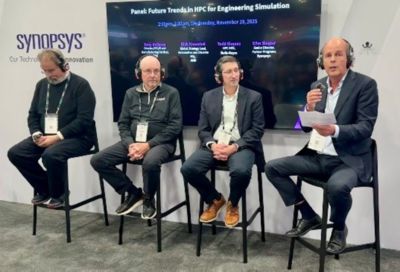
Wim Slagter, senior director partner programs at Ansys, part of Synopsys (far right), moderates “The Future of HPC” panel discussion at Supercomputing 2025, including experts from HPE, AMD, and Rolls-Royce.
This is especially powerful for industries where accuracy and predictive fidelity directly influence safety, performance, and sustainability.
Industrial Access to Exascale Is Becoming a Reality
One of the most significant developments discussed during the panel is the rapid expansion of industrial access to exascale systems. According to Tony DeVarco, director HPC/AI and manufacturing vertical at HPE, platforms such as Frontier and the upcoming exascale system at the High-Performance Computing Center of the University of Stuttgart (HLRS) in Europe are now making space available for commercial users — a major shift from past generations of supercomputers that were reserved primarily for government research.
This means companies can begin to run simulations at scales that vastly exceed the capacity of their internal clusters. It represents a new era where cutting-edge computational power is no longer limited to major research labs but is becoming accessible to engineering teams across a broad range of industries.
The Rising Importance of Sustainable HPC
As compute performance increases, so does energy consumption. Modern processors are pushing power envelopes into ranges that make traditional cooling strategies difficult to sustain. During the discussion, Rick Knoechel, global strategy lead for automotive & discrete manufacturing at AMD, noted that liquid cooling is now a central design consideration for each new generation of processors developed with partners like HPE.
DeVarco shared that HPE brings more than 50 years of liquid-cooling experience — a legacy inherited from SGI and Cray — to help customers meet performance goals without compromising on energy efficiency.
The industry is moving rapidly toward greener, more efficient data centers. This shift will help organizations reduce operational costs while improving reliability and enabling higher-density compute deployments.
Collaboration as a Catalyst for Breakthroughs
Throughout the panel, one theme consistently emerged: True progress in HPC requires close collaboration among hardware providers, independent software vendors (ISVs), and the engineering teams who rely on these tools. Simons shared a striking example at Rolls-Royce, describing how early work on the Ansys LS-DYNA implicit solver allowed a simulation that once required 1,000 hours to run in just a few hours today — thanks not only to modern hardware but to deep algorithmic improvements made by Ansys, part of Synopsys.
Knoechel echoed this sentiment, highlighting how innovations such as chiplet architectures and the AMD 3D V-Cache have produced dramatic real-world performance gains — sometimes achieving one-and-a-half to two times the performance improvements of previous generations.
These examples illustrate the power of co-design. When hardware, software, and customer requirements evolve together, the results are far greater than what any one technology can deliver on its own.
GPU Acceleration Is Reshaping Simulation
Another major direction highlighted during the discussion is the accelerating shift toward GPU-based solvers. GPUs are no longer limited to artificial intelligence (AI) or graphics workloads; they are increasingly being adopted for traditional engineering applications such as computational fluid dynamics (CFD), structural analysis, optics, and photonics analysis. The panel noted that this transition requires considerable effort and close engagement with ISVs, but the payoff — faster results, higher fidelity, and reduced compute costs — is substantial.
This trend is set to continue as new GPU architectures deliver even higher throughput and improved efficiency.
Achieving New Levels of Fidelity
The availability of exascale systems is enabling simulations with unprecedented detail. HPE’s DeVarco referenced recent work by GE Aerospace that demonstrated the ability to run extremely high-resolution transient CFD simulations on the Frontier system — capturing flow features at scales that were previously impossible.
Higher fidelity translates directly into better prediction, improved design robustness, and more informed engineering decisions. As one Ford engineering leader summarized in a recent discussion with Rick Knoechel: “We want more fidelity, and faster results.”
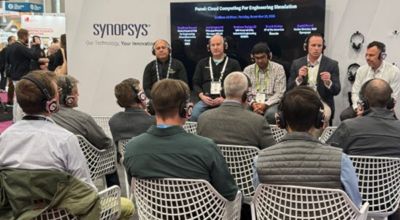
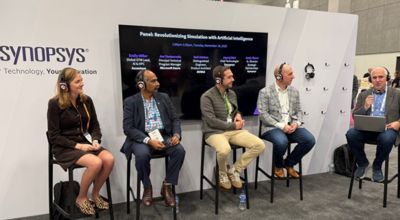
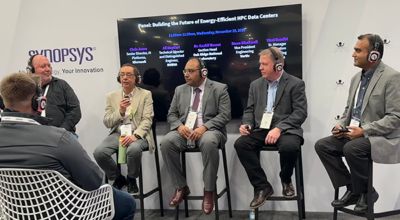
In addition to “The Future of HPC” panel, Synopsys hosted Supercomputing 2025 panels on cloud computing for engineering simulation, artificial intelligence (AI), and energy-efficient high-performance computing (HPC) data centers.
Looking Ahead
The insights shared during the SC25 panel point to an exciting future for HPC. Exascale computing is becoming more accessible. Liquid cooling and energy efficiency are moving to the forefront of data-center design. Collaboration across the ecosystem is accelerating the performance of engineering solvers. And GPU-enabled simulation is opening the door to new levels of fidelity, speed, and scalability.
Together with the broader themes discussed in Shaping the Future of Scalable Engineering at Supercomputing 2025, these developments signal a new era of high-performance engineering — one where customers can innovate faster, explore more design possibilities, and push the boundaries of product performance.
If you would like to dive deeper into how these trends translate into real-world engineering impact, please watch our on-demand webinar, Advancements in Sustainable HPC Solutions for Ansys Applications. It offers practical insights into sustainable HPC architectures, GPU-accelerated workflows, and the technologies reshaping engineering simulation today.




The Advantage Blog
The Ansys Advantage blog, featuring contributions from Ansys and other technology experts, keeps you updated on how Ansys simulation is powering innovation that drives human advancement.