Synopsys and Ansys power the future of innovation—connecting silicon to systems.
The drive to construct data centers capable of meeting the needs of a world eager to build on the possibilities enabled by artificial intelligence (AI) has created a power demand that is unprecedented. In 2018, U.S. data centers consumed 76 TWh of power — 1.9% of total U.S. energy consumption. Yet by 2028, U.S. data centers are projected to need between 325 and 580 TWh of power — accounting for some 12% of total U.S. energy consumption.
Those numbers represent huge challenges for every aspect of an AI data center, from the chips and printed circuit boards (PCB) to the cooling systems in the facility. In short, the question of how to meet the energy demands of an AI data center is not limited to the server farm itself. It is a challenge that touches every system in the center. Thus, meeting that challenge effectively requires a holistic approach, one that looks at all aspects of the data center. Ansys, part of Synopsys, provides the tools needed to address the energy demands of data centers from the chip to the facility level.
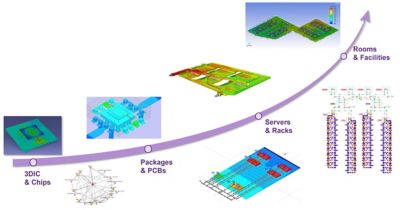
Artificial intelligence (AI) data centers are a multisystem engineering challenge.
Simulating Server Rooms
Data centers, regardless of their purpose, are large facilities comprising multiple server rooms filled with racks that hold individual servers. For the most part, they all look the same regardless of who built them. However, before the first rack is installed, engineers must consider several key aspects to ensure the server room operates as efficiently as possible, starting with power.
Data centers must obtain their power from somewhere, and with water usage, grid limitations, and thermal dissipation already being areas of concern for the public, many companies are considering sustainable energy alternatives, such as wind, solar, and nuclear. Engineers can use simulation solutions such as Ansys Fluent fluid simulation software, Ansys Granta MI materials data management software, and Ansys Discovery 3D simulation software to assess the environmental footprint of their chosen power source early in the design phase. Such an assessment enables engineers to understand which areas, components, materials, processes, and other factors have the largest impact on the data center’s environmental footprint.
Engineering teams must then ensure there is sufficient, clean, and reliable power for the facility to operate efficiently. Determining the power demands of a data center isn’t straightforward because server power requirements fluctuate with workload and server configurations. Simulation solutions such as Ansys Maxwell advanced electromagnetic field solver and Ansys Q3D Extractor parasitic extraction electromagnetic simulation software can help evaluate the power demands and optimize for load balance and power quality.
However, one of the greatest areas of concern for server rooms is the cooling system. If you’ve ever sat next to a computer, you know how hot they can get. Now multiply that by tenfold. Maintaining the optimal server room temperature and humidity range is crucial for ensuring performance and hardware longevity. Overheating can lead to downtime, while unstable humidity levels can cause corrosion or static discharge. Engineers can use simulation solutions, such as Fluent software, Ansys Icepak electronics cooling simulation software, and Ansys Thermal Desktop thermal-centric modeling software, to modify layout and equipment specifications for optimal thermal management, avoiding costly trial-and-error procedures and unnecessary investments in additional cooling. Simulation solutions can also address acoustic and noise outputs created by data centers so they create as litle disturbance to the communities they reside in.
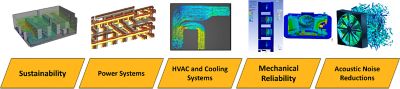
Engineering considerations for a server room
Unlimited Cosmic Power, Itty Bitty Living Space
If the server rack is the bones of a data center, then the chip is the brain. Today’s chips increasingly integrate specialized processing elements and memory in sophisticated multi-die packages. Designing these systems requires understanding complex interactions across electrical, thermal, and mechanical domains that can only be predicted through comprehensive multiphysics simulation. Power delivery networks and thermal management systems must be analyzed holistically, as electrical performance affects thermal profiles while heat dissipation impacts electrical performance in a continuous feedback loop. This interdependency is particularly critical for the neural processing units (NPUs) used in AI workloads, which can experience dramatic power fluctuations during different computational phases.
Similarly, high-bandwidth, low-power interfaces between dies demand detailed electromagnetic analyses to ensure signal integrity while operating within increasingly tight power constraints — a challenge that grows more complex as die-to-die communication speeds increase. The complexity extends to power integrity across multiple domains, as NPUs and other specialized processors typically operate at different voltage levels and varying power requirements.
Mechanical stress in chips presents another challenge, as the complex structures experience thermal expansion and contraction during assembly and operation that can affect both reliability and electrical performance through stress-induced parameter shifts.
Multiscale physics challenges have also become increasingly important as system designs span from nanometer-scale transistors to centimeter-scale packages and beyond. This wide range of physical dimensions requires simulation tools, such as Synopsys RedHawk-SC power integrity simulation software, Synopsys Exalto silicon-optimized electromagnetic modeling software for signoff, Synopsys Pathfinder-SC electrostatic discharge reliability signoff for large IP and 3D integrated circuits (3D-IC), and other Synopsys high-performance computing (HPC) and data center solutions, capable of seamlessly transitioning between different scales while maintaining accuracy and computational efficiency.
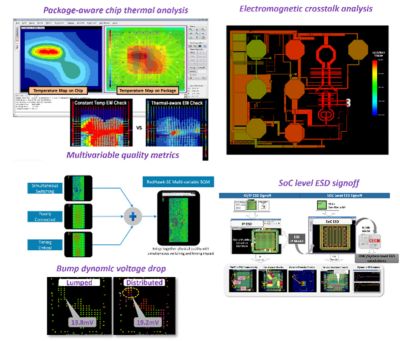
System-on-chip validation using Synopsys Redhawk-SC software, Synopsys Exalto software, and Synopsys Pathfinder-SC software
Keeping It Cool With Thermal Management
While a server room filled with high-performance chips attract much of the attention associated with an AI data center, as much as 40% of the power used in an AI data center is consumed by the systems built to keep those chips cool. If an engineer can reduce the amount of heat generated within the server rooms, less work is required to keep those rooms cooled to a suitable temperature.
How racks are configured and how air or water flow through the racks and rooms can have a significant impact on energy requirements. Simulation software can model a wide range of rack and server configurations that enables engineers to find optimal combinations of compute performance, thermal performance, and more. In addition to these options, engineers can incorporate simulations of cooling solutions such as two-phase cooling and immersion cooling — individually or in combination — to determine the optimal configuration of the data center's core, thereby optimizing compute performance, energy consumption, heat output, cooling system efficiency, and cost.
However, even if every element in the data center has been designed and built to minimize power consumption and heat dissipation, heat will still be generated by the activities within the data center. Cooling systems will draw that away from the server room, and in a well-designed data center, that heat can be turned back into power through heat exchange and waste heat recovery systems — and that power can then be reused within the data center in place of power that would otherwise need to be drawn from the generation systems. Simulation solutions, such as Ansys Mechanical structural simulation software, Fluent software and Thermal Desktop software, enable engineers to identify opportunities to optimize power consumption throughout an AI data center.
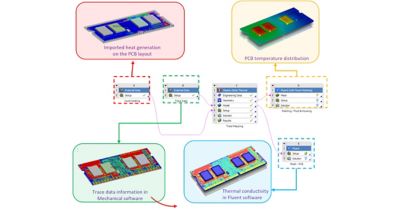
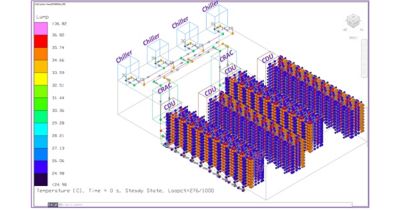
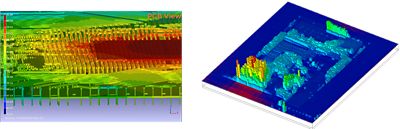
Different thermal management simulations at the chip level (left). Thermal management simulation of a liquid- and air-cooled server room (right).
The Future of Data Centers With Digital Twins
No single manufacturer or designer will create every component required in an optimized AI data center. Chip companies build chips, server and network vendors build systems that use those GPUs, and other vendors build heating, ventilation, and air conditioning (HVAC) systems; power conditioning and transformation systems; security systems; and more.
A designer architecting an AI data center can use the Ansys TwinBuilder simulation-based digital twin platform to create a digital twin of the data center using simulations of components and facilities built by other manufacturers and vendors. The manufacturers and vendors can save their own models in a reduced-order model (ROM) format that enables the AI data center designer to work with simulations of their data center components. Building a digital twin of an AI data center enables a designer to fully model and tune every aspect of the data center’s performance — from compute performance to energy consumption. The designer can manipulate aspects of the design to simulate changes — thereby exploring the effect on emissions or power consumption, for example, if an element in the cooling infrastructure is altered — all before breaking ground on the data center itself.
Then, once the optimal design has been modeled in the digital twin, the digital twin becomes the guide for deployment and scaling out of the data center itself. Once the data center is built, the digital twin can be connected logically to the data center, enabling it to be used to monitor and manage performance aspects.
The energy demands of an AI-enabled future are eye-popping. Yet so too is the potential for transformation enabled by AI. With the right tools, designers can build data centers that can enable a future powered by AI, and do so in ways that ensure uptime and performance while minimizing power requirements, energy waste, and a negative environmental impact.
See how Ansys data center solutions drive efficiency and resiliency.





The Advantage Blog
The Ansys Advantage blog, featuring contributions from Ansys and other technology experts, keeps you updated on how Ansys simulation is powering innovation that drives human advancement.